
Player Management Math Quiz
How the Scales are Structured
Who Usually Takes This Test?
See How You Compare
Below is a preview of how scores are typically distributed across each scale.
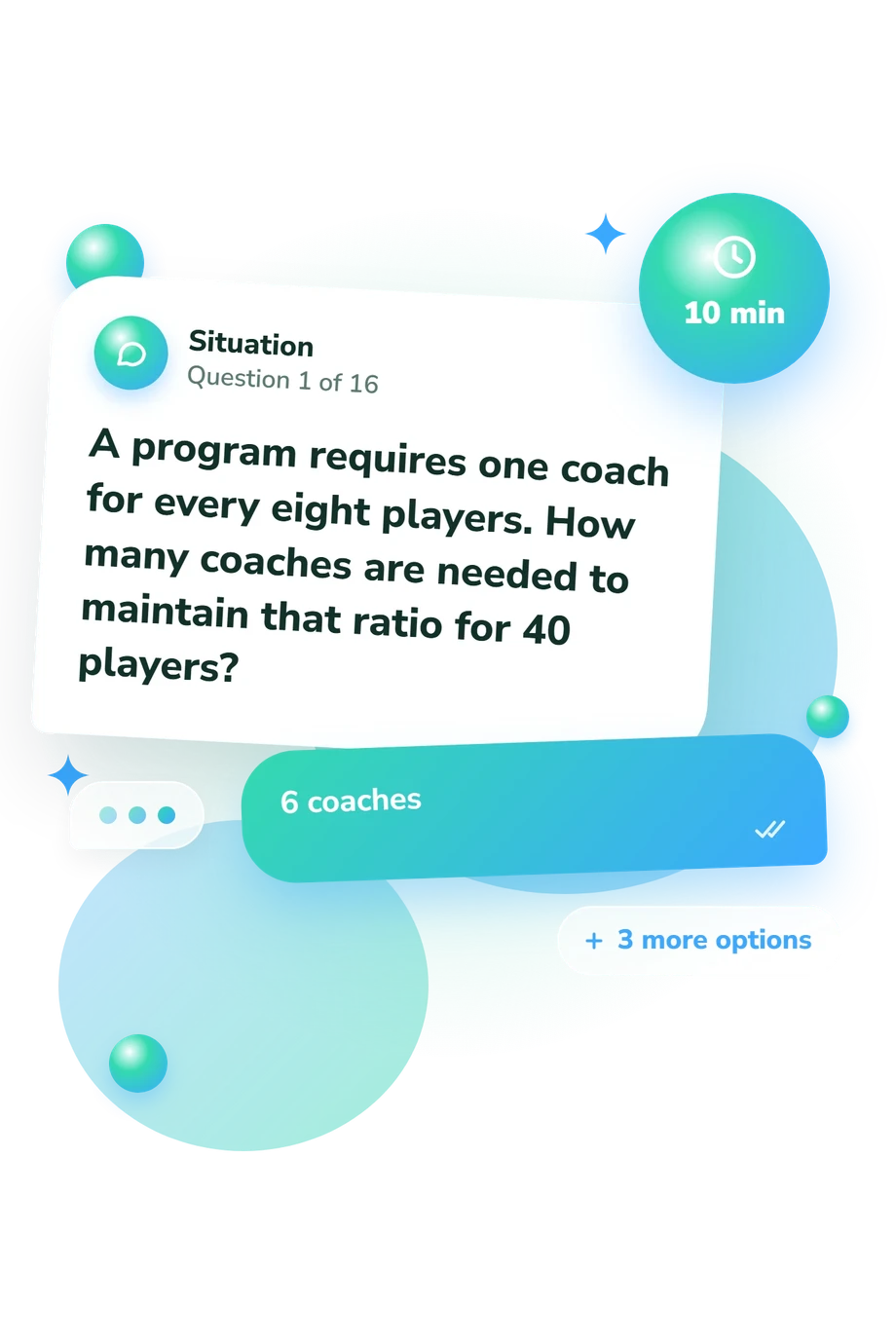
Example Questions From the Test
- 6 coaches
- 4 coaches
- 5 coaches
- 8 coaches
- 5%
- 25%
- 80%
- 20%
- 15%
- 12%
- 18%
- 72%
Player Management Math Quiz - Description and methodology of the test
Coaches, analysts, and player-development staff may want a quick way to check whether everyday numbers are being translated into sound roster and workload decisions. This player management math quiz addresses that practical need through short sports scenarios rather than abstract exercises. The emphasis on player management calculations helps readers notice whether their arithmetic is ready for routine planning, comparison, allocation, and availability decisions.
What This Assessment Explores
The assessment focuses on numerical accuracy in practical squad situations, not overall coaching judgment. It shows how confidently someone handles player workload calculations alongside staffing, minutes, availability, performance, and resources.
The question themes show what the result draws on:
- Ratios show whether allocations preserve the intended relationship.
- Percentages and rates show how accurately change and availability are compared.
- Averages and medians show how uneven figures are summarized.
- Probability shows whether independent chances are combined correctly.
- Budgets show whether funds and allocations are calculated accurately.
Together, these themes create a focused check of applied quantitative reasoning, not overall management ability. Player Management Math Knowledge runs from 0-16: Foundations to build (0-6), Developing command (7-12), and Strong command (13-16). It reflects performance on these questions only.
Methodology and Evidence Base
Each item presents a short management scenario with four answer choices and asks for one numerical result. The set covers ratios, percentage change, rates, averages, median, probability, availability, injury exposure, workload, minutes, and budget arithmetic. Its sports management math framing connects calculation with roster planning, while one overall total is interpreted through the displayed educational performance bands for these questions.
It is an educational online questionnaire scored through the displayed performance bands, with numerical items on player allocation, workload, availability, and budgets. Turner et al. (2024) offers a relevant conceptual anchor because it links sports contexts with mathematical reasoning, quantitative sense-making, and problem solving. That comparison marks a conceptual connection, not this questionnaire's provenance. Foster et al. (2021) similarly places analytics within squad, strategy, health, and performance decisions; the questionnaire uses a related setting without reproducing that review.
Performance can be affected by concentration, arithmetic fluency, familiarity with the metrics, or guessing. Use the profile to guide practice or discussion alongside observation and broader evidence when evaluating real management work.
- Turner, Erin, Sanlyn Buxner, Seneca B. Miller, Christina Baze, and Ricardo Valerdi. (2024). Connecting mathematics and sports in informal learning spaces. Frontiers in Education, 9, 1456653. 10.3389/feduc.2024.1456653
- Foster, George, Norm O'Reilly, and Zachary Naidu. (2021). Playing-Side Analytics in Team Sports: Multiple Directions, Opportunities, and Challenges. Frontiers in Sports and Active Living, 3, 671601. 10.3389/fspor.2021.671601
Updated: