
Colby Brock Quiz
How the Scales are Structured
Who Usually Takes This Test?
See How You Compare
Below is a preview of how scores are typically distributed across each scale.
Example Questions From the Test
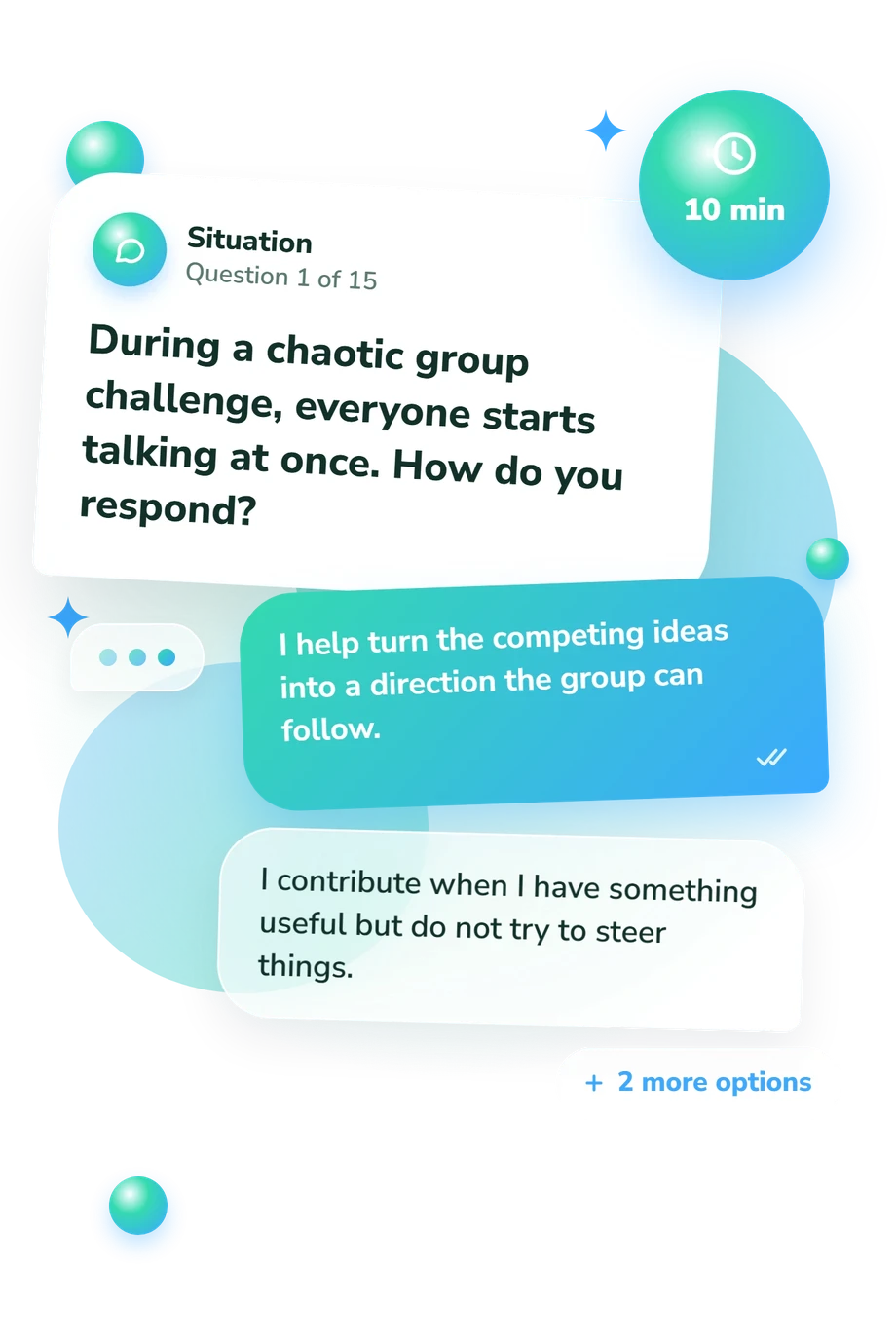
- I help turn the competing ideas into a direction the group can follow.
- I contribute when I have something useful but do not try to steer things.
- I amplify the chaos because that is often the most entertaining part.
- I step back and let the strongest personalities run the moment.
- Let the humor happen, then shift back when the serious point needs attention.
- Keep the serious tone so the conversation stays focused.
- Enjoy the joke but wait for someone else to restore the original mood.
- Go with the humor for a while, then check whether everyone wants to continue.
- A rush of energy where acting quickly matters more than understanding everything.
- A tense situation with just enough context to start forming theories.
- A mystery I can research, question, and follow through several clues.
- An unexplained event that is interesting mainly because of the atmosphere.
Colby Brock Quiz - Description and methodology of the test
Fans who want a structured way to compare their own reactions with the styles associated with Colby Brock and Sam can use this assessment for playful self-reflection. The Colby Brock Quiz turns preferences around risk, humor, preparation, and teamwork into an affinity profile rather than a verdict. A Colby Brock style comparison helps readers consider which energy feels most natural to them.
What This Test Measures
Items focus on uncertainty, changing plans, humor, preparation, teamwork, and fixed or flexible roles. They describe on-screen style affinity, so a Colby Brock fan can read the answer pattern without treating it as creator identity.
These are the three profiles and the bands attached to each score:
- Colby-Inspired (0-15) measures affinity with bold, instinctive, emotionally expressive energy: Different wavelength (0-5), Shared traits (6-10), and Strong Colby affinity (11-15) mark increasing alignment with that style.
- Sam & Colby Blend (0-15) measures flexible partnership energy: Individual mode (0-5), Situational blend (6-10), and Strong duo affinity (11-15) move from a consistent personal role toward adaptive collaboration.
- Sam-Inspired (0-15) measures a curious, observant, plan-aware style: Different wavelength (0-5), Shared traits (6-10), and Strong Sam affinity (11-15) mark increasing curiosity, preparation, and active engagement.
Methodology and Evidence Base
Each item presents a scenario with four response options. You choose the reaction that feels most natural across group challenges, investigations, friendship dynamics, filming roles, and unexpected setbacks. The items compare tendencies, not factual knowledge about Colby Brock or Sam. Instead, the Colby Brock affinity profile concerns style, not knowledge.
Scoring is profile-based: three displayed scores identify the highest profile as your strongest affinity. Scores within one point indicate a blended result. The scores summarize choices about initiative, preparation, role flexibility, and reactions to uncertainty.
Wishful identification research addresses perceived similarity and attraction to media characters, while Cohen’s audience-identification work offers a parallel for media involvement. Sensation-seeking ideas from Zuckerman, Eysenck, and Eysenck contextualize risk and intensity; work by Kashdan and colleagues offers a curiosity-and-exploration parallel. These are conceptual parallels, not evidence establishing the three profiles, their scoring, or this questionnaire as a standardized or validated measure.
Honest self-report and self-awareness shape the profile; current mood or recent experiences may influence choices. Read it as a reflective snapshot rather than a fixed account of personality or relationships.
- Hoffner, Cynthia A., and Martha Buchanan. (2005). Young Adults' Wishful Identification With Television Characters: The Role of Perceived Similarity and Character Attributes. Media Psychology, 7(4), 325-351. 10.1207/S1532785XMEP0704_2
- Cohen, Jonathan. (2001). Defining Identification: A Theoretical Look at the Identification of Audiences With Media Characters. Mass Communication & Society, 4(3), 245-264. 10.1207/S15327825MCS0403_01
- Zuckerman, Marvin, Sybil B. Eysenck, and H. J. Eysenck. (1978). Sensation Seeking in England and America: Cross-Cultural, Age, and Sex Comparisons. Journal of Consulting and Clinical Psychology, 46(1), 139-149. 10.1037/0022-006X.46.1.139
- Kashdan, Todd B., Matthew W. Gallagher, Paul J. Silvia, and Beate P. Winterstein. (2009). The Curiosity and Exploration Inventory-II: Development, Factor Structure, and Psychometrics. Journal of Research in Personality, 43(6), 987-998. 10.1016/j.jrp.2009.04.011
Updated: