
Chemical Reactions Quiz
How the Scales are Structured
Who Usually Takes This Test?
See How You Compare
Below is a preview of how scores are typically distributed across each scale.
Example Questions From the Test
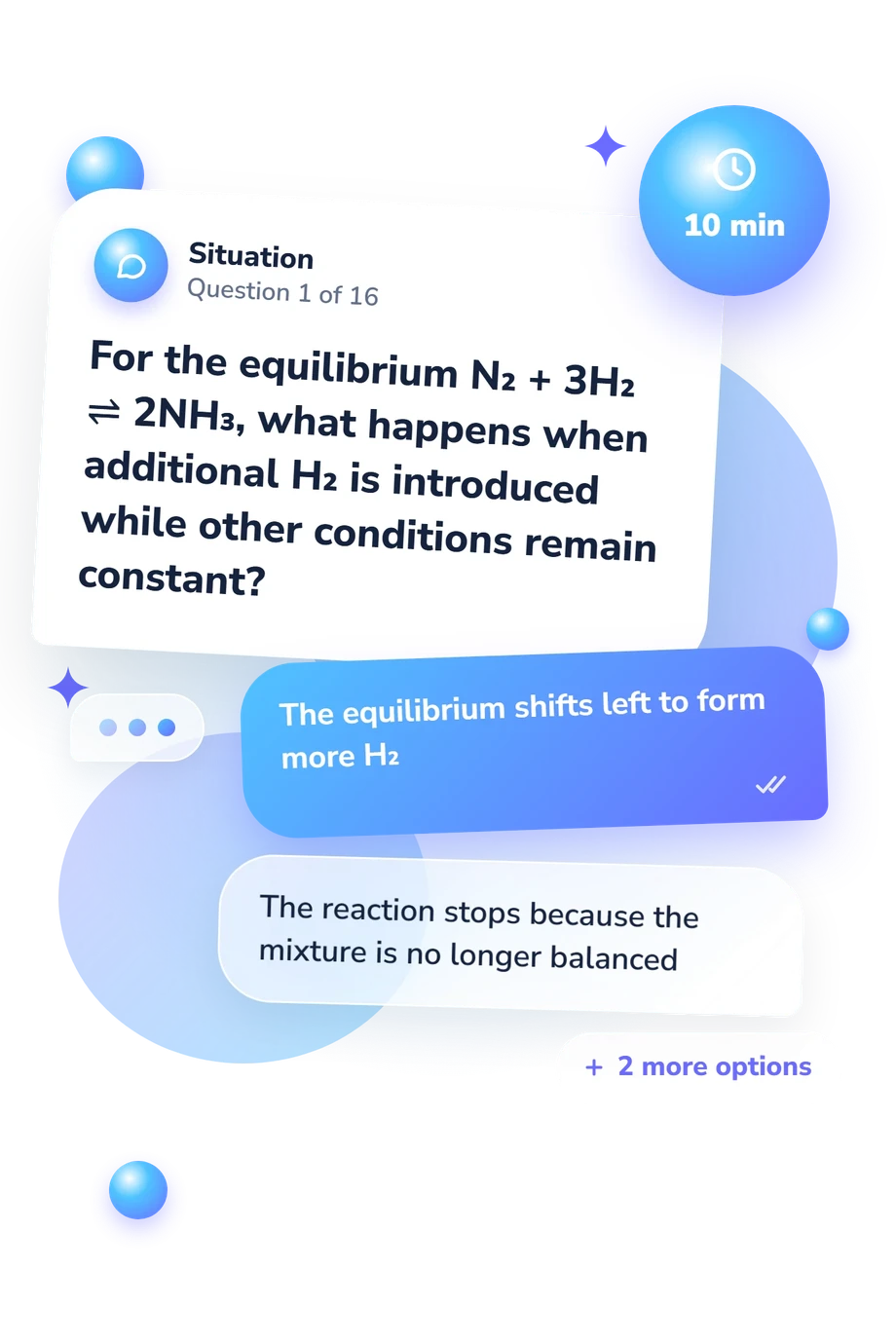
- The equilibrium shifts left to form more H₂
- The reaction stops because the mixture is no longer balanced
- The equilibrium constant becomes zero
- The equilibrium shifts right to form more NH₃
- Ethanol and water
- Hydrochloric acid and sodium hydroxide
- Sodium nitrate and potassium chloride
- Silver nitrate and sodium chloride
- Ag⁺ and Cl⁻
- Ag⁺ and NO₃⁻
- Na⁺ and NO₃⁻
- Na⁺ and Cl⁻
Chemical Reactions Quiz - Description and methodology of the test
For learners revising general chemistry, the chemical reactions quiz offers a focused way to check how well core ideas connect across familiar problems. It suits students, independent learners, and anyone preparing to revisit reaction evidence, equations, and mechanisms. A quiz on chemical reactions and equations can reveal which concepts feel secure and which need deliberate practice, while the result gives a clear starting point for review.
What This Assessment Measures
This assessment checks how you connect observations, equations, and explanations of chemical change. It covers equilibrium, limiting reactants, precipitation, energy, catalysts, rates, balancing, combustion, neutralization, and reaction classification. Rather than testing recall alone, the questions provide chemical reaction practice by asking you to connect evidence with equations and mechanisms.
The result reports Chemical Reactions Knowledge on a 0-16 scale: Foundations to Review (0-6), Developing Knowledge (7-12), or Strong Knowledge (13-16). These bands indicate whether understanding needs review, is developing, or is broad across concepts and applications.
The questions represent three areas:
- Evidence and quantities show whether you recognize new substances, balance reactions, and identify limiting reactants.
- Reaction patterns show how accurately you classify synthesis, decomposition, displacement, neutralization, redox, and combustion.
- Energy and conditions reveal how you reason about equilibrium, activation energy, catalysts, surface area, and incomplete combustion.
Methodology and Evidence Base
Each item presents a situation with four answer choices. You select the option that best explains a change, predicts an outcome, identifies a reaction type, or balances a relationship. The format samples recognition and application, although an answer does not reveal every step of your reasoning.
The reported result is descriptive: it gives a knowledge score and the corresponding result band. The questionnaire is not a standardized, norm-referenced instrument.
Chandrasegaran et al. (2007) and Mulford and Robinson (2002) are conceptual reference points for this content. The questionnaire is conceptually consistent with their treatment of chemical-reaction representations and alternative conceptions, but it does not use their instruments or scoring and is not presented as an adaptation or validation of either study.
The result offers a snapshot of your chemical reaction knowledge, so explaining why an option fits the evidence or equation is more useful than memorizing a choice. Guessing, prior teaching, and concentration can affect performance, and one result cannot represent all chemistry knowledge or laboratory skill. Use the band to target further study.
- Chandrasegaran, A. L., Treagust, D. F., & Mocerino, M. (2007). The development of a two-tier multiple-choice diagnostic instrument for evaluating secondary school students’ ability to describe and explain chemical reactions using multiple levels of representation. Chemistry Education Research and Practice, 8, 293-307. 10.1039/B7RP90006F
- Mulford, D. R., & Robinson, W. R. (2002). An Inventory for Alternate Conceptions among First-Semester General Chemistry Students. Journal of Chemical Education, 79(6), 739-744. 10.1021/ed079p739
Updated: