
Can I See Ghosts Quiz
How the Scales are Structured
Who Usually Takes This Test?
See How You Compare
Below is a preview of how scores are typically distributed across each scale.
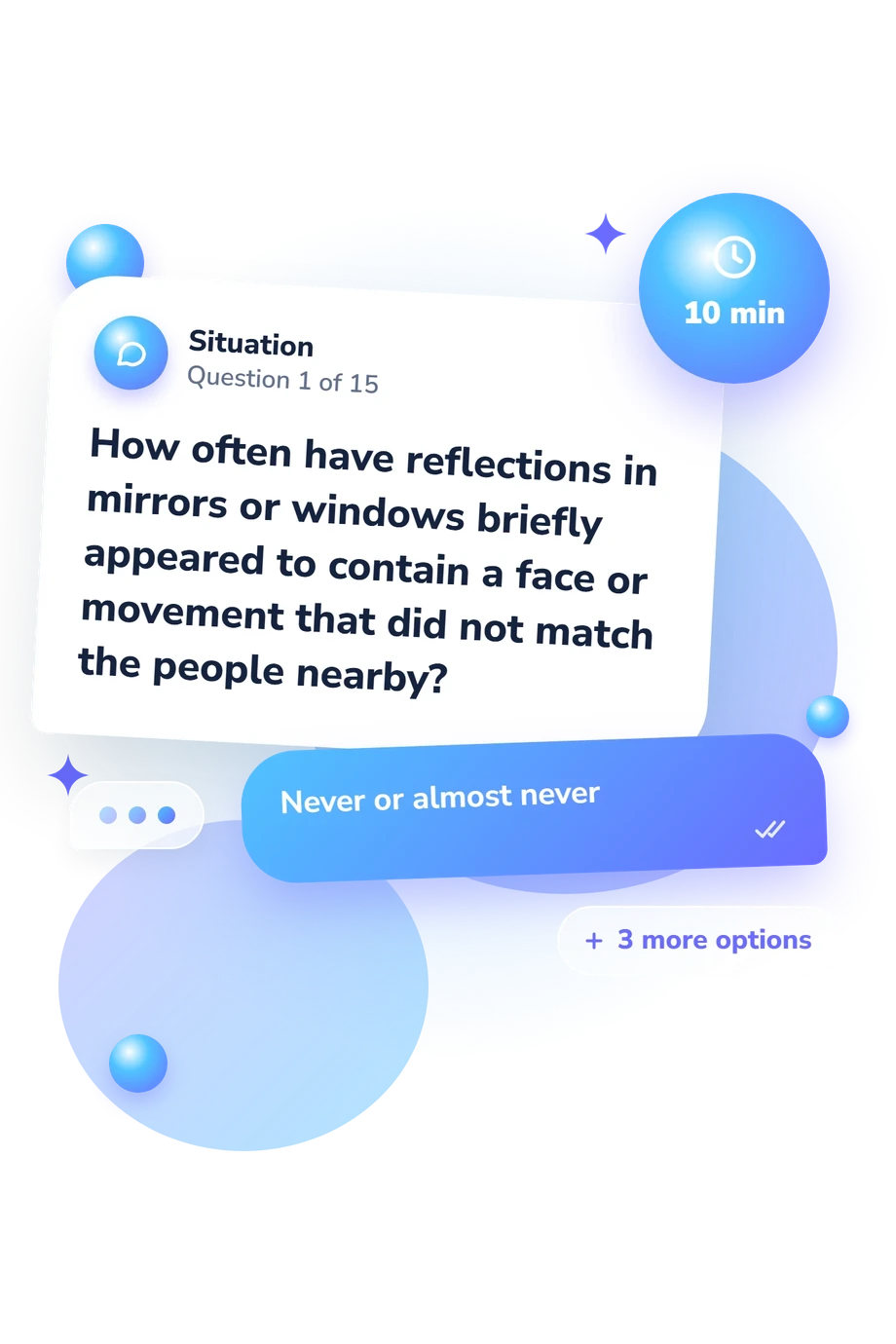
Example Questions From the Test
- Never
- On a small number of occasions
- Some months or during certain periods
- Weekly or more often
- The building or temperature is probably causing it
- I would check practical sources before deciding
- I would keep both ordinary and ghostly explanations open
- I would take the pattern as a likely sign of a presence
- This has not happened recently
- It has happened on one or two isolated occasions
- It happens sometimes in particular rooms or lighting
- It happens often in several settings
Can I See Ghosts Quiz - Description and methodology of the test
People who notice vivid, ambiguous, or presence-like experiences may benefit from answering slowly and considering the circumstances around each response. The Can I See Ghosts Quiz is intended for readers who want to examine their reactions without treating an unusual event as immediate proof of anything supernatural. For readers wondering whether they can see ghosts, the Can You See Ghosts Quiz offers a structured way to reflect on personal experiences.
What This Assessment Explores
Rather than deciding whether ghosts exist, the questionnaire examines how respondents interpret ambiguous sensory events and how often those events feel presence-related. Prompts cover reflections, scents, sounds, peripheral figures, sensed touch, sleep-related imagery, and the effects of suggestion or environmental checking. Rather than a seeing ghosts test, the result presents a profile of reported visual and nonvisual experiences and the interpretations attached to them, not a factual test of supernatural ability.
The displayed profile separates three related dimensions:
- Ghostly Interpretation Affinity (0-15) shows how readily ambiguous experiences are read in ghostly or paranormal terms: Ordinary-cause first (0-5), Open but undecided (6-10), or Ghost-oriented (11-15).
- Presence-Like Sensations (0-15) reflects reported nonvisual feelings of an unseen presence: Infrequent (0-5), Occasional (6-10), or Frequent (11-15).
- Visual Anomalies (0-15) reflects reported unusual or ambiguous visual events: Infrequent (0-5), Occasional (6-10), or Frequent (11-15).
Methodology and Scientific Basis
Methodologically, prompts pair frequency judgments with interpretation choices. Options move from no or ordinary-cause responses toward more frequent experiences or stronger paranormal interpretations, keeping occurrence separate from meaning. The result has distinct dimensions rather than one verdict.
As a paranormal experience questionnaire, the items pair unusual-experience reports with respondents’ meanings while keeping ordinary explanations in view. It is conceptually consistent with the Survey of Anomalous Experiences (Irwin et al., 2013), which separates anomalous experience from paranormal attribution. Related coverage appears in MUSEQ’s sensory modalities and SenPQ’s sensed-presence construct; Lange et al. (2019) discusses the psychometric difficulty of measuring such features. This is a separate online self-reflection questionnaire; its scoring has not been standardized or validated against those instruments, which do not supply its scoring.
No scoring key or normative sample is stated for this online questionnaire, so the bands are descriptive, not probability estimates. Self-report can be shaped by memory, expectation, stress, sleep, lighting, medication, and current context; scores do not establish a ghost, identify a medical cause, or constitute a diagnosis. Interpret them alongside the circumstances surrounding each response.
- Irwin, Harvey J., Neil Dagnall, and Kenneth Drinkwater. “Parapsychological Experience as Anomalous Experience Plus Paranormal Attribution: A Questionnaire Based on a New Approach to Measurement.” Journal of Parapsychology 77, no. 1 (2013): 39-53. 10.1037/t31377-000
- Mitchell, Claire A. A., Murray T. Maybery, Suzanna N. Russell-Smith, Daniel Collerton, Gilles E. Gignac, and Flavie Waters. “The Structure and Measurement of Unusual Sensory Experiences in Different Modalities: The Multi-Modality Unusual Sensory Experiences Questionnaire (MUSEQ).” Frontiers in Psychology 8 (2017): 1363. 10.3389/fpsyg.2017.01363
- Barnby, Joseph M., and Vaughan Bell. “The Sensed Presence Questionnaire (SenPQ): Initial Psychometric Validation of a Measure of the ‘Sensed Presence’ Experience.” PeerJ 5 (2017): e3149. 10.7717/peerj.3149
- Lange, Rense, Robert M. Ross, Neil Dagnall, Harvey J. Irwin, James Houran, and Kenneth Drinkwater. “Anomalous Experiences and Paranormal Attributions: Psychometric Challenges in Studying Their Measurement and Relationship.” Psychology of Consciousness: Theory, Research, and Practice 6, no. 4 (2019): 346-358. 10.1037/cns0000187
Updated: