
Ancestor Quiz
How the Scales are Structured
Who Usually Takes This Test?
See How You Compare
Below is a preview of how scores are typically distributed across each scale.
Example Questions From the Test
- The practical decision that needs to be made despite the tension.
- Whether the tension settles on its own before I become involved.
- Who might help the group talk through the disagreement constructively.
- The subtle shifts in tone, expression, and unspoken feeling.
- Stay with the planned route so I can complete what I came to do.
- Make a note of the path and consider returning another day.
- Take the detour if I have enough time and a clear way back.
- Follow it at once to see what unexpected discovery it offers.
- Build a new schedule so the day still has a dependable structure.
- Take a little time to adjust before committing to the new plan.
- Work with everyone involved to improvise an alternative.
- Move with the change easily and enjoy seeing where the day flows.
Ancestor Quiz - Description and methodology of the test
People who enjoy fantasy symbolism can use the ancestor quiz to reflect on qualities they recognize in themselves, from firm protection to playful curiosity and emotional attunement. Rather than assigning a literal supernatural identity, it turns responses to social, emotional, and change-related situations into a profile. If you approach it as a where did my ancestors come from quiz, the result offers imaginative context without changing the self-reflective purpose.
What This Assessment Explores
Questions explore tension, closeness, boundaries, ambiguity, endings, surprise, and reinvention. The test suits people seeking a playful personality reflection through fantasy symbolism. Its result describes which qualities are prominent in your current style, not a claim about family history.
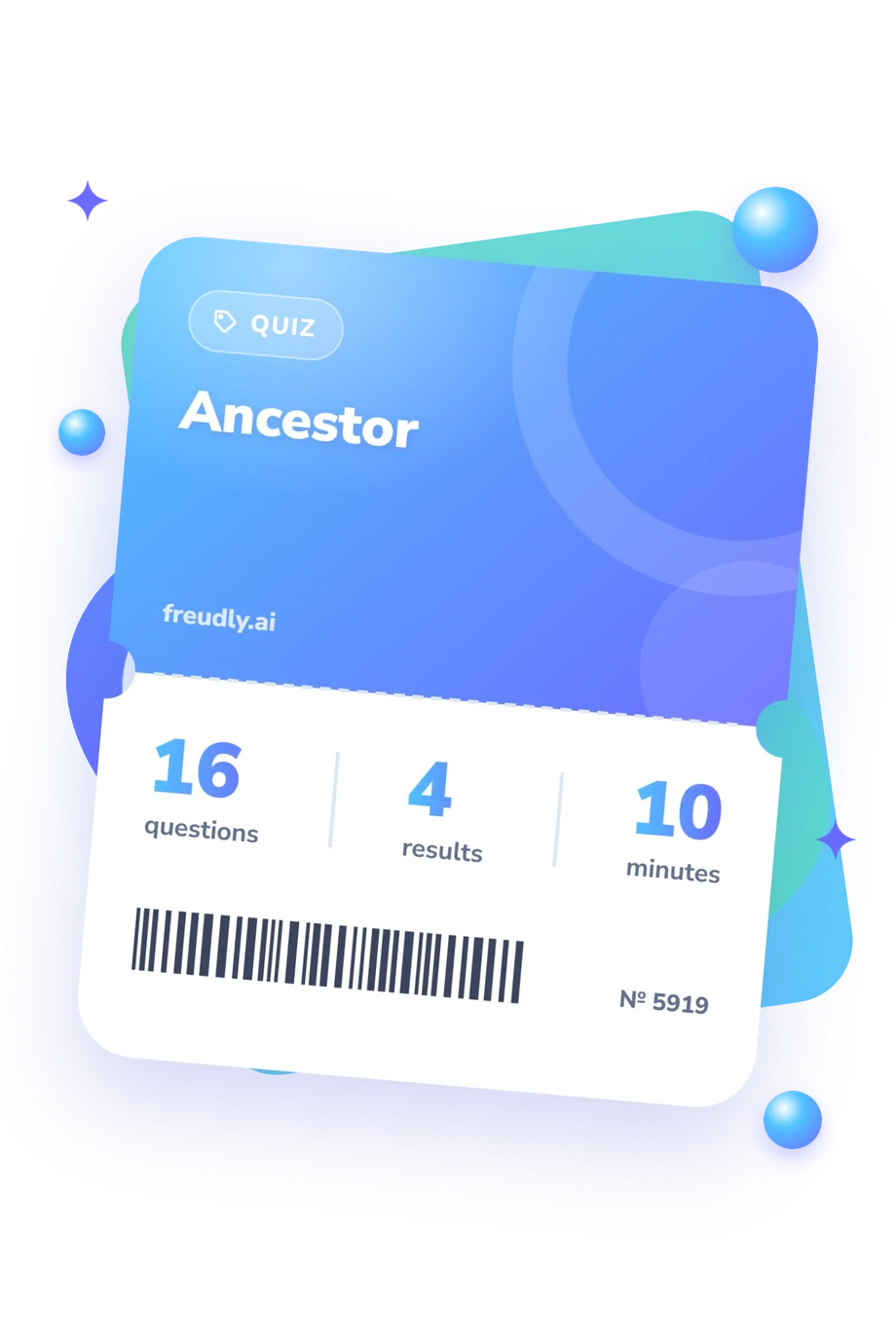
The profile contains four dimensions:
- Dragon Affinity (0-12) captures protection, firm boundaries, and attachment: Distant Ember (0-4), Guarded Flame (5-8), and Dragon Heart (9-12).
- Fae Affinity (0-12) captures curiosity, playfulness, wordplay, and mystery: Distant Glimmer (0-4), Enchanted Trail (5-8), and Fae Spirit (9-12).
- Mermaid Affinity (0-12) captures emotional attunement, adaptation, atmosphere, and water imagery: Distant Tide (0-4), Moonlit Current (5-8), and Mermaid Soul (9-12).
- Phoenix Affinity (0-12) captures renewal, reinvention, hope, and transformation: Quiet Ash (0-4), Rising Spark (5-8), and Phoenix Flame (9-12).
Within this mythical lineage quiz, the four results are read together, so one prominent theme is not treated as a permanent identity.
Methodology and Evidence Base
Each item presents a brief scenario with four response options. The choices are not right or wrong; they ask which reaction best resembles your usual tendency. Across the set, situations cover social awareness, emotional support, curiosity, protection, adaptation, renewal, mystery, and boundary-setting.
Scoring sorts responses across four affinity directions and produces a 0-12 result for each. Scores within one point indicate a blended lineage. The questionnaire presents no standardized answer-to-point key, population norms, or clinical cutoffs, so these numbers are descriptive indicators within this themed format.
Its imaginative approach is conceptually consistent with Webster and Saucier (2023), which connects imaginative involvement and magical beliefs with individual differences in supernatural possibilities. Huang and Fung (2024) address identification with narrative characters, and Weibel et al. (2018) examine creative and imaginative fantasy. These are conceptual comparators, not source instruments reproduced by the quiz.
As a magical creature personality quiz, it can prompt reflection on uncertainty, relationships, and change. Self-report results may shift with mood, context, and self-awareness, so answer for your recurring style.
- Webster, Russell J., and Donald A. Saucier. (2023). Up, Up, and Away: Individual Differences in Imaginative Involvement and Magical Beliefs Relate to Perceiving and Desiring Supernatural Powers. Imagination, Cognition and Personality, 43(2), 129-149. 10.1177/02762366231183626
- Huang, Kate Y., and Helene H. Fung. (2024). Measuring identification with narrative characters: the development and validation of a new scale. Current Psychology, 43, 24835-24849. 10.1007/s12144-024-06191-2
- Weibel, David, Corinna S. Martarelli, Diego Häberli, and Fred W. Mast. (2018). The Fantasy Questionnaire: A Measure to Assess Creative and Imaginative Fantasy. Journal of Personality Assessment, 100(4), 431-443. 10.1080/00223891.2017.1331913
Updated: