
Am I Mixed Handed Quiz
How the Scales are Structured
Who Usually Takes This Test?
See How You Compare
Below is a preview of how scores are typically distributed across each scale.
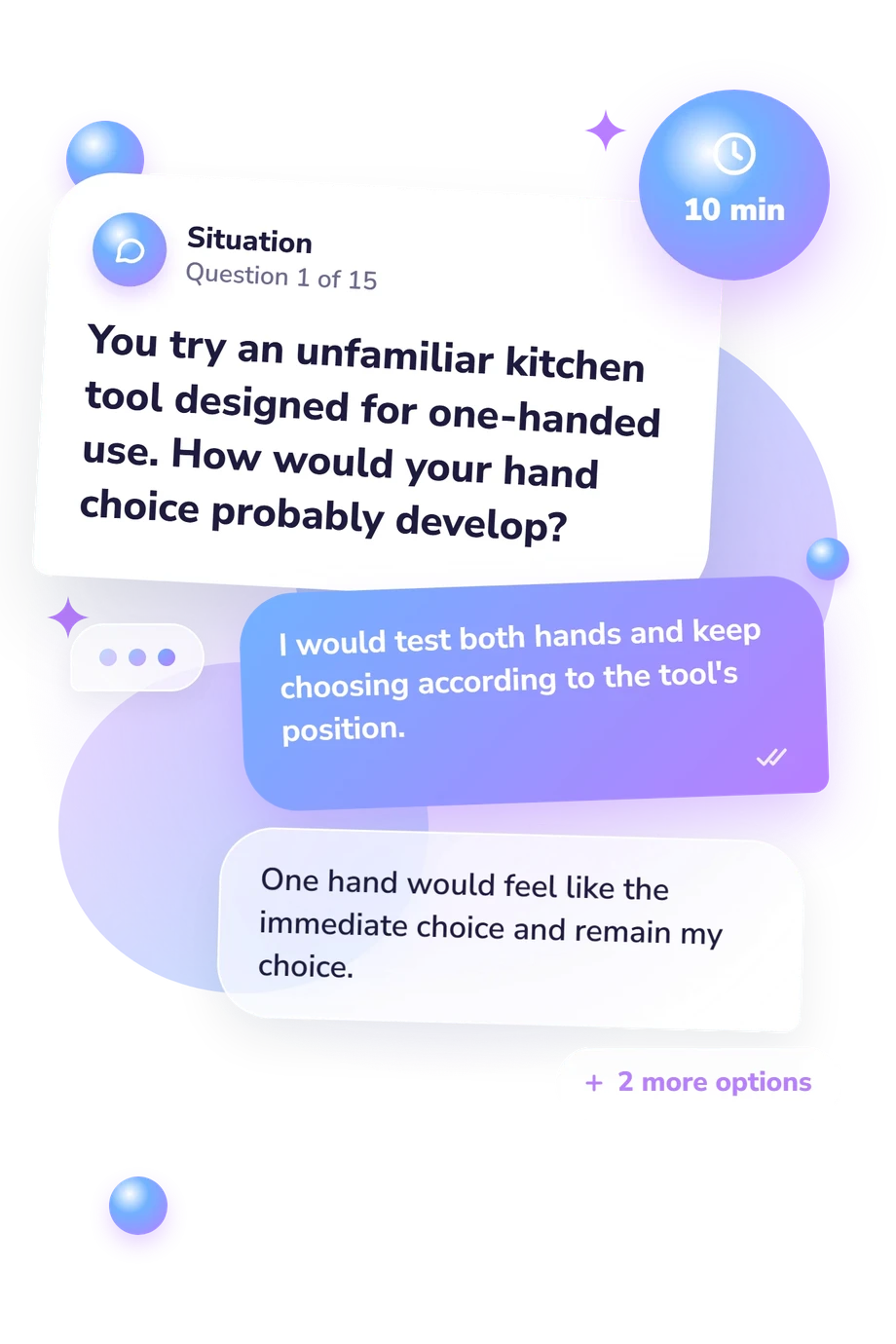
Example Questions From the Test
- Functional, with only minor awkwardness or extra attention.
- Natural enough that the change would make little difference.
- Possible, but slow and mentally demanding.
- So awkward that I would quickly return to the other hand.
- Both hands would perform at a broadly comparable level.
- One hand would be much more accurate and coordinated.
- The other hand would succeed sometimes but show a noticeable gap.
- There would be a small, consistent difference between them.
- It is difficult to keep the writing controlled or legible.
- It is readable, but only with slow, deliberate effort.
- It is reasonably close in quality, although somewhat slower.
- Its speed and control are similar to my usual performance.
Am I Mixed Handed Quiz - Description and methodology of the test
People noticing different hands for writing, throwing, tools, or sports can use this questionnaire to examine the pattern more closely. The Am I Mixed Handed Quiz offers a practical profile of preference, adaptability, and task-based switching for readers who want more detail than a single left-or-right label. As an are you left handed or right handed quiz, it looks beyond a single label when everyday choices feel inconsistent.
What This Assessment Explores
These ideas are distinct. Comfort with either hand differs from switching preferred hands between tasks, so this hand preference quiz keeps adaptability, consistency, and task-based choice separate. The result contains three dimensions:
- Bilateral Adaptability (0-15) measures ease with either hand: Clear side difference (0-5), Functional adaptability (6-10), or Similar bilateral ease (11-15).
- Hand Preference Consistency (0-15) measures repeatability within a task: Variable pattern (0-5), Moderate consistency (6-10), or Strong consistency (11-15).
- Task-Based Hand Switching (0-15) measures stable differences between activities: Limited switching (0-5), Some variation (6-10), or Strong mixed pattern (11-15).
The profile is intended for anyone curious about everyday laterality, not only people who identify strongly as left- or right-handed. Together, the scales distinguish mixed-handedness, defined by task-specific preferences, from ambidextrous tendencies, which suggest comparable ease with both hands.
Methodology and Evidence Base
Each item presents a situation with four response options about hand choice, consistency, control, ease, or switching. Topics include writing, tools, catching, throwing, sports, chores, fatigue, workspace layout, and repeated choices across settings. Together, they sample hand choice and conditions that change it.
The scoring uses dimensional self-report. Responses produce three profile scores rather than one overall label; a higher value does not automatically mean greater right-handedness or skill. Read this mixed handedness test across scales: strong within-task consistency with strong task-based switching can fit mixed-handedness, while comfort with either hand points toward comparable ease on both sides.
The framework is conceptually consistent with Das et al. (2021), which treats handedness as measurable across tasks. FLANDERS and the Edinburgh inventory are related published measures used for conceptual context; Annett’s work distinguishes right, left, and mixed patterns, and none supplies this questionnaire’s scoring or bands. This questionnaire is not adapted from them; its bands are reflective descriptions, not validated classifications.
Because answers are self-reported, context, memory, and expectations can influence the profile; read it as structured self-reflection, not a clinical classification.
- Beauty Das, Jed A. Meltzer, and Blair C. Armstrong (2021). Quantitative Assessment of Handedness and Cerebral Lateralization. Journal of Natural Sciences, 2(1), 6-22. 10.33137/jns.v2i1.34660
- Michael E. R. Nicholls, Nicole A. Thomas, Tobias Loetscher, and Gina M. Grimshaw (2013). The Flinders Handedness survey (FLANDERS): A brief measure of skilled hand preference. Cortex, 49(10), 2914-2926. 10.1016/j.cortex.2013.02.002
- Marian Annett (1967). The binomial distribution of right, mixed and left handedness. Quarterly Journal of Experimental Psychology, 19(4), 327-333. 10.1080/14640746708400109
- R. C. Oldfield (1971). The assessment and analysis of handedness: The Edinburgh inventory. Neuropsychologia, 9(1), 97-113. 10.1016/0028-3932(71)90067-4
Updated: