
Am I Emotionally Numb Quiz
How the Scales are Structured
Who Usually Takes This Test?
See How You Compare
Below is a preview of how scores are typically distributed across each scale.
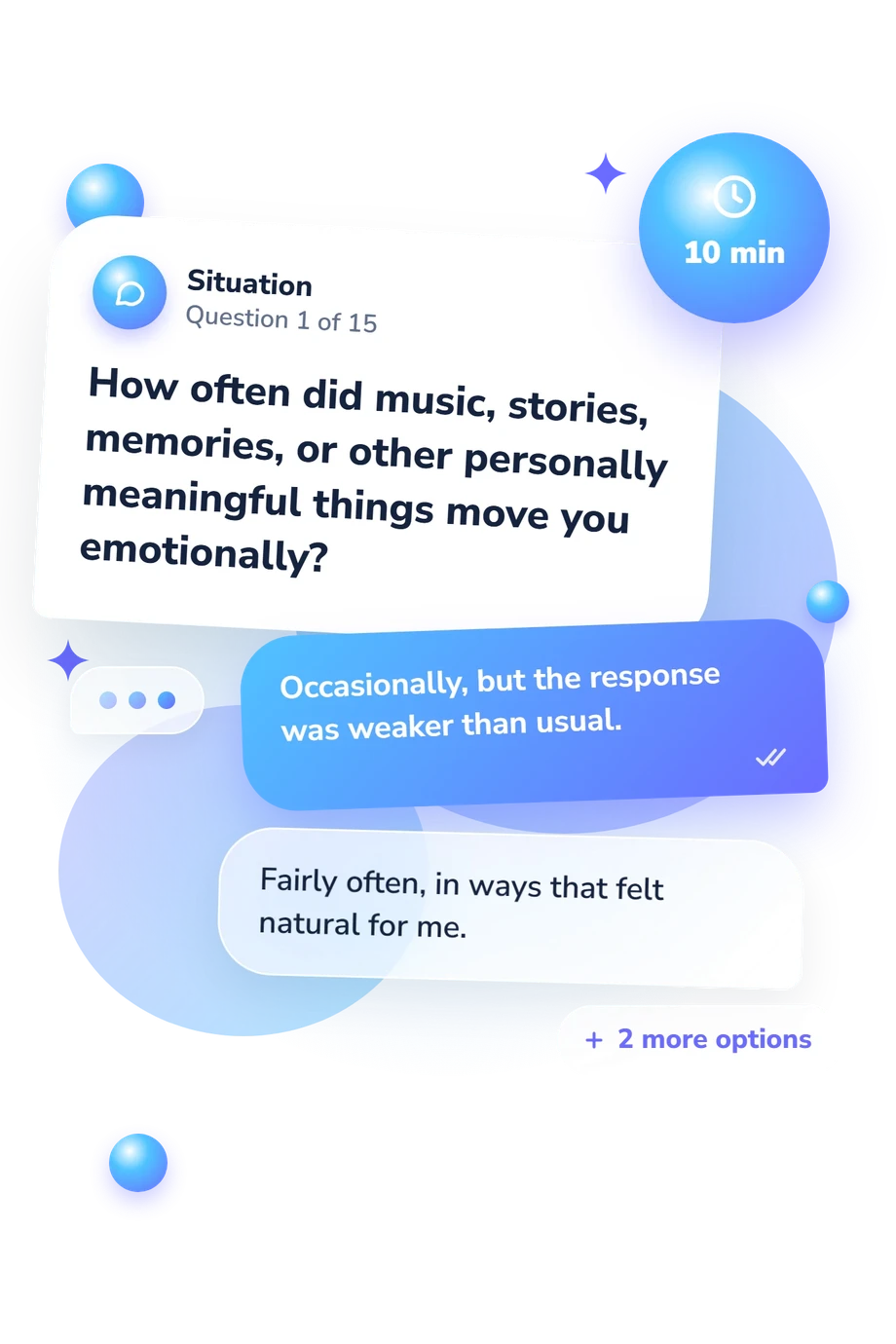
Example Questions From the Test
- Occasionally, but the response was weaker than usual.
- Fairly often, in ways that felt natural for me.
- Sometimes; whether I felt moved depended on the moment.
- Almost never, even when I expected them to affect me.
- I could usually identify a specific feeling without much effort.
- I noticed a general mood but sometimes struggled to name it.
- I often had to infer my feelings from my thoughts or behavior.
- I usually found an internal blank where a feeling might have been.
- I understood it was good but had little or no emotional reaction.
- I felt pleased, relieved, or excited in a recognizable way.
- A positive reaction appeared, but it felt faint or short-lived.
- My reaction was somewhat subdued, though still clearly positive.
Am I Emotionally Numb Quiz - Description and methodology of the test
For people who feel detached from their own experiences, the Am I Emotionally Numb Quiz offers a structured way to examine what emotional numbness looks like in daily life. This assessment does not reduce the experience to a yes-or-no label. Its questions distinguish disconnection, difficulty identifying feelings, and weaker reactions, so this emotional numbness test can help you organize a difficult-to-name experience and identify which pattern deserves closer reflection.
What This Assessment Explores
As a quiz about emotional numbness, it separates related experiences. Its items touch on presence in conversations and activities, access to preferences and feelings, bodily cues, and reactions to meaningful, pleasant, stressful, or affectionate events. The profile helps people describe a current experience without reducing it to a label.
The three displayed dimensions are:
- Connection and Presence (0-15) shows felt involvement in your life and emotional connection with people, not sociability or relationship quality. Its bands are Present connection (0-5), Variable presence (6-10), and Recurring disconnection (11-15).
- Emotional Access (0-15) shows how readily you notice, identify, and experience internal emotional signals. Its bands are Accessible signals (0-5), Mixed access (6-10), and Muted access (11-15).
- Emotional Responsiveness (0-15) shows how strongly enjoyable, moving, stressful, or meaningful experiences register emotionally. Its bands are Responsive (0-5), Inconsistent response (6-10), and Muted response (11-15).
Methodology and Scientific Basis
As an emotional numbness questionnaire, this is a self-report tool. Items ask about recent, typical, imagined, and recurring experiences, with four response options for different patterns of emotional connection, recognition, or reaction. Use a specified timeframe when one is given; otherwise, choose the option matching your usual experience. Responses are grouped into three scores, with higher scores indicating more recurring disconnection, reduced emotional access, or muted responsiveness within the relevant dimension. The displayed bands are unvalidated reflective bands, not clinical cutoffs.
Conceptually, the content is consistent with Orsillo et al. (2007), whose work is the closest source for emotional reactivity and numbing. It also relates to Glover and colleagues’ Numbing Scale and to the alexithymia construct examined by the Twenty-Item Toronto Alexithymia Scale, but it is not any of those instruments or a validated adaptation.
Stress, mood, memory, context, and self-awareness can influence self-report results; persistent or distressing patterns affecting functioning or safety warrant qualified support because the score alone cannot establish a cause or condition.
- Orsillo, S. M., Theodore-Oklota, C., Luterek, J. A., & Plumb, J. (2007). The development and psychometric evaluation of the emotional reactivity and numbing scale. The Journal of Nervous and Mental Disease, 195(10), 830-836. 10.1097/NMD.0b013e318156816f
- Glover, H., Ohlde, C., Silver, S., Packard, P., Goodnick, P., & Hamlin, G. L. (1994). The numbing scale: Psychometric properties, a preliminary report. Anxiety, 1(2), 70-79. 10.1002/anxi.3070010206
- Bagby, R. M., Parker, J. D. A., & Taylor, G. J. (1994). The twenty-item Toronto Alexithymia Scale-I. Item selection and cross-validation of the factor structure. Journal of Psychosomatic Research, 38(1), 23-32. 10.1016/0022-3999(94)90005-1
Updated: