
Plant Cell Quiz
How the Scales are Structured
Who Usually Takes This Test?
See How You Compare
Below is a preview of how scores are typically distributed across each scale.
Example Questions From the Test
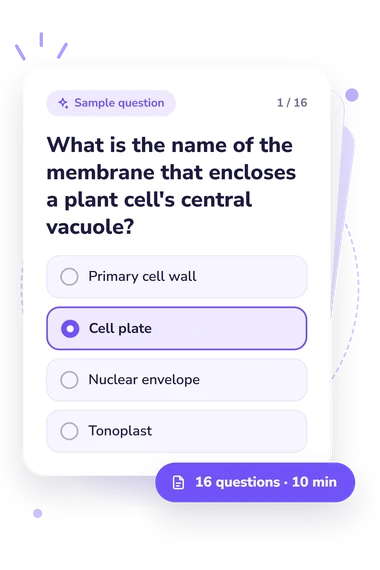
- Primary cell wall
- Cell plate
- Nuclear envelope
- Tonoplast
- Amyloplast
- Chloroplast
- Elaioplast
- Chromoplast
- Chloroplast
- Nucleus
- Mitochondrion
- Nucleolus
Plant Cell Quiz - Description and methodology of the test
For learners reviewing introductory botany, this plant cell quiz offers a focused way to check whether key structures can be identified and linked to their cellular roles. It suits students, independent learners, and anyone preparing for a biology lesson or exam. Questions also provide the practical context of a plant cell diagram quiz by connecting structural recognition with function.
What This Assessment Explores
The assessment measures knowledge of plant-cell organization: identifying structures, locating them, and explaining their roles. Short situations address water balance, plastid pigments, protein transport, cell division, and communication between neighboring cells. As a plant cell labeling quiz, it links named parts with biological function rather than treating vocabulary as isolated recall.
Topics include cell boundaries, membrane compartments, plastids, energy organelles, genetic material, protein processing, and intercellular channels. The result shows which core concepts are secure and which merit targeted review.
Its single displayed scale, Plant Cell Knowledge (0-16), is interpreted through these bands:
- 0-6 - Emerging Foundations indicates that major structures and their locations need further review.
- 7-12 - Developing Knowledge shows that many core structures are understood, while similar organelles and their functions may need comparison.
- 13-16 - Strong Knowledge reflects a well-developed command of plant-cell structures and their application in biological scenarios.
Methodology and Scientific Basis
Each item presents one best answer from four choices. Questions combine identification with functional reasoning: they ask why a cell resists bursting, which plastid stores starch, how vesicles contribute to cytokinesis, and which structures support protein synthesis or movement between cells. The format checks both terminology and application.
The knowledge framework is consistent with the plant-cell organization described by Evert and Eichhorn (2013). Otegui and Staehelin (2000) provide context for cell-plate formation during flowering-plant cytokinesis, while Bayer and Benitez-Alfonso (2024) support the treatment of plasmodesmata as intercellular channels. The questionnaire uses these works as conceptual reference points; it is not a validated adaptation of any of them.
Scoring is transparent: one point is assigned for each correct response, and the total is read as a classroom-style knowledge indicator. A plant cell parts and functions quiz can reveal content gaps, but the result is not norm-referenced or diagnostic. Performance may vary with prior instruction, wording familiarity, attention, and current confidence, so missed items are prompts for review rather than fixed judgments about ability.
- Evert, Ray F., and Susan E. Eichhorn. Raven Biology of Plants. 8th ed. W.H. Freeman and Company, 2013.
- Otegui, Marisa S., and L. Andrew Staehelin. Cytokinesis in flowering plants: more than one way to divide a cell. Current Opinion in Plant Biology 3, no. 6 (2000): 493-502. 10.1016/S1369-5266(00)00119-9
- Bayer, Emmanuelle M., and Yoselin Benitez-Alfonso. Plasmodesmata: Channels Under Pressure. Annual Review of Plant Biology 75 (2024): 291-317. 10.1146/annurev-arplant-070623-093110