
Men Wearing Panties Quiz
How the Scales are Structured
Who Usually Takes This Test?
See How You Compare
Below is a preview of how scores are typically distributed across each scale.
Example Questions From the Test
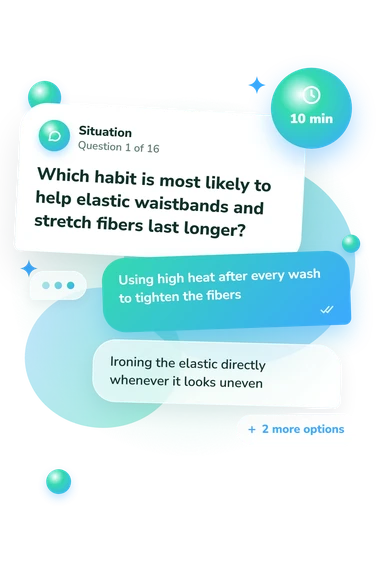
- Using high heat after every wash to tighten the fibers
- Ironing the elastic directly whenever it looks uneven
- Stretching the waistband before storage so it keeps its shape
- Using gentle care and avoiding unnecessary high heat
- Any tight underwear is suitable because discomfort is an expected part of tucking
- Wearing panties does not require tucking, and pain, numbness, or restricted circulation are reasons to stop
- Tucking is required whenever panties are worn by a man
- A smaller size is always safer because it limits movement more completely
- Heavy fabric, a loose waistband, and prominent internal seams
- Delicate lace chosen without considering stretch or placement
- The smallest available size so the garment cannot move
- A secure but nonrestrictive fit, smooth seams, and moisture-managing fabric
Men Wearing Panties Quiz - Description and methodology of the test
People comparing unfamiliar cuts, materials, or care routines can use the Men Wearing Panties Quiz to organize practical questions about comfort and garment use. The result makes this underwear quiz useful to anyone seeking clearer decisions about sizing, construction, hygiene, and activity without turning clothing preferences into assumptions about identity. It is especially relevant to anyone selecting, wearing, or maintaining close-fitting underwear.
What This Assessment Explores
Fit and comfort are the themes. Items consider waistband pressure, leg openings, front room, gussets, coverage, seams, sitting, walking, and movement. They also emphasize measuring body areas and checking brand-specific charts instead of treating a label or style name as universal.
The displayed Men Wearing Panties Knowledge scale spans 0-16: Foundations to build (0-6), Developing knowledge (7-12), and Strong knowledge (13-16). The result profiles practical knowledge about guys' underwear through this quiz, not identity, health, or suitability for one person.
The question themes show what the result covers:
- Fit and sizing examine whether proportions, stretch, and room support comfortable movement.
- Materials and construction consider fabric behavior, seams, gussets, and moisture handling.
- Activity and comfort relate garment choices to sitting, exercise, walking, and persistent pressure.
- Care and hygiene identify habits involving washing, drying, dye transfer, and garment instructions.
Methodology and Evidence Base
Each item presents a practical situation with four answer choices. Preferred responses favor nonrestrictive fit, measurements, care labels, suitable materials, and hygiene over assumptions that tighter is safer or one label fits every brand. It is a knowledge check; the total is an educational score from selected answers.
Rather than serving as a what underwear should i wear quiz, the result links choices to anatomy, movement, fabric, cut, and comfort. It teaches criteria instead of prescribing a style.
Conceptually, the questionnaire aligns with Cheng and Kuzmichev (2019) on lower-torso dimensions and underwear fit, but is not an adaptation of that study. Cheng, Kuzmichev, and Adolphe (2017) support material and compression considerations; Malik et al. (2024) add tucking context, and Abney et al. (2021) support hygiene themes.
A quiz comparing boxers or briefs has limits because category names cannot predict comfort in every context. The displayed result is an educational score with learning-oriented bands; current experience, self-awareness, anatomy, and context can shift self-reported answers, so it is best read as a learning profile, not a diagnosis or definitive recommendation.
- Cheng, Zhe, and Viktor E. Kuzmichev. "Research on the male lower torso for improving underwear design." Textile Research Journal 89, no. 9 (2019): 1623-1641. 10.1177/0040517518775925
- Cheng, Zhe, Viktor E. Kuzmichev, and Dominique Charles Adolphe. "Development of Knitted Materials Selection for Compression Underwear." AUTEX Research Journal 17, no. 2 (2017): 177-187. 10.1515/aut-2016-0006
- Malik, Mannat, Erin E. Cooney, Jean-Michel Brevelle, and Tonia Poteat. "Tucking Practices and Attributed Health Effects in Transfeminine Individuals." Transgender Health 9, no. 1 (2024): 92-97. 10.1089/trgh.2022.0064
- Abney, Sarah E., M. Khalid Ijaz, Julie McKinney, and Charles P. Gerba. "Laundry Hygiene and Odor Control: State of the Science." Applied and Environmental Microbiology 87, no. 14 (2021): e03002-20. 10.1128/AEM.03002-20