
Teeth Numbering Quiz
How the Scales are Structured
Who Usually Takes This Test?
See How You Compare
Below is a preview of how scores are typically distributed across each scale.
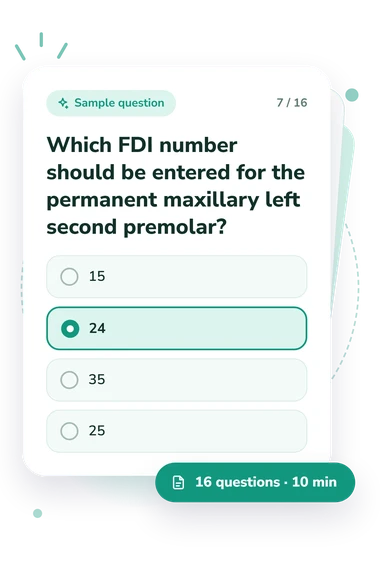
Example Questions From the Test
- Maxillary right lateral incisor
- Maxillary left central incisor
- Mandibular right central incisor
- Maxillary right central incisor
- It becomes #1 because numbering shifts forward
- It is left unnumbered because the sequence is incomplete
- It remains #2 because missing teeth do not renumber the dentition
- It becomes #16 to mark the end of the upper arch
- Mandibular right first molar
- Mandibular left first molar
- Mandibular right second molar
- Maxillary right first molar
Teeth Numbering Quiz - Description and methodology of the test
Students, trainees, and anyone revising basic chart notation can use this Teeth Numbering Quiz to practise identifying the same tooth across common systems. This Tooth Number Quiz is especially useful when a chart, referral, or study question switches between FDI, Universal, and Palmer notation. The result gives an overall picture of notation knowledge, while the question themes and missed items can guide another pass over particular rules.
What This Assessment Measures
Practical recognition is the focus here, not treatment planning. Items ask respondents to identify permanent and primary teeth, locate arches and quadrants, distinguish right from left, and convert entries between FDI and Universal notation. Palmer notation tests whether a position number is read with its quadrant symbol.
Other prompts address missing teeth, primary letters, and mirrored teeth across the midline. As a tooth numbering system quiz, it profiles notation knowledge rather than general dental ability.
The displayed scale is Teeth Numbering Knowledge (0-16), which measures interpretation of common tooth-numbering notation. Its bands are:
- Foundations to review (0-6) marks a need to revisit quadrant order, tooth sequence, and primary-tooth conventions.
- Developing knowledge (7-12) reflects core understanding with possible confusion about sides, arches, or system equivalents.
- Strong knowledge (13-16) reflects consistent interpretation and comparison of common notation.
Use the result to choose focused revision topics.
Methodology and Evidence Base
The questionnaire uses short, four-option multiple-choice items built around chart entries and identification prompts. Each item presents one notation problem and asks for the single best tooth or relationship. The four choices distinguish nearby possibilities, including reversed sides, arches, sequences, or systems, and require attention to right-left orientation.
Its content is conceptually consistent with Harris’s dental-coding discussion, the FDI two-digit system, and the American Dental Association’s Universal designation system. Palmer notation is a comparison point, not a separate score. Research by Pemberton and Ashley documented dental-notation misunderstanding in hospital settings, making focused chart-reading practice relevant.
In this dental notation quiz, one displayed knowledge result is reported with the bands above; read it as an overall guide to notation understanding. The questionnaire is not a standardized examination, and its educational bands do not establish clinical competence. Performance may vary with memory, prior instruction, and current attention. Use the result to target revision and verify uncertain conventions against an authoritative notation reference or local charting standard.
- Harris, Edward F. (2005). Tooth-Coding Systems in the Clinical Dental Setting. Dental Anthropology, 18(2), 43-49. 10.26575/daj.v18i2.132
- Keiser-Nielsen, S. (1971). Federation Dentaire Internationale two-digit system of designating teeth. International Dental Journal, 21, 104-106.
- American Dental Association. (2024). Universal Tooth Designation System: Value Set, July 2024. American Dental Association.
- Pemberton, M. N., and Ashley, M. (2017). The use and understanding of dental notation systems in UK and Irish dental hospitals. British Dental Journal, 223(6), 429-434. 10.1038/sj.bdj.2017.731