
To Kill a Mockingbird Quiz
How the Scales are Structured
Who Usually Takes This Test?
See How You Compare
Below is a preview of how scores are typically distributed across each scale.
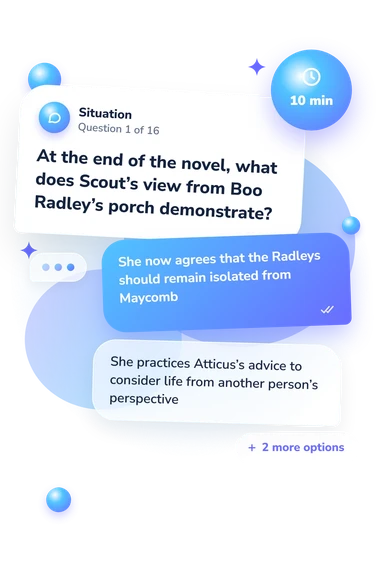
Example Questions From the Test
- Investigating the fire at Miss Maudie’s house
- Serving as sheriff after Heck Tate resigns
- Defending Tom Robinson in court
- Taking legal action against the Radley family
- Burning Miss Maudie’s house
- Raping Mayella Ewell
- Stealing money from Bob Ewell
- Attacking Jem and Scout on their way home
- Real courage can mean persevering when defeat is likely
- People should avoid helping anyone who has treated them harshly
- Physical strength is the most reliable form of bravery
- Winning public approval is necessary for a courageous act
To Kill a Mockingbird Quiz - Description and methodology of the test
Readers who have finished Harper Lee’s novel can use this assessment to check recall alongside its moral choices, social tensions, and symbols. The to kill a mockingbird quiz is intended for students, book-club members, and independent readers who want a focused result for rereading or discussion. Its outcome can show which parts of the story deserve closer attention. A mockingbird quiz can organize what you remember before returning to passages.
What This Assessment Explores
Questions in this tkam quiz link plot events with motives, ethical choices, social expectations, and symbols. It suits readers who have finished the novel and want to check recall with basic literary interpretation.
The items represent four connected areas:
- Plot and setting recall identifies major events and circumstances.
- Character knowledge distinguishes motives, loyalties, conflicts, and changes.
- Symbolic and thematic reading connects episodes with courage, compassion, prejudice, and perspective.
- Moral and social reasoning recognizes contrasts between public judgment and individual conduct.
The result is To Kill a Mockingbird Knowledge (0-16): Foundation to revisit (0-6) indicates partial recognition of key events, relationships, and symbols; Developing command (7-12) shows knowledge of the main plot and characters with room to sharpen thematic reading; Strong command (13-16) reflects detailed knowledge and connections among events, themes, and symbols.
Methodology and Evidence Base
Each item uses a four-option multiple-choice format, asking readers to select the answer that best fits the novel. The format combines recall with interpretation of motives, symbols, and social conflicts. Responses are combined into one knowledge score, read through the three bands rather than separate trait scores. This is a literary knowledge check, not a standardized psychometric instrument.
Content is anchored directly in Harper Lee (1960), while Claudia Durst Johnson (1994) supports attention to social boundaries, identity, and moral tension. Potyk and White (2020) discuss institutional racism in the novel. These works provide the literary and critical frame; they do not make this online quiz over to kill a mockingbird an adaptation of a published test or give its score established norms.
Interpret the result as performance on the content. A higher score means the respondent identified more tested events, relationships, symbols, and implications; it does not establish superior literary judgment or agreement with critical reading. Memory, rereading, classroom exposure, and option wording can affect performance, so use the result to target passages for review and discussion.
- Lee, Harper. To Kill a Mockingbird. Philadelphia: J. B. Lippincott Company, 1960.
- Johnson, Claudia Durst. To Kill a Mockingbird: Threatening Boundaries. New York: Twayne Publishers, 1994.
- Potyk, Darryl, and Cicely W. White. "Another Lesson from the Mockingbird: Institutional Racism in Harper Lee's To Kill A Mockingbird." The American Journal of Medicine, vol. 133, no. 11, 2020, pp. 1360-1361. 10.1016/j.amjmed.2020.07.008