
Am I Crazy Test
How the Scales are Structured
Who Usually Takes This Test?
See How You Compare
Below is a preview of how scores are typically distributed across each scale.
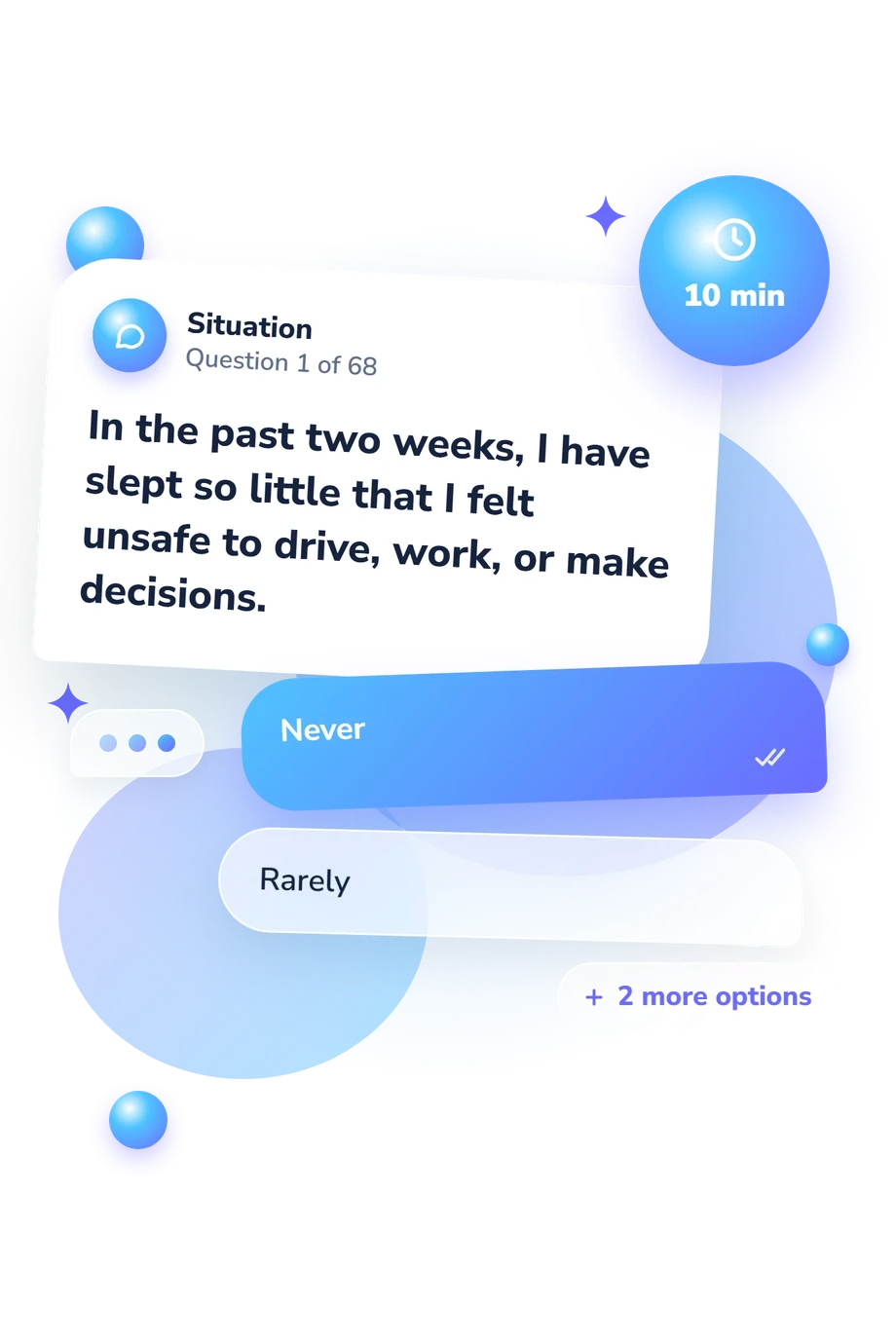
Example Questions From the Test
- Never
- Rarely
- Sometimes
- Often
- Not at all
- Sometimes
- Often
- Almost always
- Not at all
- Sometimes
- Often
- Almost always
Am I Crazy Test - Description and methodology of the test
People who feel overwhelmed, mentally unsettled, or unlike themselves may use the Am I Crazy Test to organize difficult recent experiences. The result functions as a reality check quiz, organizing recent concerns without reducing them to a single label. It is intended for readers who want to examine racing thoughts, poor sleep, detachment, mood changes, or safety concerns more clearly.
What This Assessment Explores
Rather than reducing distress to a yes-or-no label, the questionnaire separates experiences that can accompany poor sleep, overwhelm, mood changes, or altered self-awareness. Its am i crazy quiz format helps the reader see which type of difficulty is most prominent.
The displayed result uses three dimensions:
- Distress Level (0-40) measures overall emotional and mental distress across stress, overwhelm, mood shifts, and sleep disruption. Low distress is 0-13, Moderate distress 14-26, and High distress 27-40.
- Thought & Reality Disruption (0-30) measures racing or intrusive thoughts, dissociation, derealization, and feeling unlike yourself. Low is 0-9, Moderate 10-19, and High 20-30.
- Urgency & Safety Flag (0-20) measures warning signs such as impaired functioning, escalating symptoms, or feeling unsafe. Low concern is 0-6, Moderate concern 7-13, and High concern 14-20.
Together, the scales show whether strain is mild, substantial, or urgent.
Methodology and Scientific Basis
Items are first-person self-report statements about current or recent functioning and inner experience. Response choices vary by item, using frequency, intensity, agreement, and safety options. This format captures common strain and serious disruption.
Scoring is dimensional: answers are combined into three displayed totals, with higher results indicating more of the tendency described by each dimension. The labels do not establish a universal point value or clinical cutoff. The highest safety band indicates greater urgency for prompt support or immediate assistance.
Conceptually, the themes align with the Prodromal Questionnaire-Brief (Loewy et al., 2011), the Cambridge Depersonalization Scale (Sierra & Berrios, 2000), Kessler et al. (2002) for nonspecific distress, and the Columbia-Suicide Severity Rating Scale (Posner et al., 2011). These are conceptual parallels, not evidence that this online mental health self-assessment is an adaptation or validated equivalent of those instruments.
This exact item set is not presented with published norms or validation. Scores may shift with current sleep, stress, self-awareness, and response style, so read the result as a present-moment profile that can guide reflection and signal when prompt support merits consideration.
- Loewy, R. L., Pearson, R., Vinogradov, S., Bearden, C. E., & Cannon, T. D. (2011). Psychosis risk screening with the Prodromal Questionnaire-brief version (PQ-B). Schizophrenia Research, 129(1), 42-46. 10.1016/j.schres.2011.03.029
- Sierra, M., & Berrios, G. E. (2000). The Cambridge Depersonalization Scale: a new instrument for the measurement of depersonalization. Psychiatry Research, 93(2), 153-164. 10.1016/S0165-1781(00)00100-1
- Kessler, R. C., Andrews, G., Colpe, L. J., Hiripi, E., Mroczek, D. K., Normand, S. L. T., Walters, E. E., & Zaslavsky, A. M. (2002). Short screening scales to monitor population prevalences and trends in non-specific psychological distress. Psychological Medicine, 32(6), 959-976. 10.1017/S0033291702006074
- Posner, K., Brown, G. K., Stanley, B., Brent, D. A., Yershova, K. V., Oquendo, M. A., Currier, G. W., Melvin, G. A., Greenhill, L., Shen, S., & Mann, J. J. (2011). The Columbia-Suicide Severity Rating Scale: initial validity and internal consistency findings from three multisite studies with adolescents and adults. American Journal of Psychiatry, 168(12), 1266-1277. 10.1176/appi.ajp.2011.10111704
Updated: