
Am I Boy Crazy Quiz
How the Scales are Structured
Who Usually Takes This Test?
See How You Compare
Below is a preview of how scores are typically distributed across each scale.
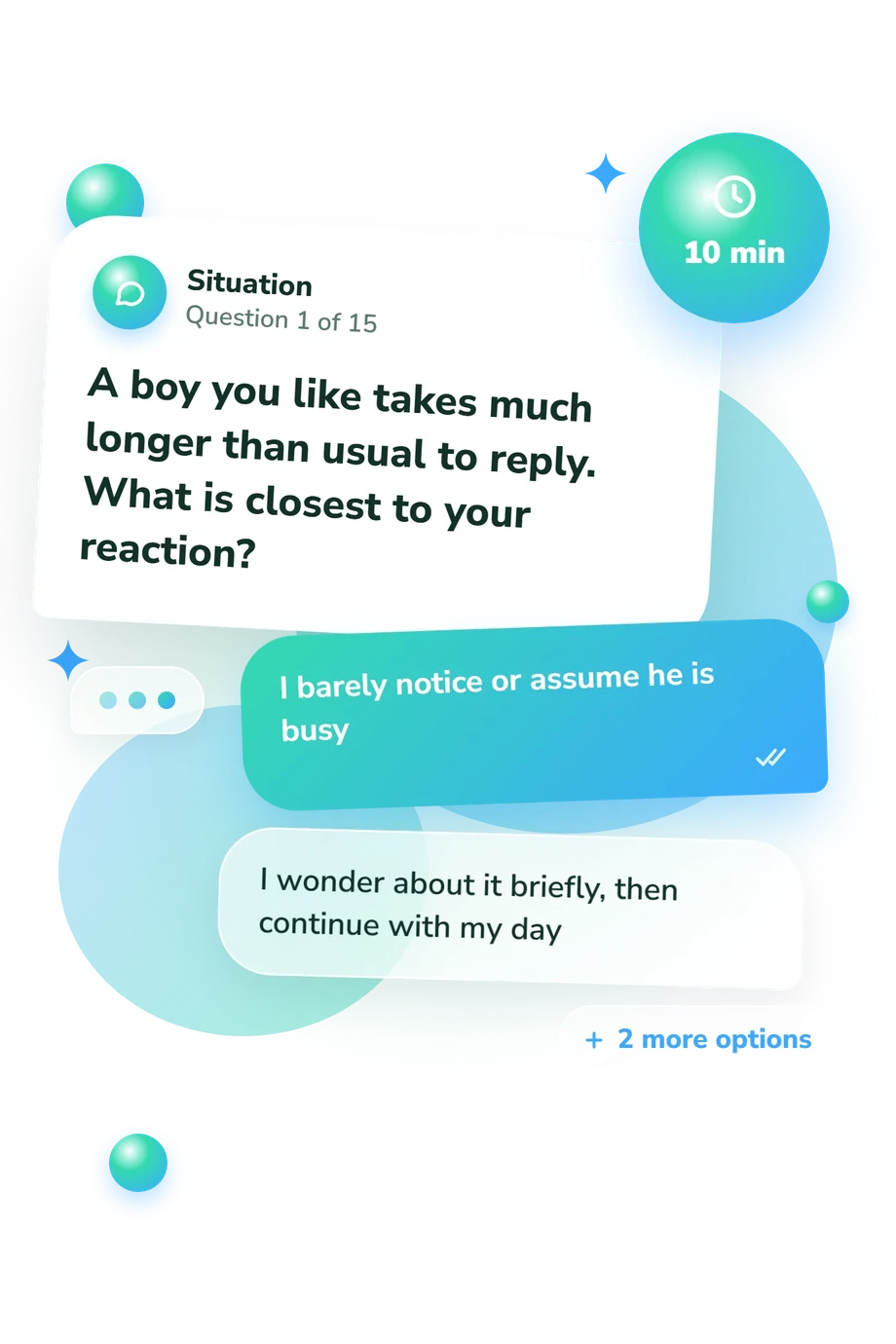
Example Questions From the Test
- I wait until my work is done before joining the conversation
- I send a short reply and return to the task
- I chat longer than intended, then rush to finish
- I keep chatting even if the task is late or I lose needed sleep
- Keep the original plan without much internal conflict
- Check whether another date with him would work instead
- Try to rearrange the friend plan if everyone seems flexible
- Cancel or substantially change the plan so I can see him
- Mostly toward hobbies, plans, or whatever I am doing
- Toward a mix of things, with an occasional thought about a boy
- Often toward messages, crushes, or possible romantic situations
- Almost automatically toward boys, dating, or romantic fantasies
Am I Boy Crazy Quiz - Description and methodology of the test
People who notice that romantic interest can compete with concentration, mood, or other commitments may use the Am I Boy Crazy Quiz to examine those patterns in a structured way. This boy crazy quiz gives shape to experiences that feel exciting, distracting, or more consuming than expected. The intended reader is anyone seeking a balanced snapshot of how crushes affect everyday attention and choices.
What This Assessment Explores
The questionnaire examines how crushes affect attention, emotion, self-view, and priorities. Scenarios cover replies, imagined futures, spending, routines, friendships, and competing plans.
The result uses three dimensions:
- Crush Preoccupation (0-15) measures persistent thoughts about boys and crushes occupying attention: Light presence (0-5) is occasional, Noticeable preoccupation (6-10) interrupts focus, and Strong preoccupation (11-15) often commands it.
- Emotional Stakes (0-15) measures how attention, uncertainty, and imagined possibilities involving boys influence mood and self-view: Light emotional stakes (0-5) have limited influence; Meaningful emotional stakes (6-10) are noticeable; Strong emotional stakes (11-15) shape expectations.
- Priority Pull (0-15) measures how pursuing or thinking about boys affects time, energy, money, and attention: Limited pull (0-5) fits priorities, Regular trade-offs (6-10) reshape plans, and Strong priority pull (11-15) displaces activities.
Together, these results separate mental presence, emotional weight, and practical trade-offs, helping you consider whether that focus feels chosen and manageable.
Methodology and Scientific Basis
Each item presents a situation with four choices, moving from little impact or disruption toward stronger preoccupation, emotional impact, or displacement of priorities. Selecting the closest reaction makes the result a self-report of tendencies, not an observation of behavior.
The result displays three scale scores, creating a profile of romantic attention; higher bands indicate more of the tendency named by each scale. The questionnaire has descriptive bands rather than population norms or clinical cutoffs, so they show intensity without making a score good or bad.
The Relational Rumination Questionnaire is the closest comparison because it addresses persistent thought, uncertainty, and emotional investment around relationships. The questionnaire is conceptually consistent with that work, but is not an adaptation or validation of it. The Love Addiction Inventory and Griffiths’s components model offer limited overlap around salience, mood effects, and interference; neither establishes addiction or validates this questionnaire.
Self-reported results can be influenced by current mood, recent romantic events, memory, and self-awareness. Read the profile in context: a high score may reflect a temporary crush, a recurring pattern, or a period when uncertainty carries unusual weight.
- Costa, Sebastiano, Nadia Barberis, Mark D. Griffiths, Loredana Benedetto, and Massimo Ingrassia (2021). The Love Addiction Inventory: Preliminary Findings of the Development Process and Psychometric Characteristics. International Journal of Mental Health and Addiction, 19(3), 651-668. 10.1007/s11469-019-00097-y
- Senkans, Svenja, Troy E. McEwan, Jason Skues, and James R. P. Ogloff (2016). Development of a Relational Rumination Questionnaire. Personality and Individual Differences, 90, 27-35. 10.1016/j.paid.2015.10.032
- Griffiths, Mark D. (2005). A 'components' model of addiction within a biopsychosocial framework. Journal of Substance Use, 10(4), 191-197. 10.1080/14659890500114359
Updated: