
A Separate Peace Quiz
How the Scales are Structured
Who Usually Takes This Test?
See How You Compare
Below is a preview of how scores are typically distributed across each scale.
Example Questions From the Test
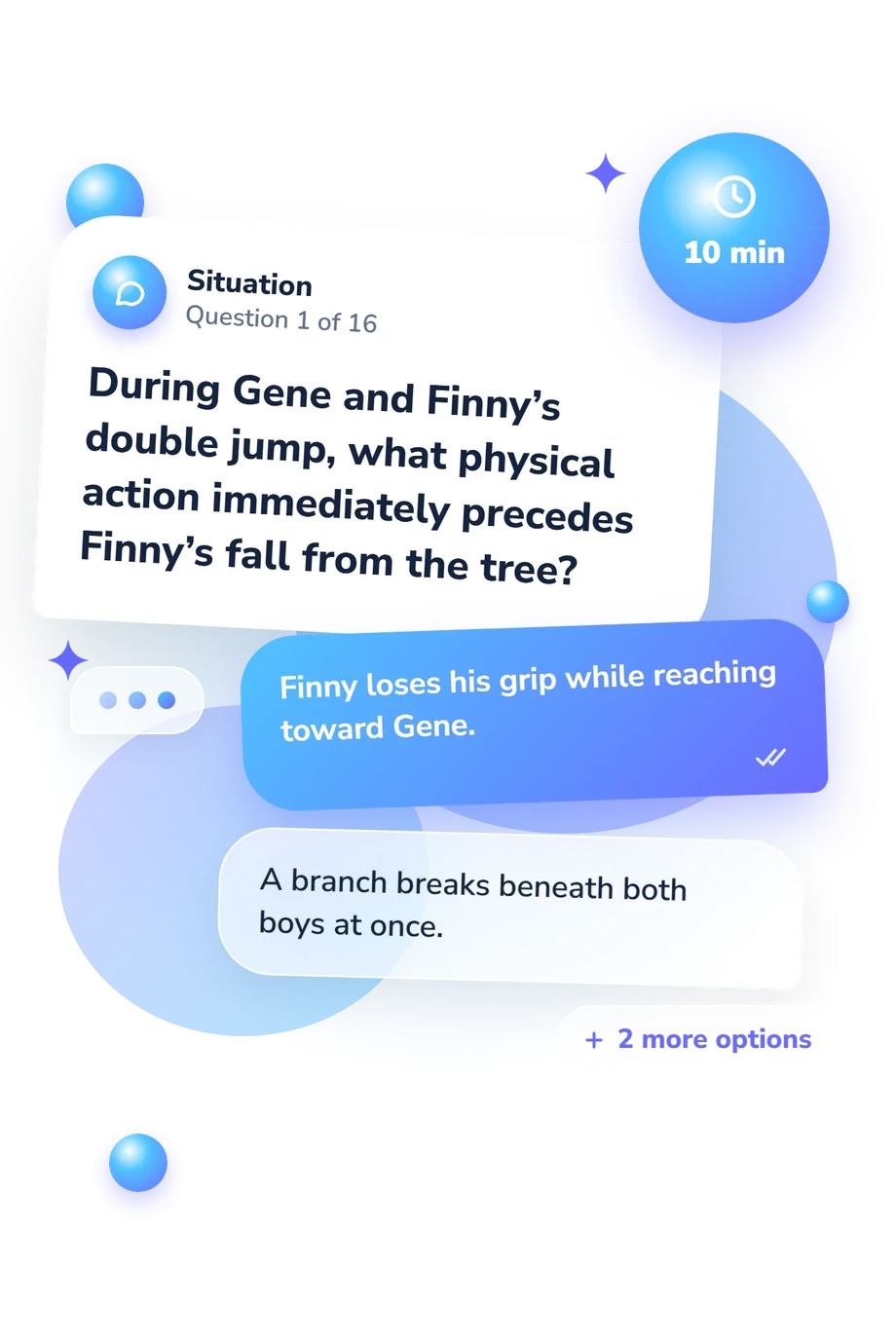
- Finny loses his grip while reaching toward Gene.
- A branch breaks beneath both boys at once.
- Gene slips while climbing and collides with Finny.
- Gene bends his knees and jounces the limb.
- An undetected head injury from the stairway fall
- A severe reaction to the anesthetic
- Bone marrow enters his bloodstream and reaches his heart
- An infection from the original tree accident
- A recruiting speech delivered by Brinker
- News that Gene plans to enlist immediately
- A promise that he can continue studying natural history
- A film presenting ski troops in an appealing way
A Separate Peace Quiz - Description and methodology of the test
Readers who want to revisit the novel’s events or test their interpretation can use the A Separate Peace Quiz as a focused knowledge check. It suits students, book-club members, and anyone returning to Gene Forrester’s account. This A Separate Peace reading quiz uses a multiple-choice format that keeps attention on details that are easy to confuse: chronology, motives, relationships, and the meaning of the title.
What This Assessment Explores
Alongside factual recall, questions connect pivotal events-Finny’s falls, Leper’s departure, Gene’s confession, and Finny’s death-with motives, symbols, and the novel’s changing idea of peace. This A Separate Peace comprehension quiz assesses whether readers recognize links among events, motives, symbols, themes.
These are the main areas the assessment explores:
- Plot and chronology show whether you place accidents, departures, returns, and the final revelation in sequence.
- Character motives reveal how Gene, Finny, Leper, and Brinker act from fear, loyalty, rivalry, or denial.
- Relationships indicate how admiration, guilt, friendship, and competition shape Gene’s account.
- Themes and symbols show how you connect the title, war, tree, and Gene’s search for peace.
One displayed scale, A Separate Peace Knowledge (0-16), summarizes recognition of the plot, relationships, conflicts, chronology, and thematic meaning. Its bands are Foundation to Build (0-6), Developing Knowledge (7-12), and Strong Knowledge (13-16).
Methodology and Source Basis
The questionnaire uses four-option multiple-choice items, and each prompt asks for the best answer. Some questions check precise recall, such as the narrator, the sequence around Finny’s fall, or the cause of his death; others ask for interpretation of denial, identity, guilt, and the title. Together, these items assess attentive reading across factual and interpretive questions.
The result for this A Separate Peace knowledge quiz is reported on the displayed scale and assigned to the catalogue’s three bands. Those bands describe performance on this questionnaire, not population norms. The overall band can guide a decision about whether broader rereading would be useful, while the questions draw attention to chronology, motives, symbols, and relationships.
Knowles’s novel supplies the textual content. Studies by Flum and Porton, Schriefer, and McGavran provide interpretive context rather than psychometric validation. The questionnaire is not an adaptation of those studies.
Interpretation also depends on memory, recency of reading, and familiarity with classroom explanations. The score captures this response set, so it cannot represent every defensible reading of the novel.
- Knowles, John. A Separate Peace. Secker & Warburg, 1959.
- Flum, Hanoch, and Harriet D. Porton. "Relational Processes and Identity Formation in Adolescence: The Example of A Separate Peace." Genetic, Social, and General Psychology Monographs, vol. 121, no. 4, 1995, pp. 369-389.
- Schriefer, Natalie. "Cold Reality: Revisions of War in John Knowles’ ‘Phineas’ and A Separate Peace." Irish Journal of American Studies, no. 11, 2022, pp. 37-48.
- McGavran, James Holt. "Fear's Echo and Unhinged Joy: Crossing Homosocial Boundaries in A Separate Peace." Children's Literature, vol. 30, no. 1, 2002, pp. 67-80. 10.1353/chl.0.0746
Updated: