
8th Grade Social Studies Quiz
How the Scales are Structured
Who Usually Takes This Test?
See How You Compare
Below is a preview of how scores are typically distributed across each scale.
Example Questions From the Test
- To conserve scarce resources and distribute civilian supplies more evenly
- To eliminate the use of money during wartime
- To prevent citizens from purchasing imported goods
- To encourage factories to stop producing military equipment
- Federalism
- Popular sovereignty
- Judicial review
- Due process
- Declared the bill unconstitutional
- Ratified a constitutional amendment
- Issued an executive order
- Overridden the presidential veto
8th Grade Social Studies Quiz - Description and methodology of the test
Students seeking a clearer picture of their readiness for middle-school social studies can use the 8th grade social studies quiz to gauge overall performance across the tested content. It suits independent practice or classroom review, showing whether broad review may be useful. This assessment can serve as a social studies quiz for class 8.
What This Assessment Measures
This assessment is aimed at learners reviewing core eighth-grade social studies content, whether they are preparing for classwork, checking retained knowledge, or deciding what to revisit. It samples recall and application across U.S. history, civics, geography, and economics rather than one chapter. The history items in this 8th grade social studies test help a student see strengths within the broader subject mix.
The result appears on one scale, 8th Grade U.S. Social Studies Knowledge (0-16). Foundations to Build (0-6) signals a need to review major concepts; Developing Knowledge (7-12) reflects understanding with some connections to reinforce; Strong Knowledge (13-16) indicates solid command across several contexts. These bands describe performance on this questionnaire, not a complete measure of school achievement.
Methodology and Evidence Base
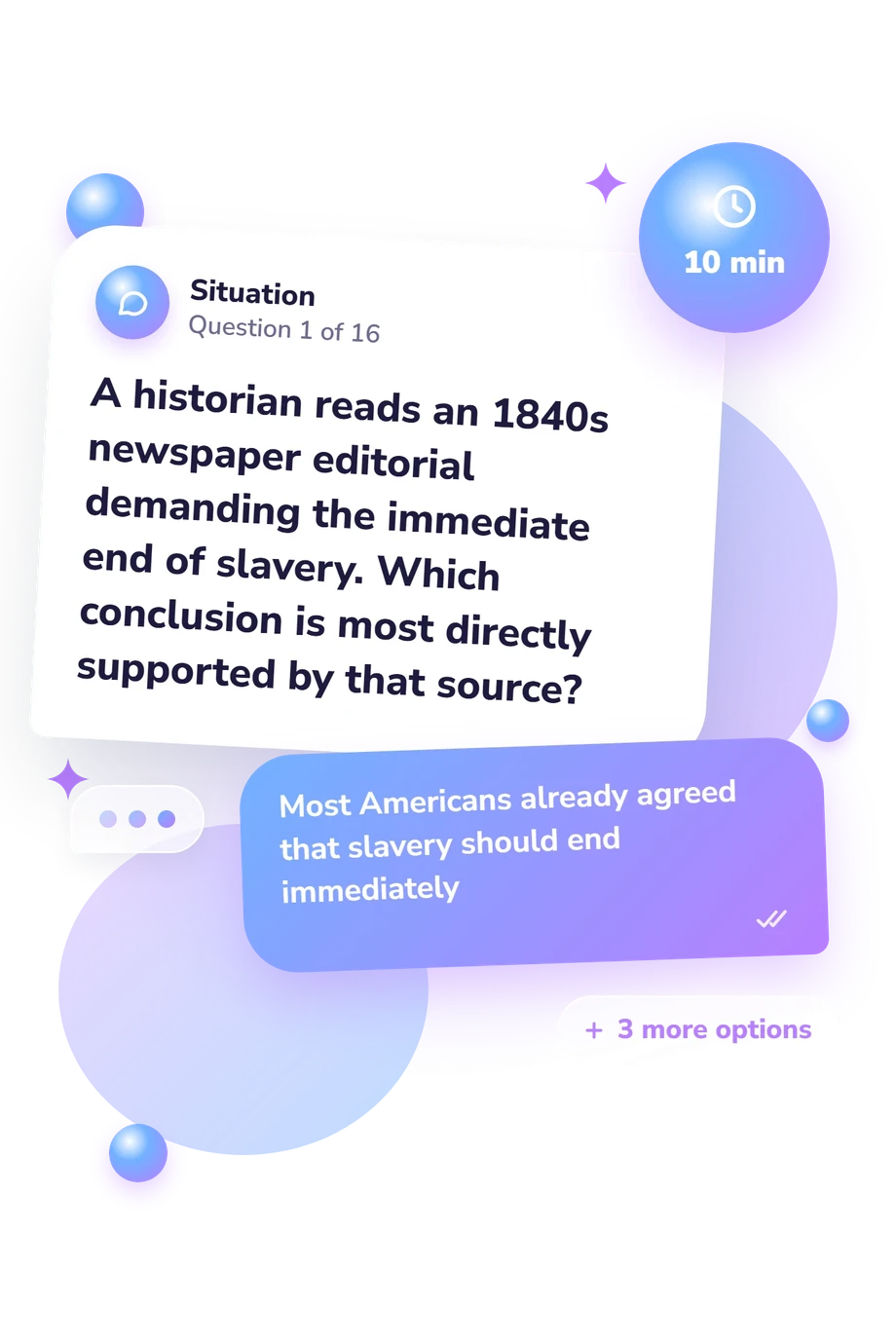
Each item presents a historical, civic, geographic, or economic situation followed by four choices. Selecting the best answer tests recognition, interpretation, and application rather than extended writing. This multiple-choice format can show factual recall and concept transfer during middle school social studies review.
The item groups cover four kinds of reasoning:
- Historical items connect events, policies, people, and consequences.
- Civics items identify constitutional principles, government powers, amendments, and court decisions.
- Geography items relate location, transportation, migration, and urbanization to community change.
- Economics items apply scarcity, supply and demand, taxation, banking, and production to concrete cases.
Content aligns conceptually with the C3 Framework and the NAEP U.S. History and Civics Frameworks. These frameworks support the domains and reasoning styles, but this questionnaire is not an adaptation of either assessment. Reich’s multiple-choice research supports reading selected answers as performance on bounded multiple-choice tasks, not a portrait of historical understanding. The displayed score provides an overall performance summary, and its bands distinguish levels of performance. Reviewing missed answers can guide further study, since context, familiarity, and guessing can affect a result.
- Swan, Kathy, S. G. Grant, and John Lee. The College, Career, and Civic Life (C3) Framework for Social Studies State Standards: Guidance for Enhancing the Rigor of K-12 Civics, Economics, Geography, and History. Silver Spring, MD: National Council for the Social Studies, 2013.
- National Assessment Governing Board. U.S. History Framework for the 2018 National Assessment of Educational Progress. Washington, DC: U.S. Government Publishing Office, 2018.
- National Assessment Governing Board. Civics Framework for the 2018 National Assessment of Educational Progress. Washington, DC: U.S. Government Publishing Office, 2018.
- Reich, Gabriel A. "Imperfect Models, Imperfect Conclusions: An Exploratory Study of Multiple-Choice Tests and Historical Knowledge." The Journal of Social Studies Research 37, no. 1 (2013): 3-16. 10.1016/j.jssr.2012.12.004
Updated: