
World Quiz Questions
How the Scales are Structured
Who Usually Takes This Test?
See How You Compare
Below is a preview of how scores are typically distributed across each scale.
Example Questions From the Test
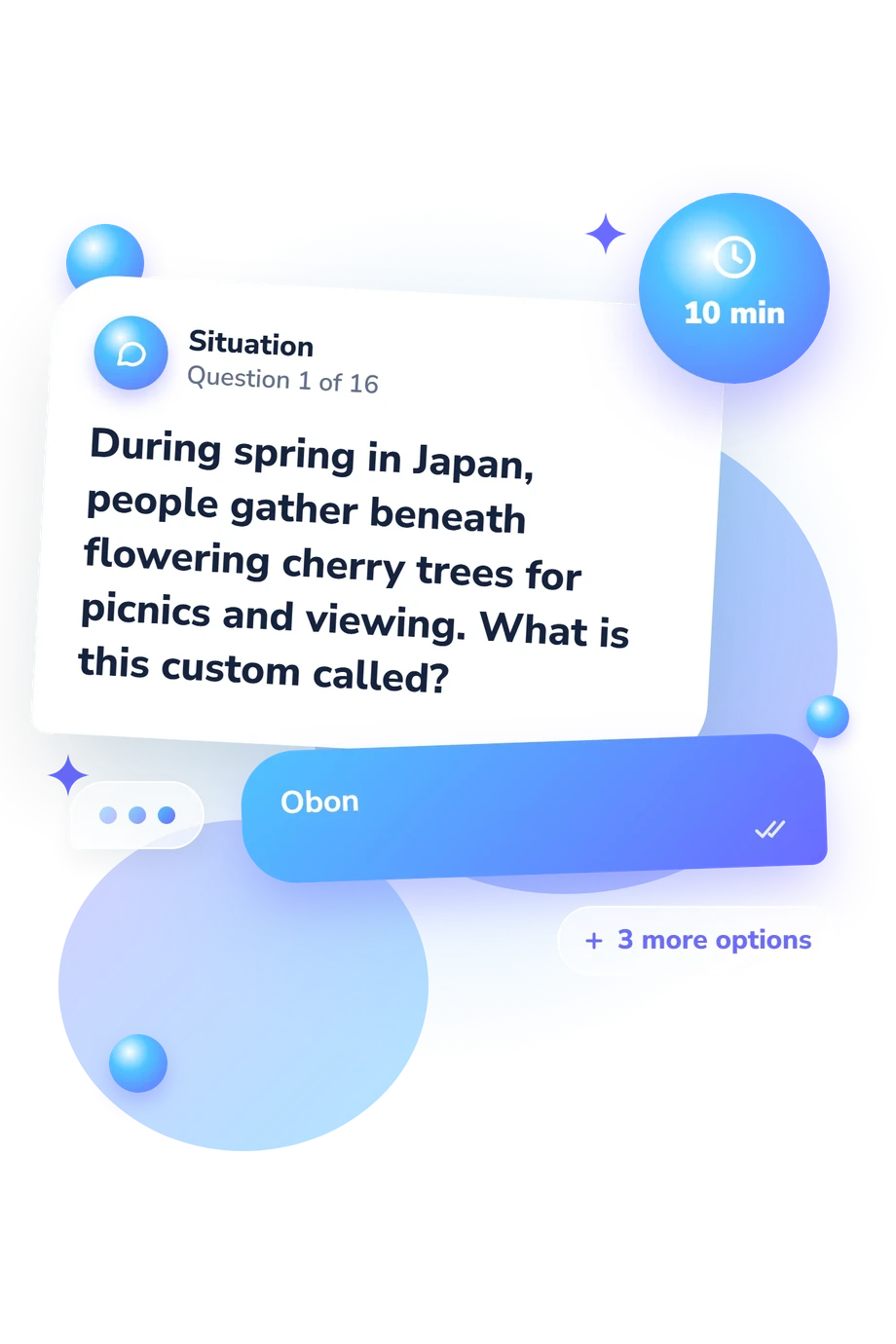
- Obon
- Hanami
- Setsubun
- Tanabata
- Desert winds and mountain shadows
- Written road charts and compass bearings
- Stars, ocean swells, winds, and wildlife patterns
- River currents and seasonal snowfall
- Designing geometric tilework
- Leading harvest dances
- Preserving history through oral storytelling and music
- Carving ceremonial masks from stone
World Quiz Questions - Description and methodology of the test
Curious learners can use this assessment to check how well they recognize cultural traditions across regions. The world quiz questions connect celebrations, foods, arts, languages, and everyday practices with the places where they are found. The result gives a focused picture of factual cultural knowledge. Readers who enjoy an international trivia quiz can use it to identify familiar areas and choose topics for further learning.
What This Assessment Explores
This assessment measures factual cultural literacy: recognizing a practice, object, celebration, or language feature and linking it to an appropriate cultural setting. Its country facts quiz format goes beyond geography, covering food, arts, performance, belief, and everyday life.
The result brings together three thematic groups:
- Celebrations and customs show whether you connect festivals, rituals, and community observances with their settings.
- Food, arts, and performance show whether you recognize dishes, textiles, dances, music, and visual traditions.
- Language and navigation show whether you identify writing direction and traditional ways of finding routes.
These themes contribute to the World Culture Knowledge scale, scored from 0-16. Cultural Explorer is 0-6, Developing World Knowledge is 7-12, and Global Culture Scholar is 13-16. The result reflects performance on tested material, not complete knowledge of any culture.
Methodology and Evidence Base
Each item gives a brief cultural situation or description followed by four answer choices. You select the alternative that best matches the fact being tested, so questions and answers in this world-culture quiz measure recognition and basic interpretation rather than extended writing. The total combines item performance into the displayed score and band; these are descriptive levels, not population norms.
The questionnaire is conceptually consistent with the Cultural Literacy Test (Stanovich & Cunningham, 1993), which links knowledge acquisition with exposure and learning. It is not a reproduction or validated adaptation of that instrument. Ang et al. (2007) helps distinguish factual cultural knowledge from broader cultural intelligence, while Deardorff (2006) treats intercultural competence as involving attitudes, skills, reflection, and behavior as well as knowledge.
This online knowledge exercise is not standardized or norm-referenced. Results may reflect reading, education, travel, language familiarity, cultural exposure, attention, and guessing. A strong score indicates recognition of tested material, but not communication skill, openness, or respectful conduct in every cross-cultural situation. Use the profile to identify strengths and choose areas for learning.
- Stanovich, K. E., & Cunningham, A. E. (1993). Where Does Knowledge Come From? Specific Associations Between Print Exposure and Information Acquisition. Journal of Educational Psychology, 85(2), 211-229. 10.1037/0022-0663.85.2.211
- Ang, S., Van Dyne, L., Koh, C., Ng, K. Y., Templer, K. J., Tay, C., & Chandrasekar, N. A. (2007). Cultural Intelligence: Its Measurement and Effects on Cultural Judgment and Decision Making, Cultural Adaptation and Task Performance. Management and Organization Review, 3(3), 335-371. 10.1111/j.1740-8784.2007.00082.x
- Deardorff, D. K. (2006). Identification and Assessment of Intercultural Competence as a Student Outcome of Internationalization. Journal of Studies in International Education, 10(3), 241-266. 10.1177/1028315306287002
Updated: