
White Blood Cell Quiz
How the Scales are Structured
Who Usually Takes This Test?
See How You Compare
Below is a preview of how scores are typically distributed across each scale.
Example Questions From the Test
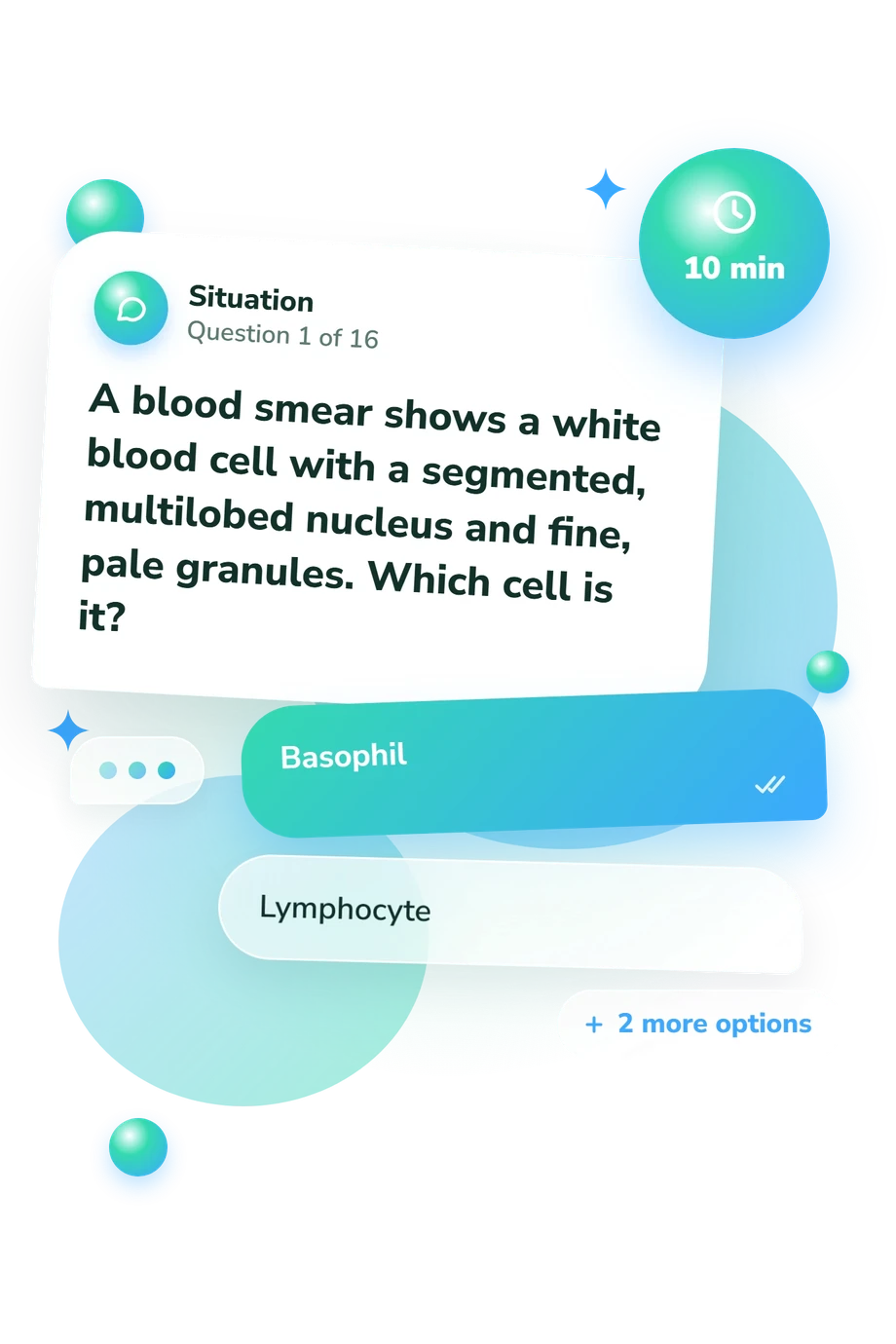
- Basophil
- Lymphocyte
- Monocyte
- Neutrophil
- Diapedesis
- Hemostasis
- Hemolysis
- Agglutination
- Neutrophil
- Basophil
- Monocyte
- Cytotoxic T cell
White Blood Cell Quiz - Description and methodology of the test
Students, trainees, and curious readers who want to review basic hematology can use this white blood cell quiz to judge how well textbook knowledge transfers to smear descriptions, terminology, and clinical reasoning. For learners revising smear morphology and differential counts, this WBC identification quiz checks how confidently they apply those ideas to unfamiliar examples. The result helps a reader decide whether to keep reviewing terminology, morphology, or clinical reasoning.
What This Assessment Measures
Designed for learners reviewing basic hematology, this assessment connects leukocyte appearance with immune function and laboratory language. As a white blood cell identification quiz, it applies recognition to brief smear descriptions and clinical situations. The result reflects foundational knowledge and helps you choose which topic to practise next.
The question themes cover these connected areas:
- Cell identification shows whether you can distinguish neutrophils, eosinophils, basophils, monocytes, and lymphocyte types from morphology or role.
- Cellular function indicates understanding of diapedesis, phagocytosis, antibody secretion, cytotoxic killing, and histamine release.
- Differential reasoning tests bands, left shift, relative proportions, and approximate absolute neutrophil count.
- Applied interpretation connects neutropenia, hypersegmentation, allergic or parasitic patterns, and leukemia with likely explanations.
Performance appears on the White Blood Cell Knowledge scale (0-16): Foundations to build (0-6), Developing knowledge (7-12), or Strong knowledge (13-16). The bands indicate whether to revisit basics, strengthen interpretation, or integrate both.
Methodology and Evidence Base
Each item uses a smear description, a direct concept question, a clinical vignette, a terminology prompt, or one calculation, with four answer choices. The best option depends on terminology, morphology, and basic reasoning. While taking this leukocyte identification quiz, compare each option with the morphology or process described.
Conceptually, the content is consistent with Ramesh et al. (2012) on classifying normal white cells in peripheral smears, Blumenreich’s account of the differential count, and the morphology and clinical framework in Rodak’s Hematology. This questionnaire is an educational knowledge check whose content is conceptually consistent with these hematology sources, not a standardized adaptation of a published instrument.
The displayed result is one educational knowledge score, with bands that organize overall command of the covered material rather than clinical cutoffs. This WBC quiz can prompt review of item themes such as cell morphology, immune functions, differential counts, and clinical patterns, but it does not provide separate topic scores. Prior study, attention, and item wording can affect performance, so read the result as a snapshot of this question set.
- Ramesh N, Dangott B, Salama ME, Tasdizen T. Isolation and two-step classification of normal white blood cells in peripheral blood smears. Journal of Pathology Informatics. 2012;3:13. 10.4103/2153-3539.93895.
- Blumenreich MS. The White Blood Cell and Differential Count. In: Walker HK, Hall WD, Hurst JW, editors. Clinical Methods: The History, Physical, and Laboratory Examinations. 3rd ed. Boston: Butterworths; 1990. Chapter 153.
- Keohane EM, Preston MM, Mirza KM, Walenga JM, editors. Rodak's Hematology: Clinical Principles and Applications. 7th ed. St. Louis: Elsevier; 2024.
Updated: