
Which Shrek Character Are You Quiz
How the Scales are Structured
Who Usually Takes This Test?
See How You Compare
Below is a preview of how scores are typically distributed across each scale.
Example Questions From the Test
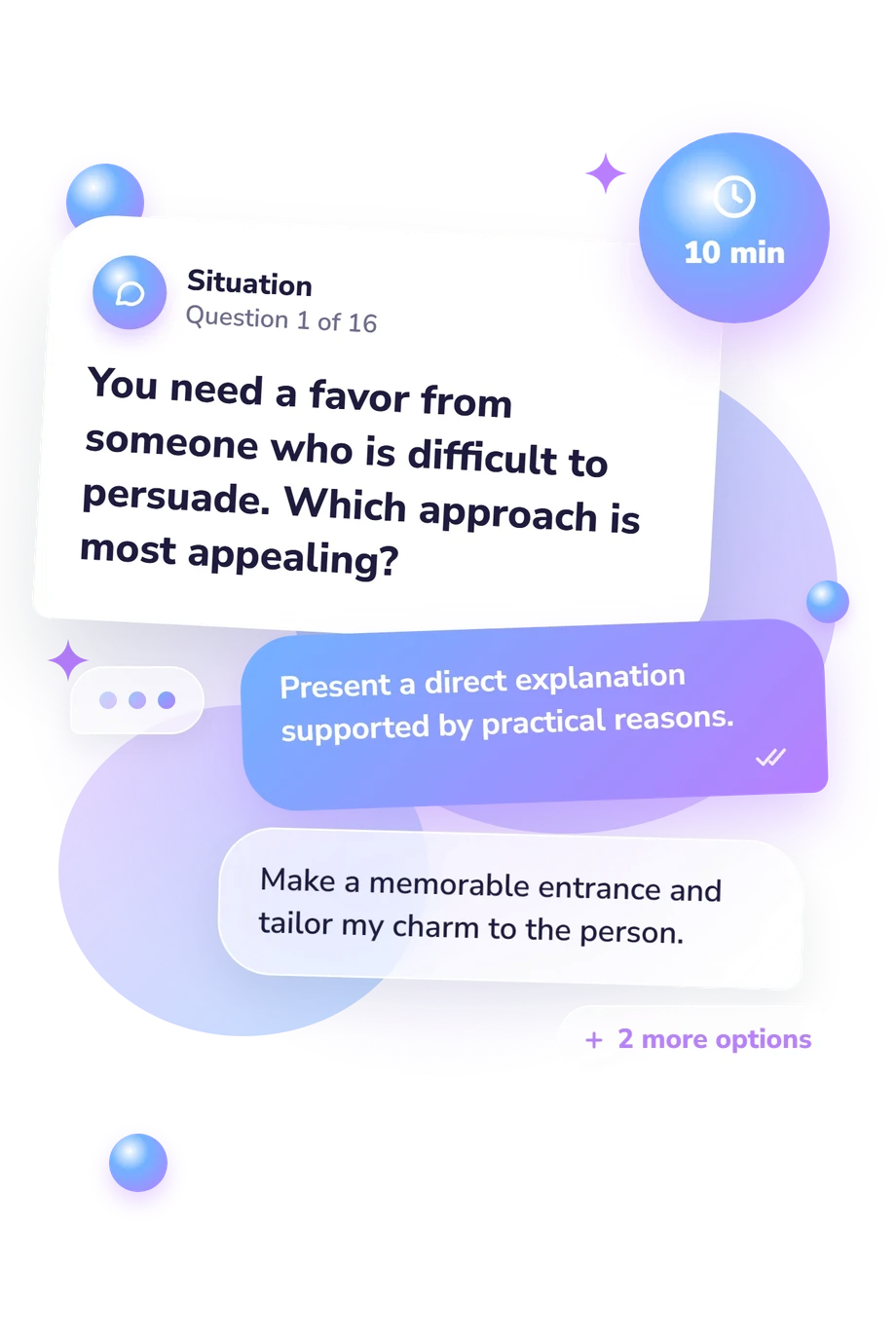
- Present a direct explanation supported by practical reasons.
- Make a memorable entrance and tailor my charm to the person.
- Ask a mutual friend to introduce the request.
- Find the person’s main motivation and negotiate around it.
- Challenge the remark clearly, even if it disrupts the occasion.
- Support my friend privately after the event.
- Deflect with a clever comment and move the conversation along.
- Stay composed and avoid giving the remark more attention.
- Let my actions challenge the assumption over time.
- Try to charm them into seeing a different side of me.
- Brush it off outwardly, even if it makes me more guarded.
- Ask directly what gave them that impression.
Which Shrek Character Are You Quiz - Description and methodology of the test
Friendship, pressure, risk, privacy, and self-expression give fans useful situations to consider in the Which Shrek Character Are You Quiz. It suits readers who want to examine personal reactions without reducing them to a fixed label. The shrek character quiz turns those reactions into a comparative result.
What This Assessment Measures
This assessment compares four fictional character affinities rather than assigning identity. To show what Shrek character you are, this quiz uses the highest affinity as the closest match; scores within one point blend. Its scenarios cover friendship, conflict, pressure, travel, changing plans, and self-expression. The dimensions are:
- Donkey Affinity (0-12) measures talkative warmth, optimism, persistence, and turning companionship into family: Quieter Connection (0-4), Friendly Spark (5-8), Strong Donkey Affinity (9-12).
- Fiona Affinity (0-12) measures adaptability, courage, self-acceptance, and willingness to challenge prescribed roles: Different Path (0-4), Fearless Streak (5-8), Strong Fiona Affinity (9-12).
- Puss in Boots Affinity (0-12) measures theatrical confidence, charm, adventure, and strategic risk: Understated Style (0-4), Adventurous Flair (5-8), Strong Puss Affinity (9-12).
- Shrek Affinity (0-12) measures independence, blunt authenticity, guarded emotions, and fierce loyalty: Open-Road Contrast (0-4), Ogre Echoes (5-8), Strong Shrek Affinity (9-12).
Methodology and Evidence Base
Each item describes an everyday situation and offers four contrasting responses. The scenarios ask about persuasion, conflict, loyalty, risk, social tension, changing plans, privacy, and self-expression. Choosing the option closest to your likely behavior makes this a scenario-based self-report exercise.
Scoring compares the four affinity scores. The questionnaire does not state how many points each response contributes, and its displayed bands are descriptive character-affinity bands. The leading score marks the closest style, while near-ties indicate overlap.
Rarity et al. (2022) connect character identification in parasocial relationships with perceived personality similarity. Cohen (2001) offers a framework for identification between audiences and media characters. The questionnaire is conceptually consistent with these ideas, while Shrek (2001) supplies the fictional portrayals; it is not an adaptation of either published measure. In this shrek personality quiz, the scenario format supports comparative self-report, while the questionnaire is not presented as a standardized instrument.
Responses can shift with mood, self-perception, and current feelings about the characters, making the result a context-dependent snapshot.
- Rarity, Erica C., Matthew R. Leitao, and Abraham M. Rutchick. (2022). Identification With Characters in Parasocial Relationships Predicts Sharing Their Personality Traits. Psychology of Popular Media, 11(2), 111-116. 10.1037/ppm0000389
- Adamson, Andrew, and Vicky Jenson, directors. (2001). Shrek [Film]. DreamWorks Pictures.
- Cohen, Jonathan. (2001). Defining Identification: A Theoretical Look at the Identification of Audiences With Media Characters. Mass Communication and Society, 4(3), 245-264. 10.1207/S15327825MCS0403_01
Updated: