
Which One Direction Member Are You Quiz
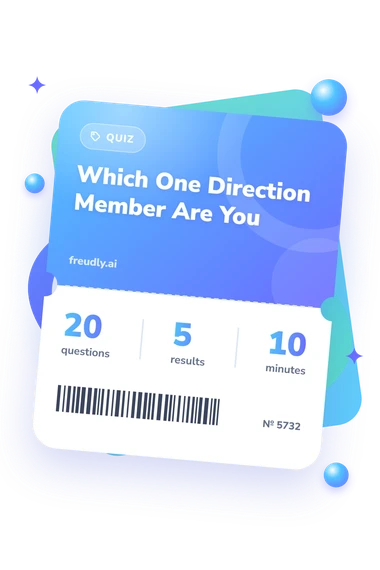
How the Scales are Structured
Who Usually Takes This Test?
See How You Compare
Below is a preview of how scores are typically distributed across each scale.
Example Questions From the Test
- Low-pressure, friendly, and full of shared laughs
- Small, thoughtful, and centered on one meaningful conversation
- Comfortable and informal, with a little time to recharge
- Well planned, with an activity that keeps everyone engaged
- Through practical reliability more than visible emotion
- With occasional heartfelt words when the moment feels right
- Openly, through affection, praise, and an inviting presence
- By making time for calm, focused conversation
- Feel disappointed and take time alone before making another plan
- Keep one part of the original plan and adjust the rest
- Call some friends and turn the change into a casual new adventure
- Look for a reliable alternative so the day still has direction
Which One Direction Member Are You Quiz - Description and methodology of the test
Fans curious about how their style compares with the band’s five public personas can use the Which One Direction Member Are You Quiz as a light, structured reflection. It suits people who enjoy a One Direction member quiz and want to consider friendship, creativity, social energy, independence, and self-presentation. The result offers a playful comparison rather than a fixed identity claim.
What This Assessment Explores
Everyday situations reveal patterns in preparation, friendship, visibility, creativity, and social recovery. A One Direction personality quiz of this kind suits people seeking a playful comparison, not a fixed identity. It shows which affinity is strongest and whether your result blends nearby profiles.
- Harry Styles Affinity (0-12) measures expressive individuality: Quiet Contrast (0-4), Selective Spark (5-8), and Expressive Original (9-12).
- Liam Payne Affinity (0-12) measures steady team support: Flexible Contrast (0-4), Situational Anchor (5-8), and Steady Teammate (9-12).
- Louis Tomlinson Affinity (0-12) measures playful loyalty and group influence: Reserved Contrast (0-4), Playful Ally (5-8), and Spirited Ringleader (9-12).
- Niall Horan Affinity (0-12) measures relaxed warmth and sociability: Focused Contrast (0-4), Easygoing Enthusiast (5-8), and Welcoming Optimist (9-12).
- Zayn Malik Affinity (0-12) measures private creativity and self-direction: Outward Contrast (0-4), Selective Individualist (5-8), and Independent Artist (9-12).
Methodology and Scientific Basis
Each item presents an everyday situation with four response options; the respondent selects the approach that feels most characteristic. Topics cover preparation, social atmosphere, conflict, affection, visibility, creative risk, and group influence, making the format a self-report of perceived tendencies.
As a celebrity personality quiz, it compares five affinity scores rather than assigning a winner in advance. The highest score marks the strongest match, while scores within one point indicate a blended profile.
The closest conceptual anchor is Self-congruity effect (Greenberg et al., 2021), which links cultural preferences with self-perception; this questionnaire is conceptually consistent with that work, not an adaptation of it. Bui (2017) adds context on similarity, identification, and parasocial interaction in celebrity choices, while Stever (2008) examines entertainment and leadership motives.
Interpret the outcome as a reflection on recognizable tendencies. The questionnaire has no stated population norms or clinical thresholds, and answers may shift with mood, fandom, social context, self-awareness, and changing public images; the profile cannot represent the whole person or predict behavior beyond these situations.
- Greenberg, David M., Sandra C. Matz, H. Andrew Schwartz, and Kai R. Fricke. (2021). The self-congruity effect of music. Journal of Personality and Social Psychology, 121(1), 137-150. DOI 10.1037/pspp0000293
- Bui, Ngoc H. (2017). Exploring Similarity Characteristics, Identification, and Parasocial Interactions in Choice of Celebrities. Psychology of Popular Media Culture, 6(1), 21-31. DOI 10.1037/ppm0000082
- Stever, Gayle S. (2008). The Celebrity Appeal Questionnaire: Sex, Entertainment, or Leadership. Psychological Reports, 103(1), 113-120. DOI 10.2466/pr0.103.1.113-120