
Which Buffy Character Are You Quiz
How the Scales are Structured
Who Usually Takes This Test?
See How You Compare
Below is a preview of how scores are typically distributed across each scale.
Example Questions From the Test
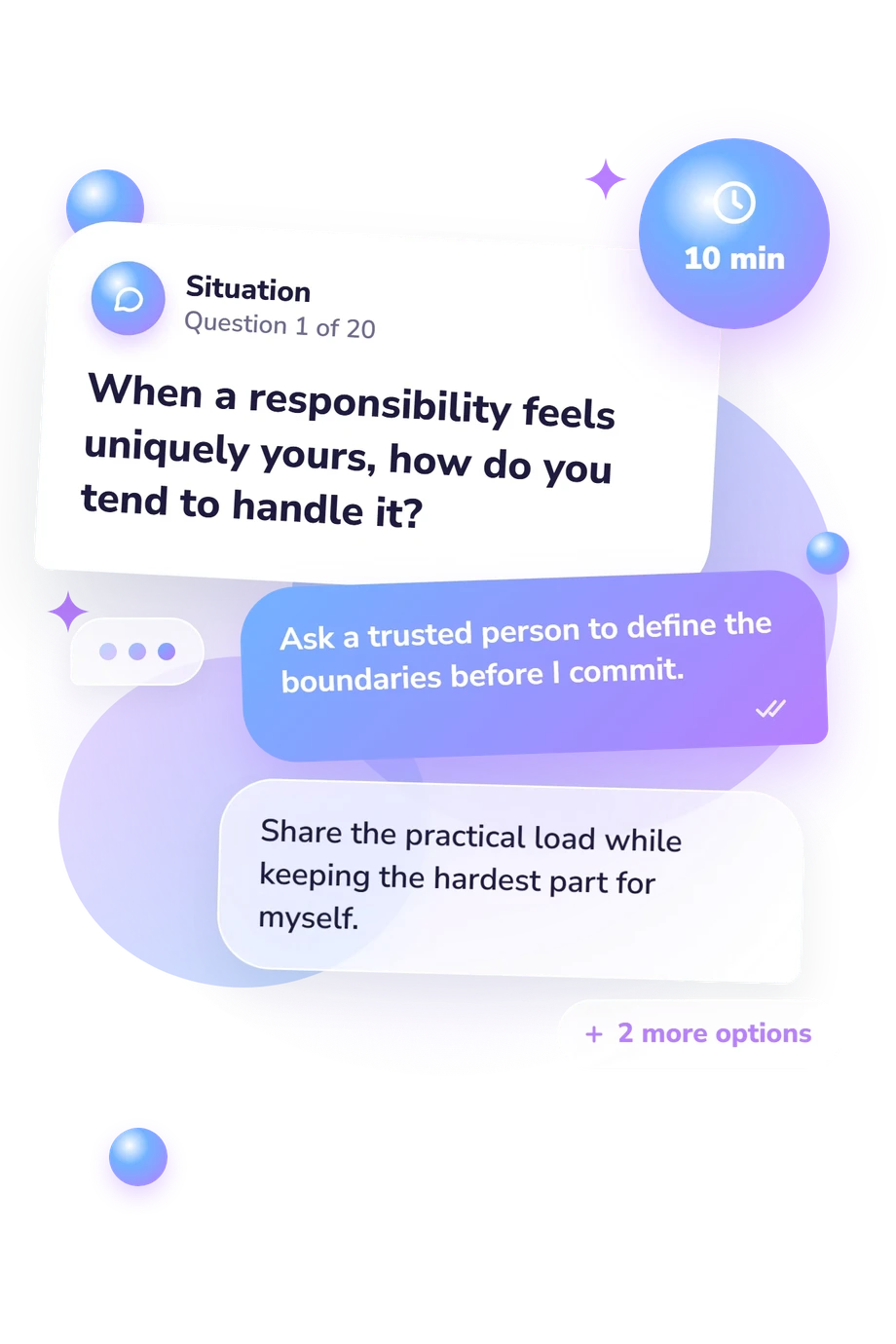
- Ask a trusted person to define the boundaries before I commit.
- Share the practical load while keeping the hardest part for myself.
- Take it on directly, even if I need to process the emotional cost later.
- Build a group plan so responsibility is distributed as evenly as possible.
- Follow the direction unless it creates a concrete problem.
- Ask for the reasoning before deciding whether to cooperate.
- Comply publicly but preserve my own interpretation of the rule.
- Challenge the assumption that rank alone deserves my loyalty.
- Make a joke that releases pressure, then return to the problem.
- Ask everyone to pause and state their concerns one at a time.
- Push for a decision so the tension does not stall the group.
- Let the mood run its course without trying to change it.
Which Buffy Character Are You Quiz - Description and methodology of the test
Fans of the series who want a playful way to reflect on their own habits can use the Which Buffy Character Are You Quiz to compare personal choices with familiar character styles. The Buffy character quiz turns choices about loyalty and group roles into character affinities, making everyday decisions a way to notice which fictional approaches feel familiar. It suits readers who enjoy character-based self-reflection and imaginative comparisons.
What This Assessment Explores
Items sample responsibility, authority, loyalty, setbacks, friendship, investigation, crises, learning, and change. Four options turn these situations into thematic affinities, not judgments.
This Buffy personality quiz names bands showing how strongly each affinity fits:
- Buffy Summers (0-12): Different Calling (0-4) favors support; Slayer Streak (5-8) shares independence; Chosen Energy (9-12) emphasizes courage and responsibility.
- Rupert Giles (0-12): Improvising Spirit (0-4) favors intuition; Watcher Wisdom (5-8) values perspective; Library Authority (9-12) emphasizes preparation and mentorship.
- Spike (0-12): Measured Presence (0-4) favors restraint; Rebel Current (5-8) shows directness; Big Bad Energy (9-12) emphasizes defiance and reinvention.
- Willow Rosenberg (0-12): Practical Pathfinder (0-4) keeps curiosity practical; Research Spark (5-8) values sensitivity and mastery; Willow-Level Wonder (9-12) emphasizes patterns and transformation.
- Xander Harris (0-12): Independent Contributor (0-4) favors distance or planning; Scooby Heart (5-8) shows loyalty; Zeppo Strength (9-12) emphasizes humor and support.
Methodology and Evidence Base
Self-report choices replace open-ended answers. The four response options present contrasting reactions to responsibility, authority, relationships, crises, learning, and change. The scoring compares responses across five profiles, but the displayed format does not state how many points any option adds. The highest score is the strongest character match; scores within one point form a blended result. This describes style, not bravery, intelligence, age, education, popularity, or approval of a character’s actions.
This Buffy character personality test uses a thematic five-profile format with relative affinity scores. Cohen’s identification framework helps contextualize why viewers may connect with a character’s perspective and goals. Jarvis and Burr (2012) examine reflective engagement with television characters in Buffy-related research, while Sestir and Green (2010) link identification and transportation with temporary self-concept shifts. Together, these sources offer conceptual context for character identification and reflective engagement, not validation of this questionnaire or its scoring.
Because the scores are relative, compare the leading profile and any one-point blend with your responses rather than treating them as fixed traits. Mood, self-image, familiarity with Buffy, and answer desirability can influence self-report.
- Jarvis, C., & Burr, V. (2012). The transformative potential of popular television: The case of Buffy the Vampire Slayer. Journal of Transformative Education, 9(3), 165-182. 10.1177/1541344612436814
- Cohen, J. (2001). Defining identification: A theoretical look at the identification of audiences with media characters. Mass Communication & Society, 4(3), 245-264. 10.1207/S15327825MCS0403_01
- Sestir, M., & Green, M. C. (2010). You are who you watch: Identification and transportation effects on temporary self-concept. Social Influence, 5(4), 272-288. 10.1080/15534510.2010.490672
Updated: