
Where Should I Shop for Clothes Quiz
How the Scales are Structured
Who Usually Takes This Test?
See How You Compare
Below is a preview of how scores are typically distributed across each scale.
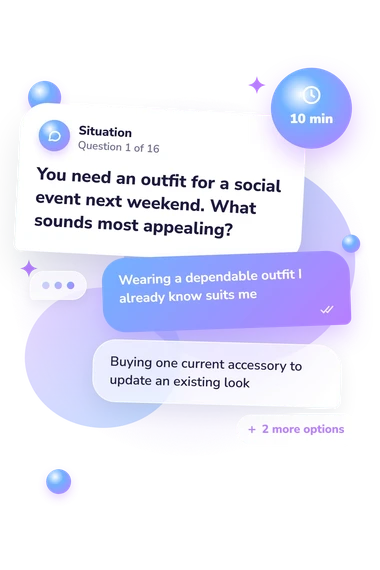
Example Questions From the Test
- Wearing a dependable outfit I already know suits me
- Buying one current accessory to update an existing look
- Trying a complete look inspired by what is popular now
- Creating an unusual combination without checking current trends
- It would probably decide which shirt I buy
- It would be one important factor alongside fabric and versatility
- I would use it as a tie-breaker after color and style
- I would focus mainly on the shirt’s immediate look and fit
- A focused edit of the season’s newest colors and silhouettes
- Familiar shapes with one visibly current detail
- Distinctive pieces that stand out whether or not they are current
- Reliable staples similar to items I already wear often
Where Should I Shop for Clothes Quiz - Description and methodology of the test
For shoppers seeking more deliberate clothing choices, the Where Should I Shop for Clothes Quiz turns everyday preferences into a practical retail profile. It suits people weighing novelty against longevity, or convenience against sourcing and resale when deciding where to shop for clothes. The result shows which store types fit your habits and where your preferences overlap, helping you decide where to shop.
What This Assessment Explores
The questionnaire examines basics, trends, construction, value, resale, and repair. It suits shoppers seeking a retail profile rather than a fixed fashion identity. The result helps answer which stores you should shop at by showing overlapping affinities.
Four dimensions are:
- Sustainable & Secondhand Shops (0-12) measures fit with resale, vintage, repair, sourcing, and lower-impact brands; New-Retail Preferrer 0-4, Conscious Combiner 5-8, and Circular Fashion Seeker 9-12.
- Timeless Quality Stores (0-12) measures preference for durable construction, consistent fit, classic lines, and long wear; Variety First 0-4, Considered Staple Buyer 5-8, and Long-Wear Curator 9-12.
- Trend-Led Retailers (0-12) measures attraction to novelty and current silhouettes; Selective Observer 0-4, Curated Trend Mixer 5-8, and New-Season Explorer 9-12.
- Value & Convenience Retailers (0-12) measures price, speed, choice, stock access, and returns; Experience-Led Shopper 0-4, Practical Deal Balancer 5-8, and Efficient Value Hunter 9-12.
Methodology and Scientific Basis
Each item presents a clothing-shopping situation with four response options. Choices contrast novelty, fit, craftsmanship, sustainability, price, speed, and discovery. Responses are organized across four dimensions, producing separate affinity scores, not a total; any result within one point of the highest forms part of a blended profile.
Conceptually, Carpenter and Moore (2010) address apparel retail choice and product attributes, while Sproles and Kendall examine consumer decision-making styles. Guiot and Roux provide a comparison point for second-hand motivations; Park and Lee discuss clothing reuse, repair, sourcing, and lower-impact choices. These sources do not validate the online scores, and the questionnaire is not an adaptation of their instruments. As a clothing shopping quiz, its original scenarios ask how shoppers weigh trend, durability, discovery, price, convenience, and sourcing.
It is a structured self-report rather than a standardized clinical measure; the cited instruments do not establish norms, reliability, or diagnostic interpretation for this questionnaire, so its four affinity scores describe shopping preferences. Response bias, self-awareness, current budget, wardrobe needs, mood, and recent shopping experiences can shift the profile; compare it with actual buying behavior.
- Carpenter, Jason M., and Marguerite Moore. "Product Attributes and Retail Format Choice among U.S. Apparel Purchasers." Journal of Textile and Apparel, Technology and Management 6, no. 4 (2010): 1-12.
- Sproles, George B., and Elizabeth L. Kendall. "A Methodology for Profiling Consumers’ Decision-Making Styles." Journal of Consumer Affairs 20, no. 2 (1986): 267-279. 10.1111/j.1745-6606.1986.tb00382.x
- Guiot, Denis, and Dominique Roux. "A Second-Hand Shoppers’ Motivation Scale: Antecedents, Consequences, and Implications for Retailers." Journal of Retailing 86, no. 4 (2010): 355-371. 10.1016/j.jretai.2010.08.002
- Park, Sunyang, and Yuri Lee. "Scale Development of Sustainable Consumption of Clothing Products." Sustainability 13, no. 1 (2021): 115. 10.3390/su13010115
Updated: