
When Will I Have a Baby Quiz
How the Scales are Structured
Who Usually Takes This Test?
See How You Compare
Below is a preview of how scores are typically distributed across each scale.
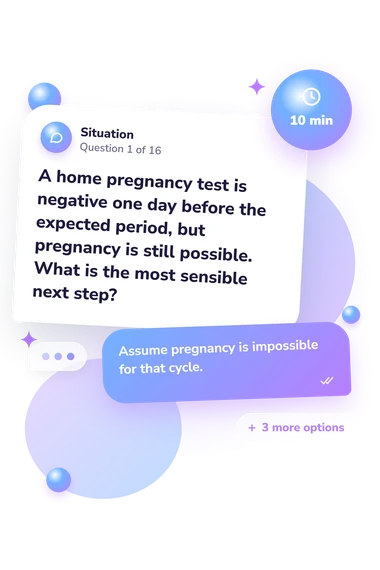
Example Questions From the Test
- Assume pregnancy is impossible for that cycle.
- Take several tests immediately and average their results.
- Repeat the pregnancy test after the expected period, following its instructions, because hCG may still be too low.
- Use an ovulation test instead because it measures the same hormone.
- It is an estimate based on the information and assumptions used by the app, not proof of ovulation.
- It confirms that an egg will be released on May 12.
- It guarantees that intercourse on any other date cannot result in pregnancy.
- It replaces medical evaluation when periods are absent or persistently irregular.
- Ovulation cannot return until exactly six months after the final pill.
- Pregnancy is impossible until three natural periods have occurred.
- Fertility can return quickly, although the timing of cycle regularity varies from person to person.
- The pill permanently postpones the age-related decline in fertility.
When Will I Have a Baby Quiz - Description and methodology of the test
People who want a clearer, evidence-aware way to think about conception timing may find the When Will I Have a Baby Quiz useful, especially when an app, a late period, or a negative test has created uncertainty. For anyone asking when they will have kids, the result identifies knowledge strengths and gaps that can make future decisions and healthcare conversations more informed.
What This Assessment Explores
This questionnaire measures fertility knowledge rather than personal fertility or a guaranteed birth date. It covers ovulation estimates, fertile windows, testing, cycle variation, age, pregnancy dating, partner factors, breastfeeding, preconception planning, and urgent warning signs.
Those wondering when they will have their first baby can use the profile to identify topics needing review. The result draws on four thematic areas:
- Cycle and ovulation timing shows whether estimates are understood as estimates rather than proof.
- Testing and pregnancy dating indicates how hCG timing and due-date conventions are understood.
- Fertility factors and probability reflects how age, health, both partners, and chance shape expectations.
- Preparation and safety knowledge shows recognition of preconception steps and urgent warning signs.
Baby Timing Knowledge: 0-16 is the displayed scale: Foundations to Build (0-6), Developing Understanding (7-12), and Strong Knowledge (13-16). The bands are educational summaries, not validated medical cutoffs.
Methodology and Scientific Basis
Each item presents a fertility or pregnancy-timing situation with four answer choices. Responses are summarized as a single knowledge score; the questionnaire does not convert it into a conception month, age, or due date.
Its approach is conceptually consistent with the Cardiff Fertility Knowledge Scale (Bunting et al., 2013), but this online questionnaire is not that published scale or a validated adaptation. Maeda et al. (2015) likewise demonstrates structured fertility-knowledge assessment without validating this questionnaire.
Setton et al. (2016) supports caution about website and app predictions of the fertile window, while ACOG guidance supports the preconception focus on folic acid, medicines, and relevant health needs. People asking what age they will get pregnant should read the result as education about timing concepts, not a forecast.
No population norms or clinical validation are established for this questionnaire, so guessing, current circumstances, and self-report can affect the score. The question of when they are going to have a baby remains dependent on factors the quiz cannot calculate.
- Laura Bunting, Ivan Tsibulsky, and Jacky Boivin. Fertility knowledge and beliefs about fertility treatment: findings from the International Fertility Decision-making Study. Human Reproduction, 28(2), 385-397, 2013. 10.1093/humrep/des402
- Eri Maeda, Hiroki Sugimori, Fumiaki Nakamura, Yasuki Kobayashi, Joseph Green, Machi Suka, Masako Okamoto, Jacky Boivin, and Hidekazu Saito. A cross sectional study on fertility knowledge in Japan, measured with the Japanese version of Cardiff Fertility Knowledge Scale (CFKS-J). Reproductive Health, 12, 10, 2015. 10.1186/1742-4755-12-10
- Robert Setton, Christina Tierney, and Tony Tsai. The Accuracy of Web Sites and Cellular Phone Applications in Predicting the Fertile Window. Obstetrics & Gynecology, 128(1), 58-63, 2016. 10.1097/AOG.0000000000001341
- American College of Obstetricians and Gynecologists. ACOG Committee Opinion No. 762: Prepregnancy Counseling. Obstetrics & Gynecology, 133(1), e78-e89, 2019. 10.1097/AOG.0000000000003013