
When Did You Lose Your Virginity Quiz
How the Scales are Structured
Who Usually Takes This Test?
See How You Compare
Below is a preview of how scores are typically distributed across each scale.
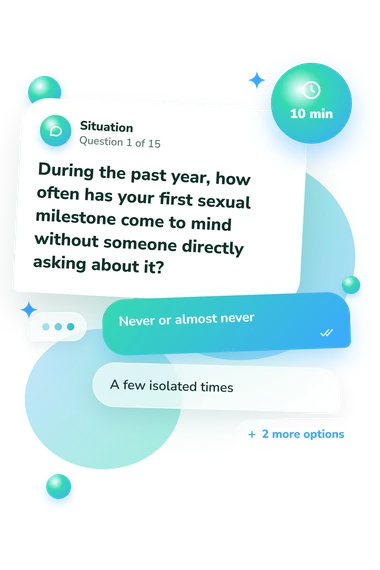
Example Questions From the Test
- Never or almost never
- A few isolated times
- Regularly, such as in certain situations or moods
- Often enough to feel like a recurring part of my inner life
- I assume they mean intercourse
- I clarify which physical act they mean
- I ask which experience the person regarded as a sexual milestone
- I avoid assuming there must be one shared definition or milestone
- I do not identify such an event, or I cannot place one
- I can identify only a broad life stage
- I know an approximate age or year
- I know a specific age, date, or narrow period
When Did You Lose Your Virginity Quiz - Description and methodology of the test
People reflecting on a first sexual milestone may want a clearer way to separate memory, personal meaning, and social expectations. The When Did You Lose Your Virginity Quiz gives that reflection a structured shape without treating one definition as universal. It is useful whether the experience feels settled, ambiguous, emotionally important, or difficult to place in time. It reflects on a past milestone, not a when will you lose your virginity quiz.
What This Assessment Explores
Items examine how you define a first sexual milestone, how much it matters now, and how clearly you place it in your story. They touch on physical acts, consent, relationship context, personal meaning, emotional response, boundaries, and memory cues. The profile suits experiences that feel clear, mixed, or hard to summarize.
The result groups these reflections into three dimensions:
- Personal Definition, 0-15, shows whether your view is Act-specific (0-5), Context-shaped (6-10), or Personally authored (11-15).
- Present-Day Meaning, 0-15, shows whether the experience is a Background detail (0-5), Meaningful chapter (6-10), or Active significance (11-15).
- Timeline Clarity, 0-15, shows whether timing is Open or undefined (0-5), Broadly placed (6-10), or Clearly placed (11-15).
These categories are reflective, not better-or-worse levels, and can explain why an age-based answer may not fit. They distinguish reflection from a what age will i lose my virginity quiz; no future age is scored here.
Methodology and Evidence Base
Each item offers four response options covering differing levels of definitional nuance, emotional significance, and timeline specificity. Some choices present alternative ways of defining or framing the milestone rather than a single relevance scale. The questionnaire does not state how individual responses are converted into points; its bands are reflective rather than norm-referenced or clinical.
Rather than serving as a when should you lose your virginity quiz, this assessment describes how a past, uncertain, or personally defined milestone is understood. It cannot answer what age you will lose your virginity, because its prompts ask about memory, meaning, and timeline clarity.
Conceptually, the questionnaire is consistent with Carpenter’s 2001 work on virginity loss as an ambiguous personal milestone; it is not presented as an adaptation. Horowitz and Bedford’s 2017 study addressed graded sexual definitions, while Erickson, Badiane, and Singer’s 2013 study addressed social context and meaning. These studies support the conceptual frame, not the online questionnaire’s standardization.
Self-report may vary with context, memory, self-awareness, and willingness to disclose. If the history includes pressure, force, exploitation, injury, or persistent distress, consider support.
- Carpenter, Laura M. (2001). The ambiguity of “having sex”: The subjective experience of virginity loss in the United States. The Journal of Sex Research, 38(2), 127-139. 10.1080/00224490109552080
- Horowitz, Ava D., and Edward Bedford. (2017). Graded Structure in Sexual Definitions: Categorizations of Having “Had Sex” and Virginity Loss Among Homosexual and Heterosexual Men and Women. Archives of Sexual Behavior, 46(6), 1653-1665. 10.1007/s10508-016-0905-1
- Erickson, Pamela I., Louise Badiane, and Merrill Singer. (2013). The Social Context and Meaning of Virginity Loss among African American and Puerto Rican Young Adults in Hartford. Medical Anthropology Quarterly, 27(3), 313-329. 10.1111/maq.12047