
What Turns You On Quiz
How the Scales are Structured
Who Usually Takes This Test?
See How You Compare
Below is a preview of how scores are typically distributed across each scale.
Example Questions From the Test
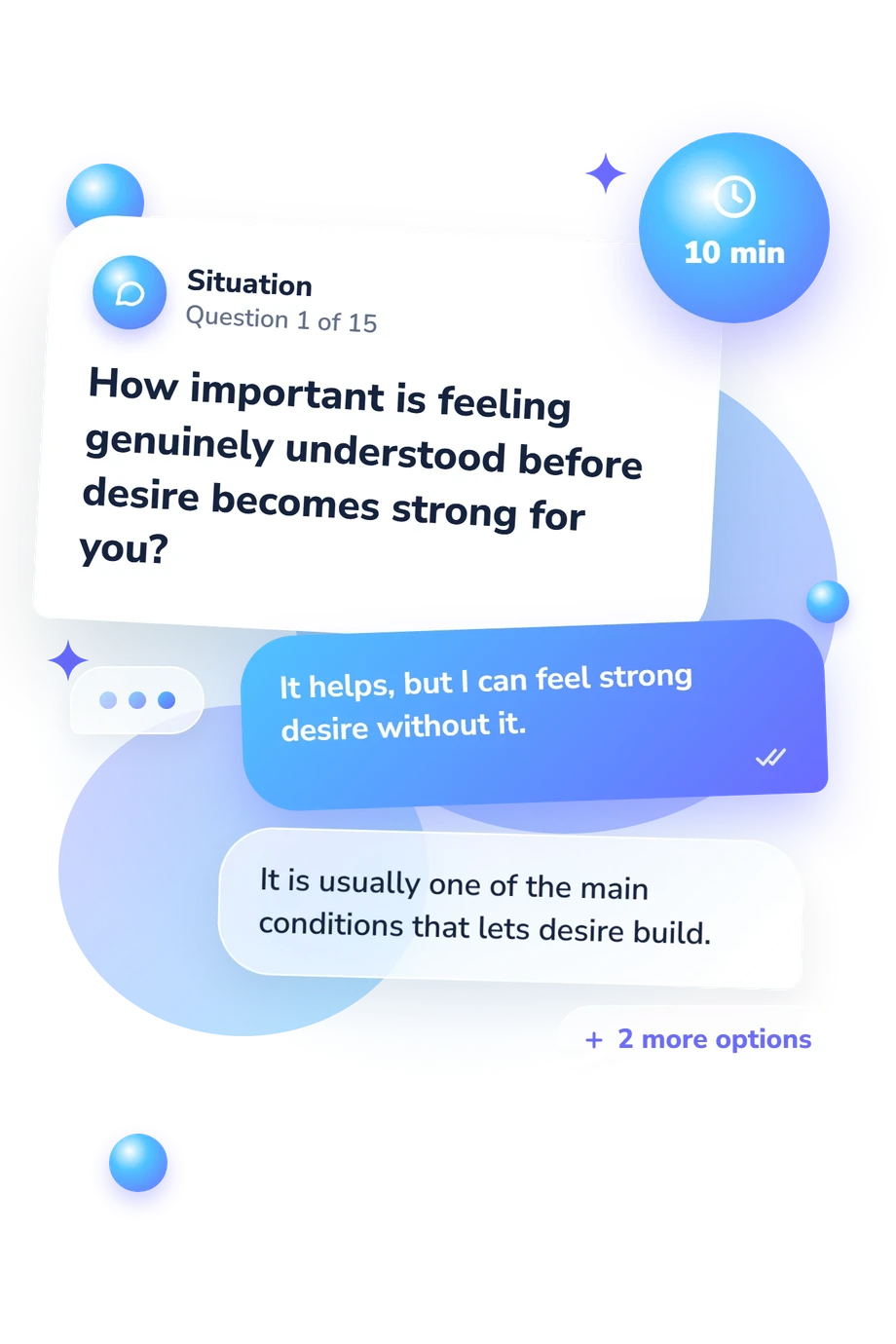
- It helps, but I can feel strong desire without it.
- It is usually one of the main conditions that lets desire build.
- It has little connection to desire for me.
- It often turns moderate interest into something much stronger.
- It feels kind, though not especially attractive.
- It creates a warm spark that can noticeably deepen attraction.
- Feeling seen in that way can be intensely attractive to me.
- I appreciate the gesture without connecting it to desire.
- To their expressions, styling, and physical chemistry.
- To the story of how they came to trust each other.
- To both the visible chemistry and what the scene might mean.
- To the interaction, with visual details playing a smaller role.
What Turns You On Quiz - Description and methodology of the test
People who want to understand what tends to activate their attraction can use the What Turns You On Quiz With Pictures as a guided self-reflection. It is suited to people exploring personal preferences across emotional, playful, and sensory situations rather than looking for a single label. Picture-based prompts make this a what's my type quiz with pictures, helping someone notice which emotional, playful, and sensory cues are most prominent in the profile.
What This Assessment Explores
The questionnaire examines three routes through which attraction may intensify: emotional connection, playful novelty, and visual or sensory chemistry. Scenarios involve openness, repair, teasing, change, appearance, voice, scent, touch, lighting, and atmosphere. The result compares these affinities rather than assigning a fixed identity.
These are the three dimensions shown in the result:
- Emotional Intimacy (0-15) indicates how strongly trust, openness, feeling understood, and affectionate connection fuel attraction.
- Playful Novelty (0-15) indicates how strongly surprise, variety, teasing, imagination, and mutually wanted experimentation contribute to attraction.
- Visual & Sensory Chemistry (0-15) indicates how strongly appearance, voice, scent, touch, lighting, and atmosphere contribute to attraction.
All three use the displayed bands Supporting Cue (0-5), Meaningful Spark (6-10), and Leading Spark (11-15). The highest score is the strongest affinity; scores within one point form a blend. The picture-based scenarios in this attraction quiz with pictures help respondents notice and compare the cues that make attraction more or less vivid.
Methodology and Scientific Basis
Each item presents an intimate situation with four response options. The options describe different reactions to each situation, and the respondent selects the one that best matches personal experience rather than a factual right answer. Situations cover closeness, novelty, sensory detail, and shared experimentation.
The result is displayed across three scales. The highest score is the strongest affinity, while scores within one point indicate a blend.
Conceptually, the structure is consistent with the Cues for Sexual Desire Scale (McCall & Meston, 2006), which examined cues associated with sexual desire. It also aligns with Meston and Buss (2007), who described sexual motivation as varied and context-dependent. These instruments provide conceptual context; the cited studies do not validate or standardise this online questionnaire itself.
Answers are most useful when read alongside current relationships, mood, expectations, and self-awareness. As a turn-on quiz, it may reflect memory, interpretation, or the wish to choose an appealing answer, so the profile is a snapshot of reported preferences. It describes possible influences on attraction, not consent, obligation, or a diagnosis.
- McCall, Katie, and Cindy Meston. "Cues Resulting in Desire for Sexual Activity in Women." The Journal of Sexual Medicine 3, no. 5 (2006): 838-852. 10.1111/j.1743-6109.2006.00301.x
- Meston, Cindy M., and David M. Buss. "Why Humans Have Sex." Archives of Sexual Behavior 36, no. 4 (2007): 477-507. 10.1007/s10508-007-9175-2
Updated: