
What Turns Me On Quiz
How the Scales are Structured
Who Usually Takes This Test?
See How You Compare
Below is a preview of how scores are typically distributed across each scale.
Example Questions From the Test
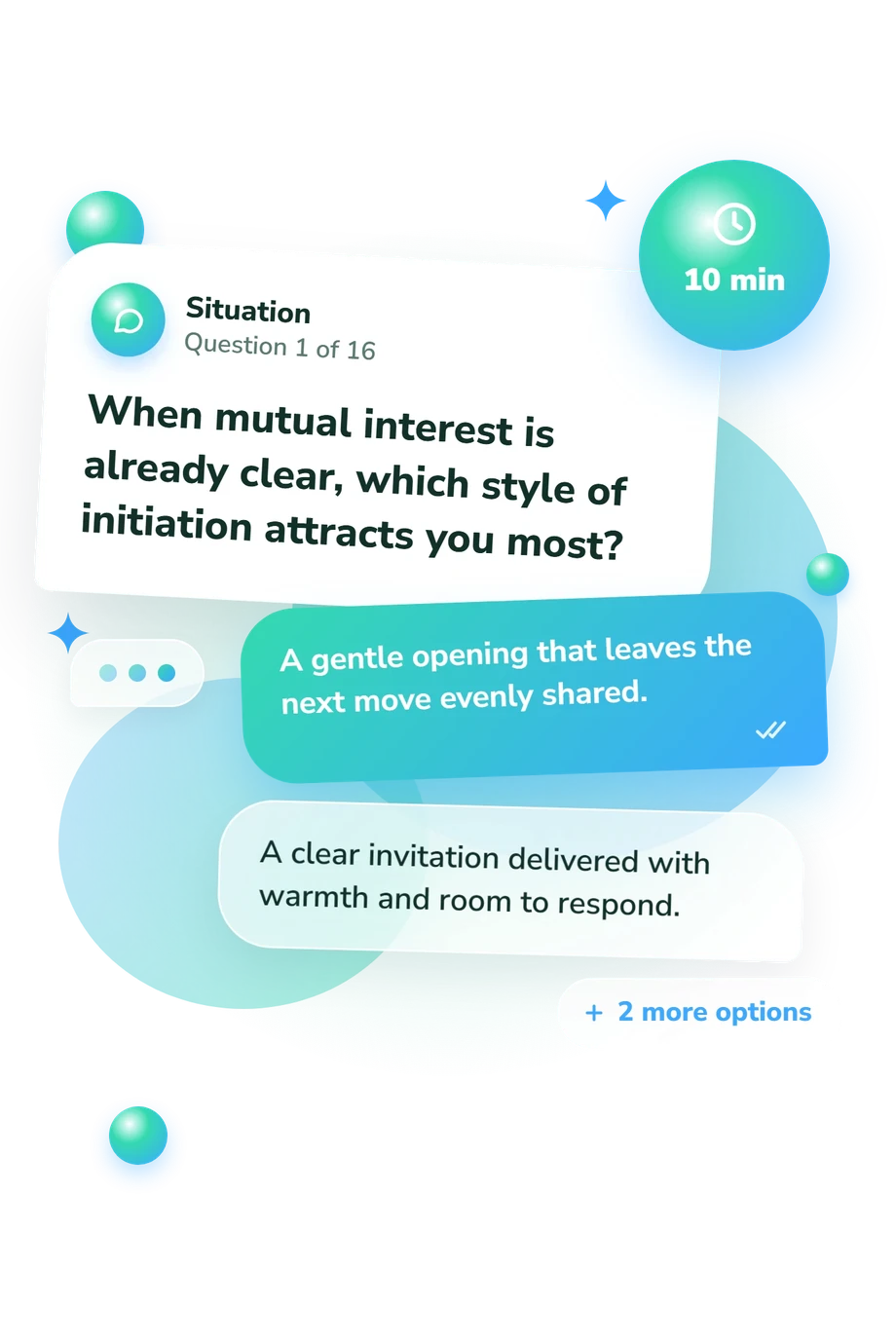
- A gentle opening that leaves the next move evenly shared.
- A clear invitation delivered with warmth and room to respond.
- A confident first move that establishes strong momentum.
- Bold, unmistakable initiative that makes me feel intensely wanted.
- There is easy warmth between us, without much emotional backstory.
- We reveal something vulnerable and feel completely accepted.
- The attraction is vivid and immediate, with little need for conversation.
- Tenderness and established trust make every gesture feel more charged.
- A short message confirming when and where we will meet.
- A reference to a meaningful moment we shared.
- A heartfelt message about what they value in our connection.
- A quick, teasing compliment that makes me smile.
What Turns Me On Quiz - Description and methodology of the test
People who want to understand attraction patterns can use the What Turns Me On Quiz as a guided self-reflection rather than a verdict about sexuality. Built around concrete situations, this quiz about what turns you on invites readers to consider how initiative, emotional safety, novelty, and sensory context shape interest. The result identifies a strongest affinity or close blend, giving language for preferences that may be easier to recognize.
What This Assessment Explores
Rather than reducing attraction to one trigger, this turn-on quiz samples situations involving initiation, desire, emotional tension, setting, anticipation, humor, imagined roles, and agreed novelty. Its four dimensions are:
- Confident Intensity (0-12) reflects bold initiative and negotiated lead-and-follow energy: Background element (0-4), Meaningful ingredient (5-8), or Leading turn-on (9-12).
- Emotional Connection (0-12) reflects trust, affection, and feeling understood: Background element (0-4), Meaningful ingredient (5-8), or Leading turn-on (9-12).
- Playful Exploration (0-12) reflects humor, surprise, imagination, and agreed novelty: Prefers Familiar (0-4), Enjoys Some Variety (5-8), or Leads With Play (9-12).
- Sensual Atmosphere (0-12) reflects lighting, sound, scent, texture, and unhurried anticipation: Background element (0-4), Meaningful ingredient (5-8), or Leading turn-on (9-12).
The highest score signals strongest affinity, while scores within one point suggest a blended result. These labels describe preference strength, not identity or a script for behavior; consent remains essential.
Methodology and Scientific Basis
Each item presents a situation and four response options, contrasting subtle or direct initiation, familiar or novel plans, and setting-led or person-led mood. The turn-me-on quiz format asks for the closest personal response, so answers are self-report indicators.
Responses are combined into four displayed dimensions, each scored from 0 to 12; the public questionnaire does not specify the point value assigned to each option. Interpretation compares the dimensions rather than treating one isolated answer as decisive.
Conceptually, the questionnaire is consistent with QTIP (Zebroff, 2021), which addresses preferences around initiation, and with McCall and Meston (2006), who examined cues linked with sexual desire. Graham, Sanders, and Milhausen (2006) offer a related excitation/inhibition framework. The questionnaire is an original self-reflection format, not an adaptation, standardized administration, or validation of those instruments.
Because the result depends on candid self-description, current relationship context, mood, interpretation of scenarios, and willingness to imagine unfamiliar situations can all influence it. It is best used as a conversation prompt or self-reflection profile; it cannot establish a clinical condition or replace broader assessment.
- Zebroff, Petra. "Questionnaire for Turn-on Initiation Preference: Development and Initial Reliability and Validation." The Journal of Sex Research 58, no. 8 (2021): 1019-1034. 10.1080/00224499.2021.1898525
- McCall, Katie, and Cindy Meston. "Cues resulting in desire for sexual activity in women." The Journal of Sexual Medicine 3, no. 5 (2006): 838-852. 10.1111/j.1743-6109.2006.00301.x
- Graham, Cynthia A., Stephanie A. Sanders, and Robin R. Milhausen. "The sexual excitation/sexual inhibition inventory for women: Psychometric properties." Archives of Sexual Behavior 35, no. 4 (2006): 397-409. 10.1007/s10508-006-9041-7
Updated: