
What Turning Red Character Am I Quiz
How the Scales are Structured
Who Usually Takes This Test?
See How You Compare
Below is a preview of how scores are typically distributed across each scale.
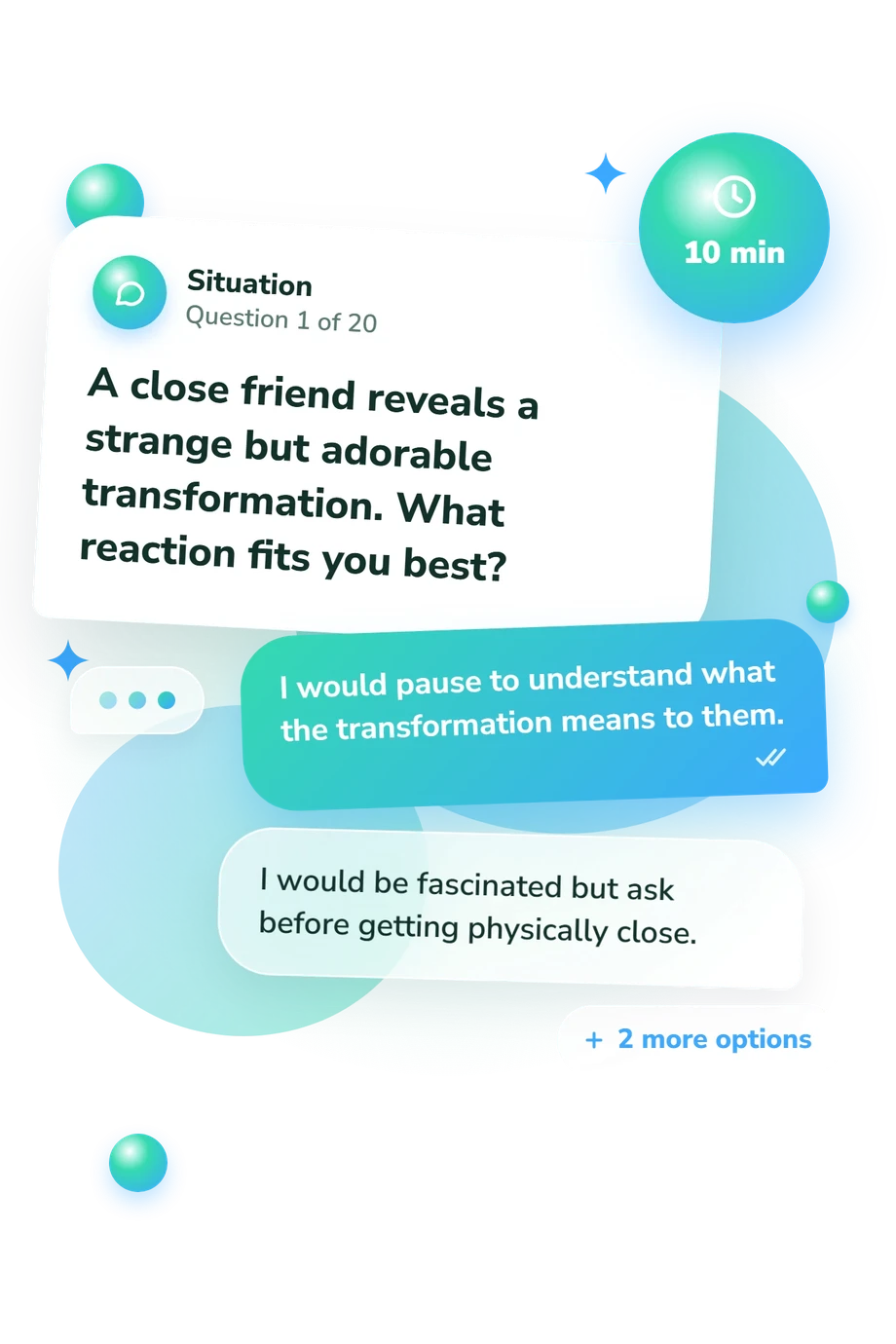
Example Questions From the Test
- I would pause to understand what the transformation means to them.
- I would be fascinated but ask before getting physically close.
- I would react with huge delight while still watching their comfort level.
- I would start imagining fun ways the group could include this new reality.
- A calm review of the plan’s weak points.
- A practical reminder of what each person needs to do.
- A warm statement about why the group matters to me.
- A loud, wholehearted burst of confidence that gets everyone moving.
- My energy rises too, and I process the situation out loud.
- I start assigning immediate tasks to create order.
- I remain visibly composed and take in more than I say.
- I seek one person to compare impressions with quietly.
What Turning Red Character Am I Quiz - Description and methodology of the test
Viewers who want to connect everyday reactions with the personalities in Pixar’s Turning Red can use the What Turning Red Character Am I Quiz as a playful character-affinity profile. This questionnaire functions as a Turning Red personality quiz, reflecting on loyalty, family expectations, emotional intensity, independence, and group energy. The result shows affinities across five fictional styles, allowing the profile to reflect multiple character resemblances.
What This Assessment Explores
This Turning Red character quiz covers feelings, expectations, loyalty, group energy, protection, and independence. Scores show resemblance, not worth.
The dimensions are:
- Abby Park Affinity (0-12) measures expressive loyalty: Measured Momentum (0-4), Bursts of Abby (5-8), Absolute Abby Energy (9-12).
- Mei Lee Affinity (0-12) measures ambition, adaptability, and self-definition: Different Rhythm (0-4), Shared Spark (5-8), Major Mei Energy (9-12).
- Ming Lee Affinity (0-12) measures protection, responsibility, and structure: Looser Reins (0-4), Caring Planner (5-8), Mighty Ming Energy (9-12).
- Miriam Mendelsohn Affinity (0-12) measures warm, accepting friendship and supportive presence: Independent Current (0-4), Loyal Groove (5-8), Maximum Miriam Energy (9-12).
- Priya Mangal Affinity (0-12) measures calm presence, wit, and understated expression: Open Flame (0-4), Quiet Wit (5-8), Peak Priya Energy (9-12).
Methodology and Evidence Base
Each item presents a social or emotional situation with four response options. Choices contrast observation, planning, openness, protection, and energetic participation. The result reports five separate affinity scores with the displayed ranges and bands; point assignment per answer is not specified.
As a Turning Red character test, this is a thematic self-report exercise. It is conceptually consistent with Huang and Fung’s (2024) validated scale for narrative-character identification, not an adaptation of it; that scale’s validation does not validate this online questionnaire. Cohen (2001) provides theoretical context, while Hoffner and Buchanan (2005) connect wishful identification with perceived similarity and character attributes. The fictional characters come from Turning Red (Shi and Cho, 2022).
These sources support comparison with fictional characters, but they do not standardize this questionnaire’s online totals. No norms, reliability estimates, or clinical validation are stated. Mood, recent experiences, self-awareness, and scenario interpretation can influence self-report, so the result works best as a structured reflection on style rather than a fixed personality description.
- Shi, Domee, and Julia Cho (writers). (2022). Turning Red [Film]. Walt Disney Pictures and Pixar Animation Studios.
- Huang, Kate Y., and Helene H. Fung. (2024). Measuring identification with narrative characters: the development and validation of a new scale. Current Psychology, 43, 24835-24849. 10.1007/s12144-024-06191-2
- Hoffner, Cynthia, and Martha Buchanan. (2005). Young Adults' Wishful Identification With Television Characters: The Role of Perceived Similarity and Character Attributes. Media Psychology, 7(4), 325-351. 10.1207/S1532785XMEP0704_2
- Cohen, Jonathan. (2001). Defining Identification: A Theoretical Look at the Identification of Audiences With Media Characters. Mass Communication and Society, 4(3), 245-264. 10.1207/S15327825MCS0403_01
Updated: