
What Kind of Couple Are We Quiz
How the Scales are Structured
Who Usually Takes This Test?
See How You Compare
Below is a preview of how scores are typically distributed across each scale.
Example Questions From the Test
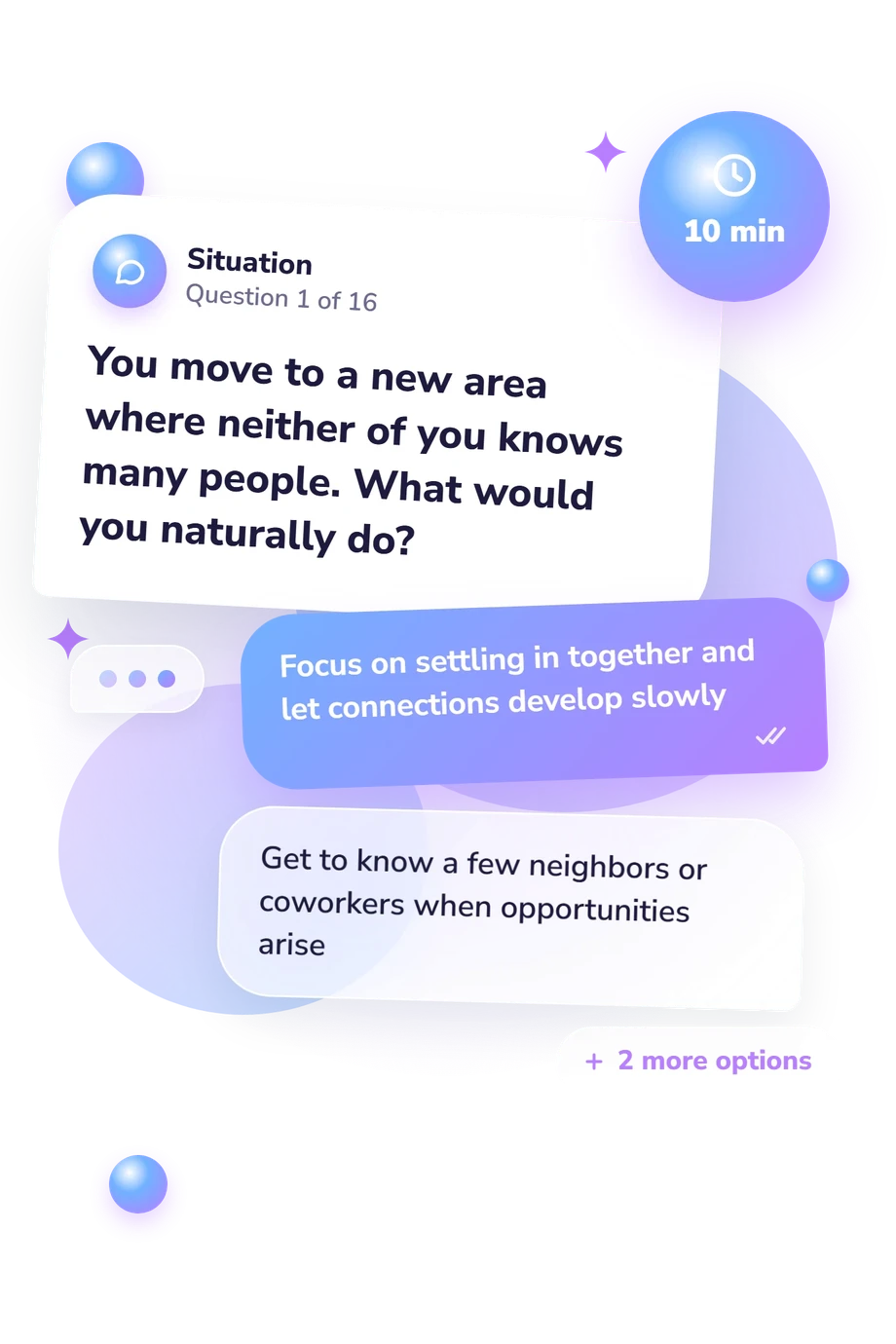
- Focus on settling in together and let connections develop slowly
- Get to know a few neighbors or coworkers when opportunities arise
- Join an activity where you can regularly meet people with shared interests
- Actively explore groups, events, and invitations until you build a network
- Offer reassurance without analyzing the habit unless more is requested
- Share an honest first impression and let the person decide what to do
- Explore what may be helping or blocking the change
- Explore the pattern together and agree on a practical way to support progress
- Most shared time is just for us, with social plans kept occasional
- We maintain a small circle and see people when schedules align
- Shared relationships regularly appear in our weekends and celebrations
- Hosting, gathering, and maintaining a broad shared network are central to us
What Kind of Couple Are We Quiz - Description and methodology of the test
Couples who want a clearer picture of how they spend time, handle change, and connect with others can use the What Kind of Couple Are We Quiz as a structured conversation starter. It is intended for partners reflecting on shared habits rather than seeking a clinical label. The result offers a practical way to think about the type of couple you are and identify patterns worth discussing.
What This Assessment Explores
Four themes organize the questionnaire: novelty, comfort, shared development, and social connection. The profile describes couple patterns for reflection, not a fixed identity or verdict about relationship quality. It helps partners discuss the couple we are in everyday terms.
The profile reports these dimensions:
- Adventure Partners (0-12) measures shared novelty: Familiarity First (0-4), Selective Explorers (5-8), or Adventure Partners (9-12).
- Cozy Companions (0-12) measures shared comfort: Cozy Is Optional (0-4), Balanced Nesters (5-8), or Cozy Companions (9-12).
- Growth Teammates (0-12) measures coordinated development: Independent Development (0-4), Occasional Collaborators (5-8), or Growth Teammates (9-12).
- Social Connectors (0-12) measures shared social involvement: Private-Pair Lean (0-4), Selective Connectors (5-8), or Social Connectors (9-12).
Methodology and Scientific Basis
Each item presents four descriptions of a shared situation, and the respondent selects the option that best matches the partnership. The answers are grouped across thematic scores; displayed bands summarize relative affinity, while close results may form a blended profile. The questionnaire does not establish a clinical cutoff or a points-per-answer rule beyond its own scoring presentation.
Conceptually, it is consistent with Reissman et al. (1993), which connects shared activities with satisfaction and distinguishes self-expansion from boredom. Aron and Elaine Aron's expansion-of-self framework explains why novel joint experiences may feel relationship-building. Harasymchuk et al. (2020) links exciting activities with relationship goals, while Czikmantori et al. (2018) supports examining differing social desires in couples. These sources support the themes, but do not make this online questionnaire a standardized adaptation of any one instrument.
Because it is self-report, the result can shift with recall, current circumstances, and self-awareness. For partners wondering what couple they are, the profile can start a conversation, but it remains a snapshot rather than a diagnosis or complete assessment.
- Reissman, Charlotte, Arthur Aron, and Merlynn R. Bergen. "Shared Activities and Marital Satisfaction: Causal Direction and Self-Expansion versus Boredom." Journal of Social and Personal Relationships, 10(2), 243-254, 1993. 10.1177/026540759301000205
- Aron, Arthur, and Elaine N. Aron. Love and the Expansion of Self: Understanding Attraction and Satisfaction. Hemisphere, 1986.
- Harasymchuk, Cheryl, Amy Muise, Chantal Bacev-Giles, Judith Gere, and Emily A. Impett. "Broadening Your Horizon One Day at a Time: Relationship Goals and Exciting Activities as Daily Antecedents of Relational Self-Expansion." Journal of Social and Personal Relationships, 37(6), 1910-1926, 2020. 10.1177/0265407520911202
- Czikmantori, Thomas, Birk Hagemeyer, and Stefan Engeser. "A Dyadic Typology of Social Desires in Couples." Journal of Personality, 86(4), 590-603, 2018. 10.1111/jopy.12338
Updated: