
What Fast Food Restaurant Am I Quiz
How the Scales are Structured
Who Usually Takes This Test?
See How You Compare
Below is a preview of how scores are typically distributed across each scale.
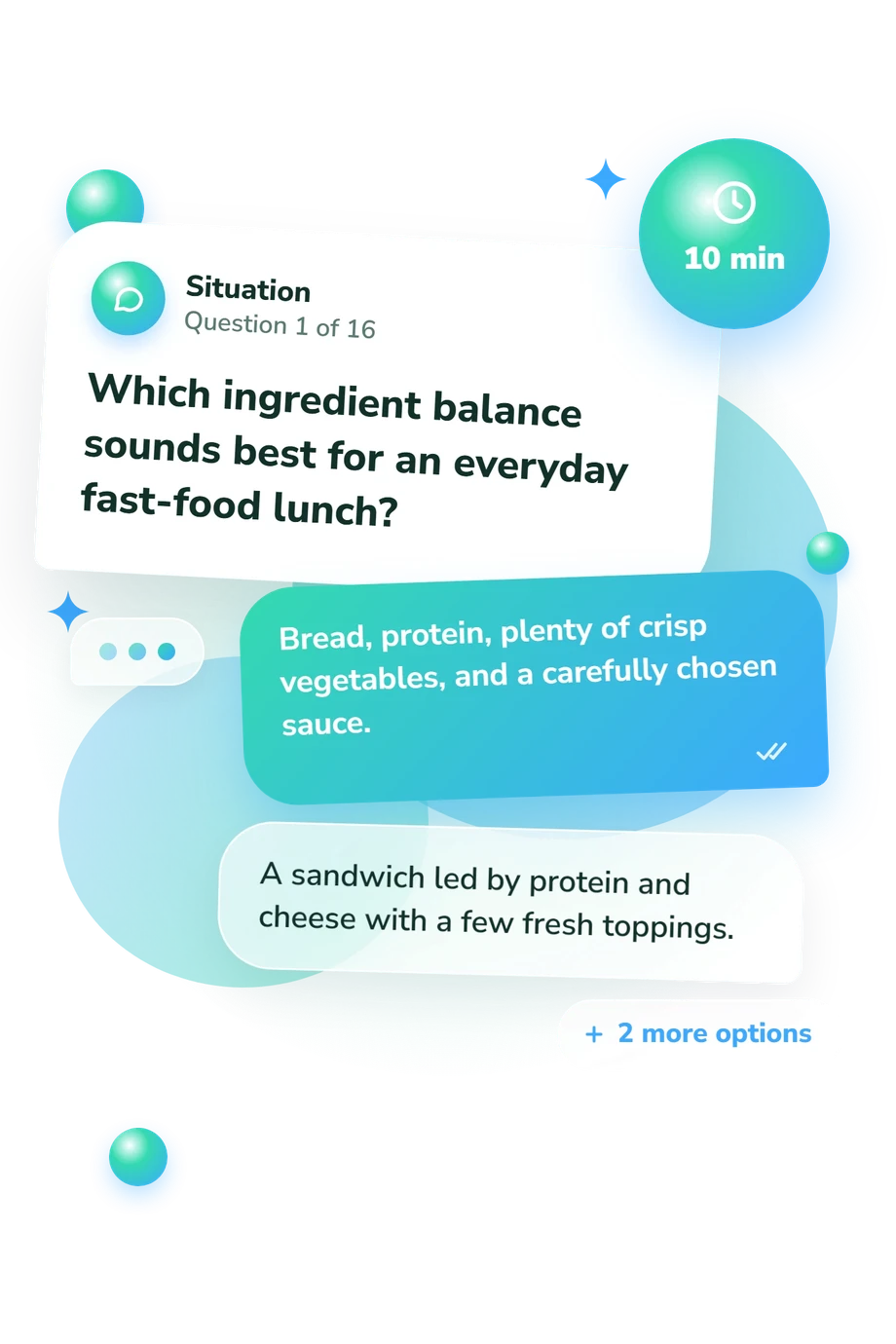
Example Questions From the Test
- Generous, comforting, and easy to share from boxes and buckets.
- Hearty individual meals with familiar sides.
- Light, tailored sandwiches that everyone assembles differently.
- Quick handheld items with bold sauces and playful combinations.
- Try it—the playful format is a big part of the appeal.
- Consider it after checking whether the flavors suit me.
- Stick to a basic taco or burrito instead.
- Choose another restaurant with a more traditional menu.
- Ideal—I like shaping each layer of the meal myself.
- Useful, although I tend to repeat a combination I already know.
- A little tedious; I would prefer only a couple of choices.
- Unappealing; I would rather order a finished signature item.
What Fast Food Restaurant Am I Quiz - Description and methodology of the test
Readers who want to connect everyday cravings with a recognizable restaurant style can use this assessment as a playful preference profile. The What Fast Food Restaurant Am I Quiz translates choices about comfort, consistency, customization, novelty, and shared meals into four menu affinities. It also works as a fast food personality quiz for anyone curious about ordering habits and the situations that shape a meal choice.
What This Assessment Explores
Rather than measuring nutrition or brand loyalty, it examines familiarity, customization, boldness, portability, comfort, and sharing. It offers a descriptive restaurant preference quiz result for readers curious about ordering style.
These four result types show:
- KFC Affinity (0-12) matches crispy chicken, hearty sides, buckets, and comfort occasions: Different Comfort (0-4), Occasional Bucket Mood (5-8), or Comfort-Feast Match (9-12).
- McDonald's Affinity (0-12) matches familiar classics, convenience, group appeal, and consistency: Different Flavor (0-4), Compatible (5-8), or Classic Match (9-12).
- Subway Affinity (0-12) matches ingredient control, crisp fillings, customization, and portability: Different Format (0-4), Casual Customizer (5-8), or Made-Your-Way Match (9-12).
- Taco Bell Affinity (0-12) matches bold flavors, playful combinations, customization, and late-hour food: Different Flavor (0-4), Borderline Bold (5-8), or Craveable Experimenter (9-12).
Methodology and Scientific Basis
Each item presents an everyday food decision with four response options. Together, the contrasts examine signature orders versus customization, consistency versus novelty, individual portability versus shared comfort, and familiar meals versus adventurous combinations. The format therefore samples preferences across situations instead of asking for one favorite brand.
Scoring produces four independent affinity scores. The highest score is the strongest match, while scores within one point form a blended result. The labels describe the profile shown here; they are not population norms or clinical cutoffs.
Baek et al. (2006) is the closest conceptual reference because it treats fast-food selection as a combination of practical, sensory, social, and situational criteria. This questionnaire is conceptually consistent with that work, not an adaptation of it. Steptoe et al. (1995) contributes a motive-based framework involving familiarity, convenience, sensory appeal, and context; it supports the thematic grouping, not the numerical scoring.
As a fast food restaurant personality test, this is a non-standardized self-report snapshot. Answers can shift with hunger, mood, recent experiences, and self-awareness, so the result reflects current preferences rather than a fixed personal trait.
- Baek, Seung-Hee, Sunny Ham, and Il-Sun Yang. (2006). A cross-cultural comparison of fast food restaurant selection criteria between Korean and Filipino college students. International Journal of Hospitality Management, 25(4), 683-698. 10.1016/j.ijhm.2005.07.001
- Steptoe, Andrew, Tessa M. Pollard, and Jane Wardle. (1995). Development of a measure of the motives underlying the selection of food: The Food Choice Questionnaire. Appetite, 25(3), 267-284. 10.1006/appe.1995.0061
Updated: