
What Do I Like Quiz
How the Scales are Structured
Who Usually Takes This Test?
See How You Compare
Below is a preview of how scores are typically distributed across each scale.
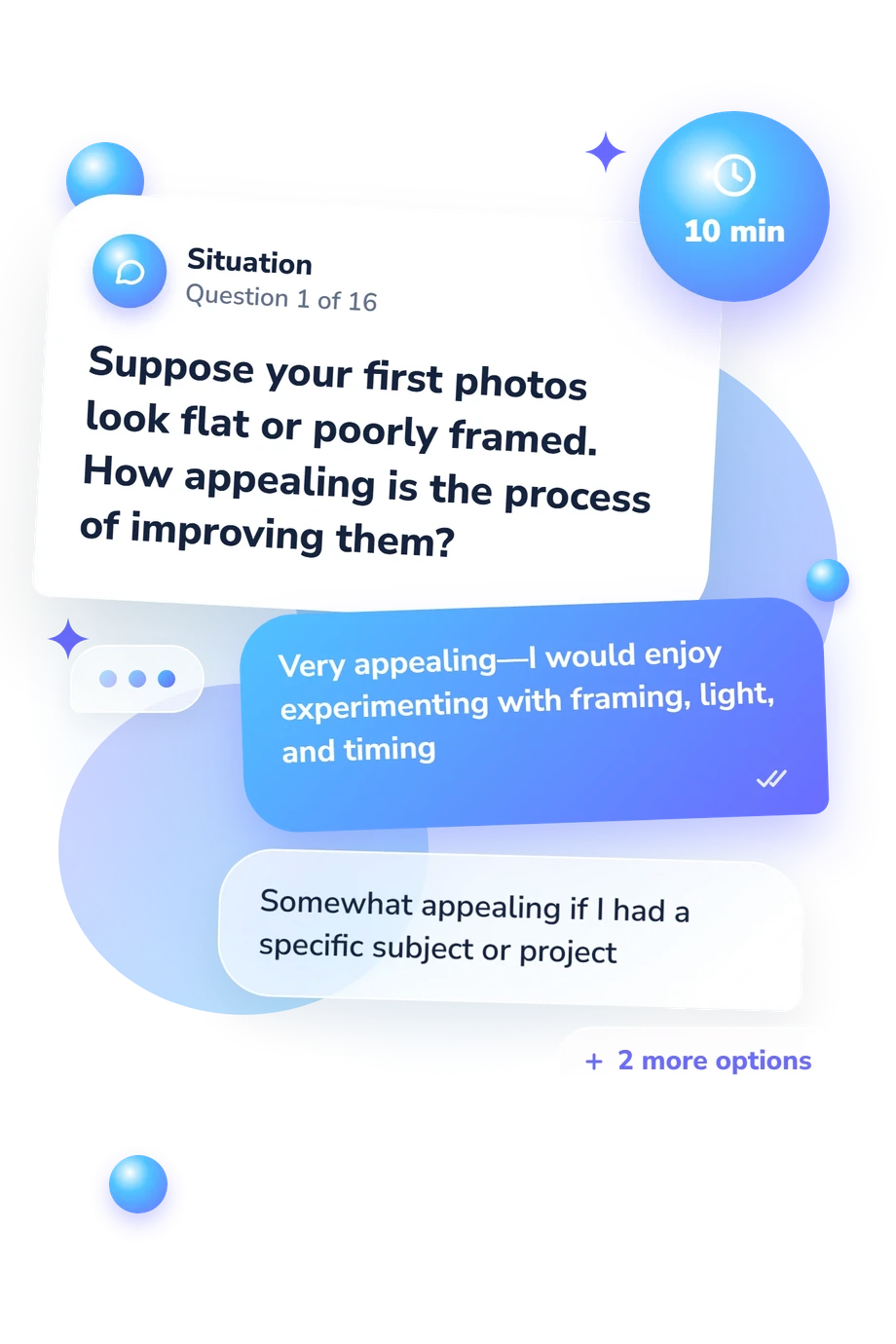
Example Questions From the Test
- A short list of favorite moments and recommendations
- A carefully selected photo series that tells the story
- A folder containing a few representative snapshots
- A practical item bought or made during the experience
- Find a comfortable spot and watch the activity around me
- Follow a route that helps me cover as much ground as possible
- Photograph details, light, and scenes that catch my eye
- Take a few pictures while mainly looking for shops or food
- Buy a dependable favorite that requires no preparation
- Bring an easy homemade dish I already know
- Make a new dish and enjoy presenting it to the group
- Help with serving or setup rather than preparing food
What Do I Like Quiz - Description and methodology of the test
People who feel unsure which leisure activities fit them can use this assessment to compare several everyday interests. Framed as a what do you like quiz, it gives readers direction without asking them to commit to one hobby. The What Do I Like Quiz turns those preferences into a profile of likely affinities, making it easier to notice promising activities and reflect on why they appeal.
What This Assessment Explores
The questionnaire compares attraction to four leisure activities through scenarios about effort, novelty, social play, movement, and visual attention. As a hobby preference quiz, it shows whether each interest feels central, approachable, occasional, or less appealing. The highest score marks the strongest affinity; scores within one point may form a blended result.
The four dimensions:
- Board Games (0-12) shows interest in rules, decisions, playful competition, and shared game time: Flexible socializer 0-4, Casual player 5-8, Tabletop strategist 9-12.
- Cooking (0-12) indicates whether food preparation feels practical, exploratory, or creatively satisfying: Convenience first 0-4, Recipe explorer 5-8, Kitchen creator 9-12.
- Hiking (0-12) captures the pull of movement, changing scenery, route progress, and outdoor conditions: Indoor pull 0-4, Trail curious 5-8, Outdoor explorer 9-12.
- Photography (0-12) describes interest in noticing, framing, improving, and preserving visual moments: Different focus 0-4, Curious observer 5-8, Visual storyteller 9-12.
Methodology and Scientific Basis
Each prompt describes an everyday situation and offers four response options, ranging from familiar, low-effort choices to more exploratory, skill-building, social, or immersive choices. The themes sort responses into four hobby scores, not one overall personality score.
The conceptual reference is the Tromsø Interest Questionnaire (Dahl & Nierenberg, 2021), which applies Hidi and Renninger’s Four-Phase Model of Interest Development. This questionnaire uses a lighter preference-mapping format; it is conceptually consistent with that framework, not a standardized adaptation of the published instrument.
Scoring is comparative: each result range receives a descriptive band, the highest score marks the strongest affinity, and scores within one point may form a blended profile. Used thoughtfully, the result can help you find hobbies you like by showing where your interests cluster rather than declaring a single permanent answer.
Self-report remains context-sensitive. Mood, recent experiences, confidence, and response bias can shape answers, a limitation discussed by Paulhus. The profile is therefore a snapshot of current preference, not a normed measure of ability, identity, or future enjoyment.
- Dahl, Tove I., and Ellen Nierenberg. “Here’s the TRIQ: The Tromsø Interest Questionnaire Based on the Four-Phase Model of Interest Development.” Frontiers in Education, vol. 6, 2021, article 716543. DOI 10.3389/feduc.2021.716543.
- Hidi, Suzanne, and K. Ann Renninger. “The Four-Phase Model of Interest Development.” Educational Psychologist, vol. 41, no. 2, 2006, pp. 111-127. DOI 10.1207/s15326985ep4102_4.
- Paulhus, Delroy L. “Measurement and Control of Response Bias.” Measures of Personality and Social Psychological Attitudes, edited by J. P. Robinson, P. R. Shaver, and L. S. Wrightsman, Academic Press, 1991, pp. 17-59. DOI 10.1016/B978-0-12-590241-0.50006-X.
Updated: