
What Demigod Are You Quiz
How the Scales are Structured
Who Usually Takes This Test?
See How You Compare
Below is a preview of how scores are typically distributed across each scale.
Example Questions From the Test
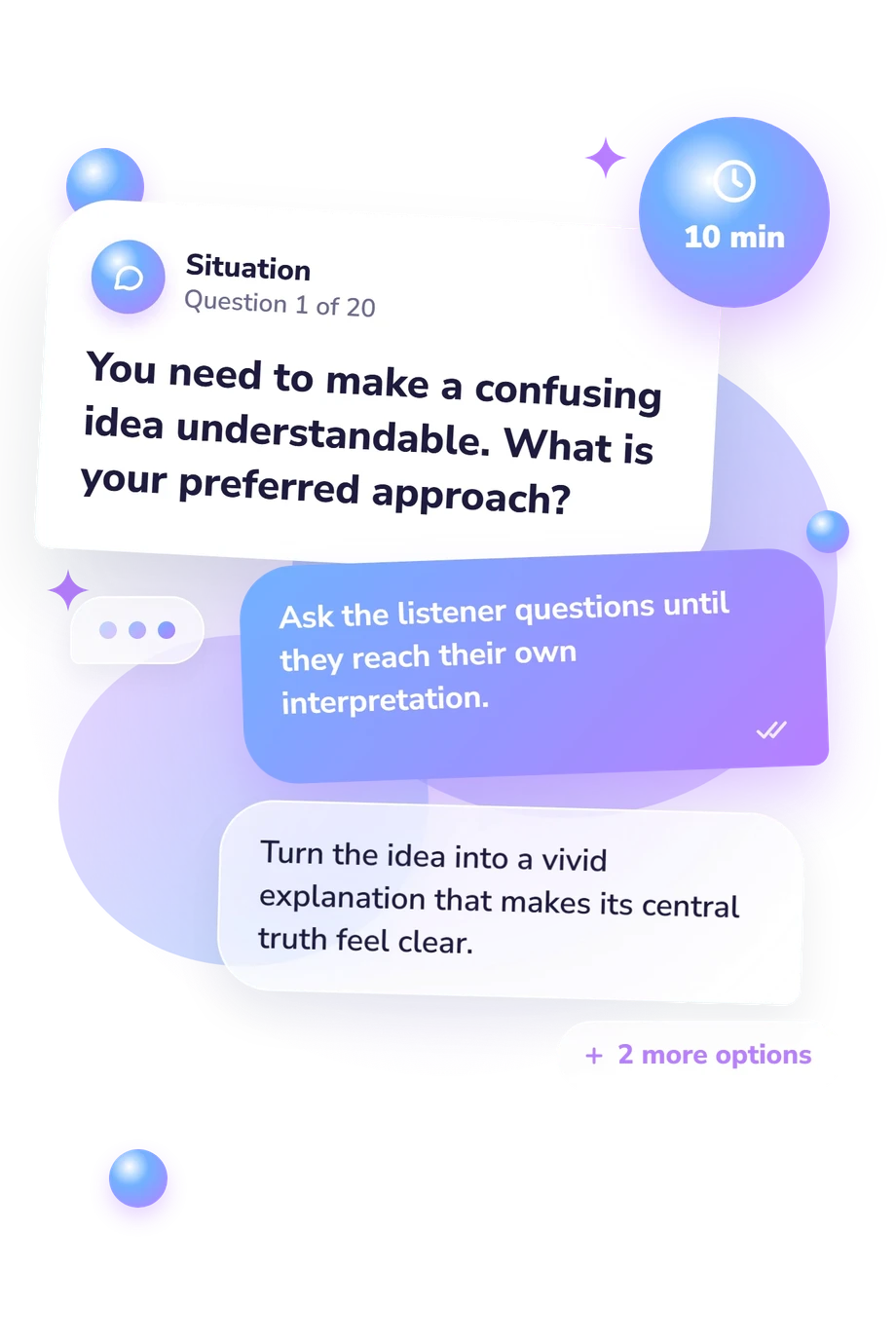
- Ask the listener questions until they reach their own interpretation.
- Turn the idea into a vivid explanation that makes its central truth feel clear.
- Try several playful examples and keep whichever one lands.
- Build a precise outline and illustrate it with one strong example.
- Performing music, poetry, or a story for the gathered crowd.
- Coordinating the timetable so every contributor gets a turn.
- Designing the visual setting and overall atmosphere.
- Moving among the guests and starting unexpected conversations.
- Beside a quiet study overlooking an old city square.
- On a rugged coast where waves and weather are always present.
- Near a lively market with people constantly passing through.
- Along a deep mountain lake surrounded by open wilderness.
What Demigod Are You Quiz - Description and methodology of the test
People drawn to mythology, personality reflection, and imaginative self-assessment can use the What Demigod Are You Quiz to explore which Olympian patterns resemble their preferences. Those asking whether they might be a demigod can use this am i a demigod quiz to reflect on values, habits, and instincts. The result gives readers a comparative profile for considering how they tend to respond across social, practical, and creative situations.
What This Assessment Explores
Situations probe relationships, expression, planning, ambiguity, movement, independence, emotion. This quiz about which demigod you are measures preferences, not mythological knowledge, and interprets choices symbolically. Its dimensions are:
- Child of Aphrodite (0-12) measures beauty, bonds: Independent Orbit (0-4) lower, Aphrodite Echo (5-8) moderate, Aphrodite-Aligned (9-12) strong.
- Child of Apollo (0-12) measures expression, insight: Quieter Light (0-4) lower, Apollo Echo (5-8) moderate, Apollo-Aligned (9-12) strong.
- Child of Athena (0-12) measures strategy, planning: Different Instincts (0-4) lower, Athena Echo (5-8) moderate, Athena-Aligned (9-12) strong.
- Child of Hermes (0-12) measures communication, adaptability, exploration: Steady Route (0-4) lower, Hermes Echo (5-8) moderate, Hermes-Aligned (9-12) strong.
- Child of Poseidon (0-12) measures freedom, intensity, nature: Calmer Shores (0-4) lower, Poseidon Echo (5-8) moderate, Poseidon-Aligned (9-12) strong.
Methodology and Scientific Basis
Each item presents a social, practical, or imaginative situation with four response options. The forced-choice self-report format samples preferences in action rather than mythological knowledge, while mood, memory, and self-image can influence a selection. By comparing your choices, it builds a profile rather than a quiz asking whether you are a demigod.
The scoring compares the five displayed scores; the highest indicates the strongest symbolic match, and results within one point form a blend. This is a relative pattern, not a ranking of personal value. It does not assign a permanent identity; preferences can shift with circumstances.
Conceptually, the questionnaire is consistent with Bolen's Greek-god archetype framework, which links mythic figures with recurring psychological patterns. Bolen's companion framework, Jung's archetypal context, and Rutter and Singer's collection provide related interpretive context. These works offer conceptual parallels for the symbolic comparison, while the questionnaire remains its own online format.
It invites reflection on decision-making, social style, creativity, and independence through this demigod life quiz. The displayed bands function as internal result categories, so interpretation depends on the patterns in this questionnaire and the context of the respondent's choices.
- Bolen, Jean Shinoda. Gods in Everyman: A New Psychology of Men's Lives and Loves. San Francisco: Harper & Row, 1989.
- Bolen, Jean Shinoda. Goddesses in Everywoman: A New Psychology of Women. New York: Harper & Row, 1985.
- Rutter, Virginia Beane, and Thomas Singer, eds. Ancient Greece, Modern Psyche: Archetypes Evolving. London and New York: Routledge, 2015.
- Jung, C. G. The Archetypes and the Collective Unconscious. 2nd ed. Translated by R. F. C. Hull. Princeton, NJ: Princeton University Press, 1981. 10.1515/9781400850969
Updated: