
Freudly+971 508685814hello@freudly.ai
Freudly

What Commander Should I Play Quiz
What Commander Should I Play Quiz - Free Play Test - FreudlyTake a free what commander should i play quiz to find out what commander should i play is the perfect fit. Quick, no sign-up needed. Start now!en
Taking 10 minutes, this 20-question What Commander Should I Play Quiz maps your preferences across political choices, tribal aggression, token swarms, graveyard value, and spell-based control. The result offers a practical profile of the play experiences and strategic patterns you may find most engaging when choosing a deck.
Questions: 2010 minutes
What Commander Should I: situation and reply bubbles
July 22, 2026July 22, 2026Material has been updatedJuly 22, 2026Material has been published
8,928 views
805 completions
694 likes
Daniel HallPsychologist · Test reviewer
694 likes
Scale Explorer

How the Scales are Structured

Breena, the Demagogue — Table PoliticsBtD—TP
Measures your preference for using table politics, incentives, and negotiated combat dynamics as part of your game plan.
example score7/12
7/12Political Participantexample score
0 – 4Self-Directed Plan
5 – 8Political Participant
9 – 12Demagogue Match
A score of 7 suggests you often enjoy making deals and shaping opponents' decisions, while still relying on a solid independent strategy.
Gishath, Sun's Avatar — Dinosaur StampedeGSA—DS
This scale measures your preference for ramping into big Dinosaur threats and winning through explosive, creature-driven attacks with Gishath-style variance.
example score8/12
8/12Dinosaur-Friendlyexample score
0 – 4Smaller Footprint
5 – 8Dinosaur-Friendly
9 – 12Sun's Avatar Match
A score of 8 places you in the Dinosaur-Friendly range, suggesting you enjoy big tribal swings but may still want some control over setup and consistency.
Krenko, Mob Boss — Goblin SwarmKMB—GS
Measures your affinity for Krenko’s mono-red Goblin swarm game plan focused on token multiplication and explosive combat turns.
example score7/12
7/12Goblin-Curiousexample score
0 – 4Different Tempo
5 – 8Goblin-Curious
9 – 12Mob Boss Match
A score of 7 suggests you like the idea of multiplying Goblins and turning the corner fast, but you may still want more flexibility than a pure Krenko plan.
Muldrotha, the Gravetide — Graveyard ValueMtG—GV
Measures your affinity for generating value by replaying permanents from the graveyard and rebuilding through recursion.
example score7/12
7/12Recursion Explorerexample score
0 – 4Cleaner Resources
5 – 8Recursion Explorer
9 – 12Gravetide Match
A score of 7 places you in Recursion Explorer, suggesting you enjoy reusing cards for steady advantage while still preferring a clear, structured path to closing the game.
Talrand, Sky Summoner — Spells and ControlTSS—SaC
This scale measures your preference for a spells-and-control playstyle that turns instants and sorceries into an evasive token board.
example score6/12
6/12Tempo-Curiousexample score
0 – 4Board-First Mage
5 – 8Tempo-Curious
9 – 12Sky Summoner Match
A score of 6 places you in the Tempo-Curious range, suggesting you like the idea of casting spells to build flying pressure, even if full-time reactive play may not always be your default.
just completed the test
DATA-BASED USER COHORTS

Who Usually Takes This Test?

Commander deck switchers
41%OF USERS
Players who rotate decks often and want a quick nudge toward a commander that matches how they like to build and play.
Newer EDH explorers
34%OF USERS
People learning the format who want an easy starting point based on whether they prefer swarms, recursion, spells, big creatures, or politics.
Playstyle self-checkers
25%OF USERS
Regulars who know their cards but enjoy comparing their table habits—interaction, resource management, and threat timing—to a clear archetype.
BASED ON AGGREGATED, ANONYMIZED DATA FROM TENS OF THOUSANDS OF FREUDLY USERS.
Benchmarking

See How You Compare

Once you complete the test, your results are compared with real-world data from people in your country.
Below is a preview of how scores are typically distributed across each scale.
Shaded area — where most people score
Dot — the average
You — your score lands on each curve after the test— your score, after the test
Breena, the Demagogue — Table PoliticsBtD—TP
You?
Average4.9
Typical rangeTypical3.1 – 6.7
Possible0 – 12
Gishath, Sun's Avatar — Dinosaur StampedeGSA—DS
You?
Average7.2
Typical rangeTypical5.7 – 8.7
Possible0 – 12
Krenko, Mob Boss — Goblin SwarmKMB—GS
You?
Average3.5
Typical rangeTypical2 – 5
Possible0 – 12
Muldrotha, the Gravetide — Graveyard ValueMtG—GV
You?
Average3.4
Typical rangeTypical1.4 – 5.5
Possible0 – 12
Talrand, Sky Summoner — Spells and ControlTSS—SaC
You?
Average6.2
Typical rangeTypical4.5 – 7.9
Possible0 – 12
Featured On
SAMPLE QUESTIONS

Example Questions From the Test

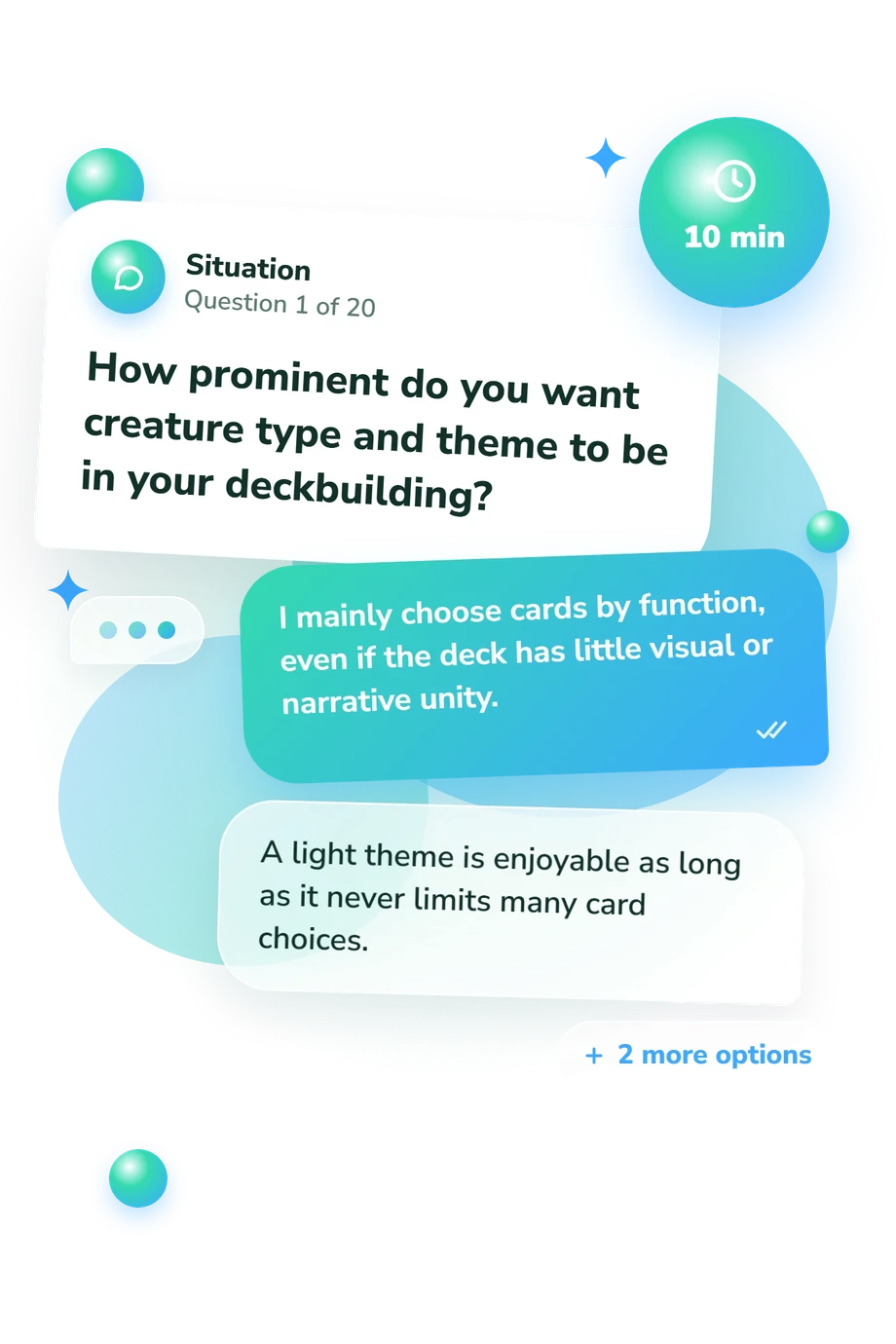
    • I mainly choose cards by function, even if the deck has little visual or narrative unity.
    • A light theme is enjoyable as long as it never limits many card choices.
    • I like a recognizable tribe with room for practical support cards.
    • I want the deck to feel unmistakably like a Dinosaur stampede from start to finish.
    • I usually prefer a mixed cast of individually flexible cards.
    • I enjoy some tribal links, but I want several unrelated plans too.
    • A strongly connected creature package sounds appealing if it still allows a few surprises.
    • I love tight tribal synergy where nearly every creature helps the same escalating plan.
    • A deck that wins through a plan mostly concealed from the combat politics around it.
    • A creature deck that occasionally benefits from opponents' decisions.
    • A counters strategy supported by incentives that redirect pressure away from me.
    • A political engine where negotiation, diverted attacks, and growing creatures all reinforce one another.
WHAT THE TEST MEASURES

What Commander Should I Play Quiz - Description and methodology of the test

Players choosing between very different Commander builds can use this profile to clarify the game experiences they want to create. The What Commander Should I Play Quiz is intended for someone choosing a new deck, refining a shortlist, or explaining why certain commanders feel appealing. For people asking what Magic deck should I play, this quiz frames the choice around pace, interaction, commitment, and board development.

What This Assessment Explores

Questions link preferences to politics, tribal aggression, token swarms, graveyard recursion, and spell-heavy control. A commander deck personality quiz compares them. The profiles are:

  • Breena, the Demagogue - Table Politics (0-12) measures political affinity: Self-Directed Plan (0-4), Political Participant (5-8), and Demagogue Match (9-12).
  • Gishath, Sun's Avatar - Dinosaur Stampede (0-12) measures big-tribal appeal: Smaller Footprint (0-4), Dinosaur-Friendly (5-8), and Sun's Avatar Match (9-12).
  • Krenko, Mob Boss - Goblin Swarm (0-12) measures token-swarm preference: Different Tempo (0-4), Goblin-Curious (5-8), and Mob Boss Match (9-12).
  • Muldrotha, the Gravetide - Graveyard Value (0-12) measures recursion comfort: Cleaner Resources (0-4), Recursion Explorer (5-8), and Gravetide Match (9-12).
  • Talrand, Sky Summoner - Spells and Control (0-12) measures spell preference: Board-First Mage (0-4), Tempo-Curious (5-8), and Sky Summoner Match (9-12).

Methodology and Evidence Base

Each item offers four answer choices about pace, commitment, interaction, recovery, uncertainty, and board development. Choosing an option signals which play pattern feels more attractive.

Selections are aggregated into five commander-specific affinity profiles. No universal points-per-answer rule is stated, so the named bands are profile categories rather than calibrated probabilities or rankings of deck strength. A Commander playstyle quiz suggests a direction without deciding what you will enjoy in games.

Methodologically, the approach is conceptually consistent with Varismaa's TCG motivation study (2026), which examines engagement with trading card games. Rosewater's Magic psychographics and Styborski's Commander overview add context about motivation, deck identity, and multiplayer play. Kahn and colleagues' Trojan Player Typology provides a broader comparison for play motivations across games; these sources do not validate this exact online scoring model.

Because it is an online self-report profile rather than a standardized, norm-referenced measure, results can shift with current mood, playgroup experience, card familiarity, and imagined deckbuilding preferences, so use them to compare styles rather than infer technical skill, win rate, social ability, or a guaranteed commander choice.

Literature:
  • Varismaa, Vilma. "The Demographics and Motivations of Trading Card Game Players." Proceedings of DiGRA 2026, 2026. 10.26503/dl.v2026i3.2812.
  • Rosewater, Mark. "The Three Magic Psychographics." Making Magic, Magic: The Gathering, May 26, 2025.
  • Styborski, Adam. "An Introduction to Commander." Magic: The Gathering, October 28, 2016.
  • Kahn, Adam S., Cuihua Shen, Li Lu, Rabindra A. Ratan, Sean Coary, Jinghui Hou, Jingbo Meng, Joseph Osborn, and Dmitri Williams. "The Trojan Player Typology: A cross-genre, cross-cultural, behaviorally validated scale of video game play motivations." Computers in Human Behavior, vol. 49, 2015, pp. 354-361. 10.1016/j.chb.2015.03.018.

Updated:

Popular tests
Comments
Leave a Comment