
Veterinary Terminology Quiz
How the Scales are Structured
Who Usually Takes This Test?
See How You Compare
Below is a preview of how scores are typically distributed across each scale.
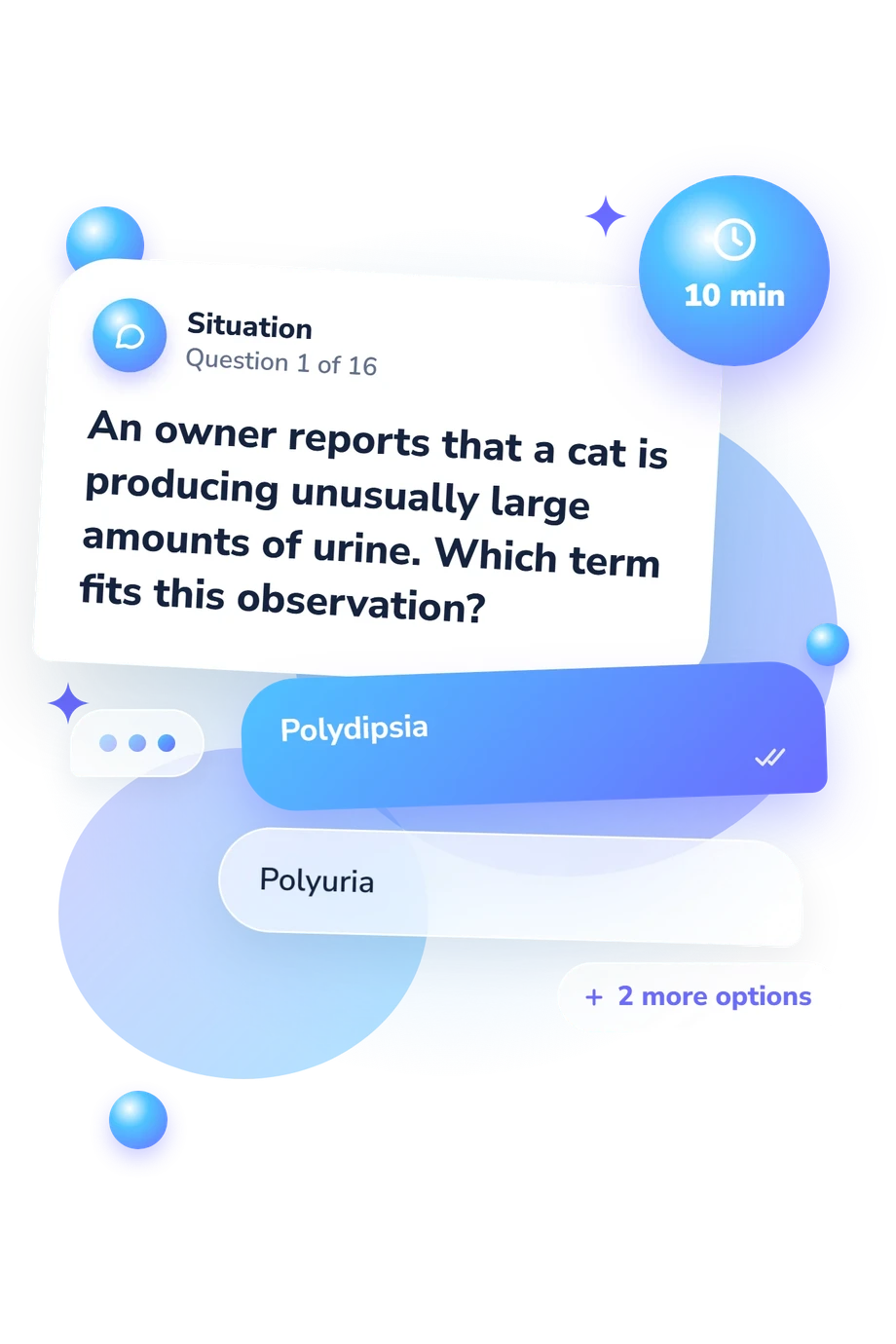
Example Questions From the Test
- Polydipsia
- Polyuria
- Dysuria
- Anuria
- Hematemesis
- Hematuria
- Hemoptysis
- Hematochezia
- An irregular breathing pattern
- A faster-than-expected heart rate
- A lower-than-expected body temperature
- A weaker-than-expected pulse
Veterinary Terminology Quiz - Description and methodology of the test
For anyone building confidence in animal-care vocabulary, this veterinary terminology quiz offers a focused way to check whether common clinical words are understood in context. It suits learners, animal-care entrants, and readers of basic clinical documentation who want a practical veterinary medical terminology quiz for checking recognition and choosing review topics. The result indicates an overall level of veterinary terminology knowledge and suggests review priorities for study and self-reflection.
What This Assessment Measures
The questions ask whether a reader can match veterinary terms with signs, procedures, positions, or record entries. They cover observations, anatomy, abbreviations, treatment, surgery, and prognosis. This veterinary terminology assessment emphasizes applied recognition.
The score indicates performance across the tested practical contexts and can guide broad review of common terms, rather than pinpointing every vocabulary gap.
The score draws on four topic groups:
- Clinical signs show whether terms match symptoms or measurable findings.
- Anatomy and positioning show whether directional, bilateral, and recumbency language is understood.
- Procedures and treatment show whether abbreviations, routes, and surgery terms are recognized.
- Records and outcomes show whether words such as prognosis and iatrogenic are interpreted accurately.
Veterinary Terminology Knowledge ranges from 0-16: Foundations to build (0-6), Developing knowledge (7-12), or Strong knowledge (13-16). These bands describe tested vocabulary knowledge, not a professional credential.
Methodology and Evidence Base
Each item presents a short clinical situation or documentation phrase followed by four answer choices. The respondent selects the term or meaning that best fits, so the format tests recognition and contextual application rather than recall of isolated word lists. Responses are summarized in the single knowledge score; the questionnaire does not state a separate weighting system.
The questionnaire is conceptually consistent with Robertson and David-Steel (n.d.) and Romich (2015), whose terminology references correspond to the vocabulary tested by these veterinary terminology questions. It is not an adaptation of either source; it provides a descriptive educational score without established norms or reliability evidence.
Interpret the descriptive result as an educational snapshot of performance on the tested vocabulary, not as a norm-referenced comparison or evidence of professional readiness. The total reflects recognition in brief written scenarios; performance may also reflect prior coursework, guessing, wording familiarity, and current context. It does not assess hands-on technique, diagnostic reasoning, or treatment decisions.
- Robertson, Kelly, and Matéa David-Steel. Introduction to Veterinary Terminology. NorQuest College and Open Education Alberta, n.d. 10.29173/oer/d3ota94m.
- Romich, Janet Amundson. An Illustrated Guide to Veterinary Medical Terminology. 4th ed. Cengage Learning, 2015. ISBN: 9781133125761.
Updated: