
Utrecht-Management of Identity Commitments Scale for Parents (U-MICS-PI) Test
How the Scales are Structured
Who Usually Takes This Test?
See How You Compare
Below is a preview of how scores are typically distributed across each scale.
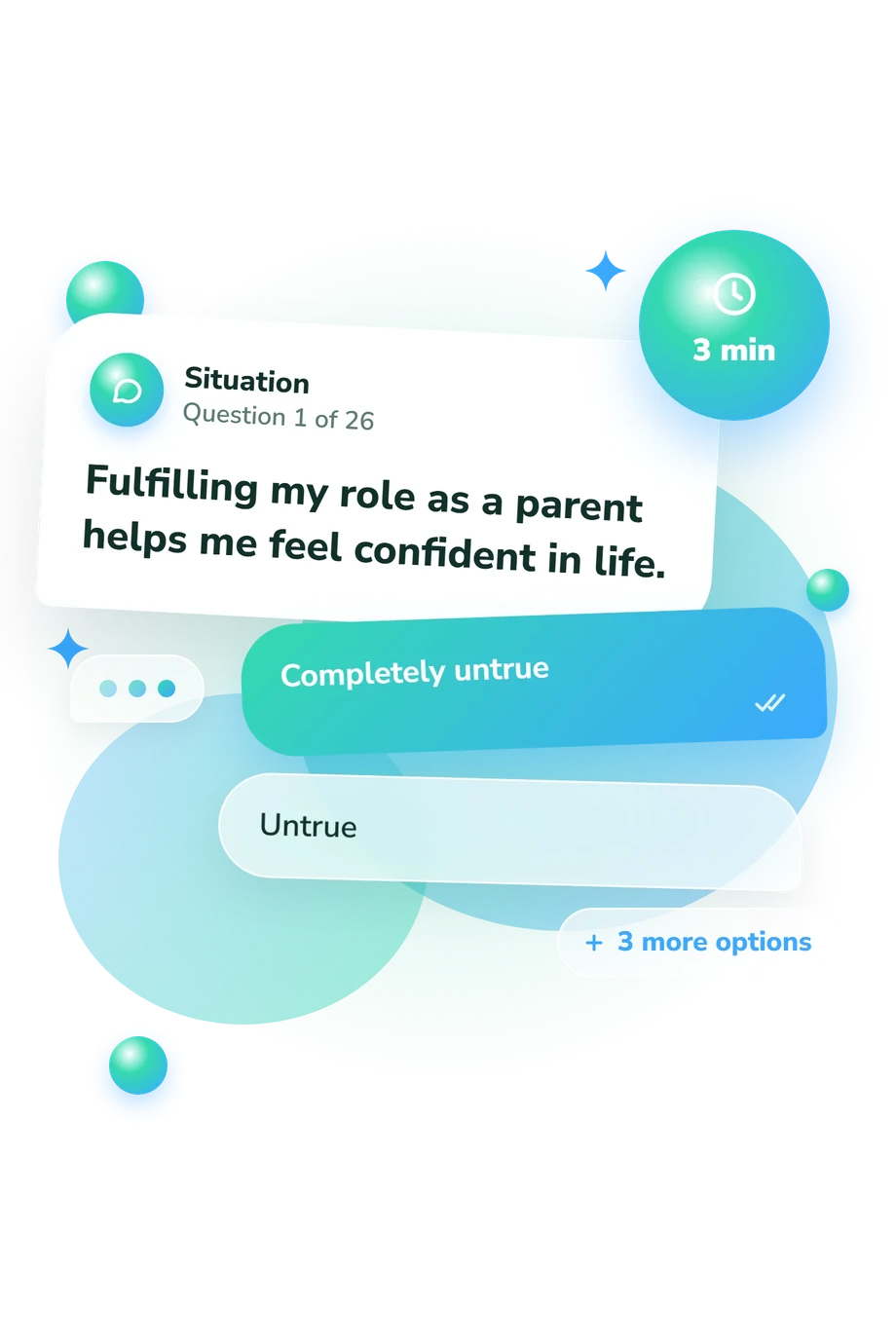
Example Questions From the Test
- Completely untrue
- Untrue
- Neither true nor untrue
- True
- Completely true
- Completely untrue
- Untrue
- Neither true nor untrue
- True
- Completely true
- Completely untrue
- Untrue
- Partly true, partly untrue
- True
- Completely true
Utrecht-Management of Identity Commitments Scale for Parents (U-MICS-PI) Test - Description and methodology of the test
Parents who want to examine how they occupy and question their role can use this assessment for a focused snapshot of parental identity. The Utrecht-Management of Identity Commitments Scale for Parents (U-MICS-PI) Test translates feelings about responsibility, confidence, reflection, and doubt into a profile rather than a single verdict. As a parental identity scale, it can help readers notice patterns they may wish to explore further.
What This Assessment Explores
This parenting identity assessment examines commitments connected with raising children. Items address confidence in the role, learning about a child, discussion with others, and doubts about previously adopted parenting responsibilities; the latter concern stability or change in parental commitments, not parenthood preference alone. It offers identity insight, not a rating of parenting competence or family functioning.
The three displayed dimensions are:
- Commitment Making (5-25) reflects recognition and assumption of parental responsibilities; bands: Low commitment clarity (5-12), Moderate commitment clarity (13-18), High commitment clarity (19-25).
- In-Depth Exploration (5-25) reflects active analysis of parenting responsibilities and new ways to fulfill them; bands: Low reflection (5-11), Moderate reflection (12-18), High reflection (19-25).
- Reconsideration of Commitments (3-15) reflects re-evaluating previously adopted parenting decisions and responsibilities; higher scores may indicate instability; bands: Stable commitments (3-6), Occasional reconsideration (7-11), Frequent reconsideration (12-15).
Methodology and Evidence Base
The response format uses a five-point agreement scale from Completely untrue to Completely true, with a midpoint for uncertainty or mixed feelings. Responses cover situations involving confidence in the parental role, active exploration of the child and parenting responsibilities, and re-evaluation of previously adopted parenting decisions and responsibilities. The result reports separate scores for the three displayed dimensions rather than one combined total; this makes the questionnaire a parental role questionnaire as well as a structured reflection exercise.
Methodologically, the questionnaire is conceptually consistent with the three-process identity model described by Crocetti, Rubini, and Meeus (2008): commitment, in-depth exploration, and reconsideration of commitments. The closest parental application is U-MICS-PI (Piotrowski, 2018), which extends this framework to the parental identity domain. Piotrowski (2021) provides contextual evidence about associations among parental identity, personality, and well-being, not validation of this online profile.
Scores indicate current self-perception and can shift with stress, family circumstances, recent experiences, or willingness to report doubts openly. This online version is not standardized, and its displayed bands are catalogue interpretation bands rather than population norms.
- Piotrowski, K. (2018). Adaptation of the Utrecht-Management of Identity Commitments Scale (U-MICS) to the measurement of the parental identity domain. Scandinavian Journal of Psychology, 59(2), 157-166. 10.1111/sjop.12416
- Crocetti, E., Rubini, M., & Meeus, W. H. J. (2008). Capturing the dynamics of identity formation in various ethnic groups: Development and validation of a three-dimensional model. Journal of Adolescence, 31(2), 207-222. 10.1016/j.adolescence.2007.09.002
- Piotrowski, K. (2021). Parental identity status in emerging and early adulthood, personality, and well-being: A cluster analytic approach. Scandinavian Journal of Psychology, 62(6), 820-832. 10.1111/sjop.12779
Updated: