
Unicorn Quiz
How the Scales are Structured
Who Usually Takes This Test?
See How You Compare
Below is a preview of how scores are typically distributed across each scale.
Example Questions From the Test
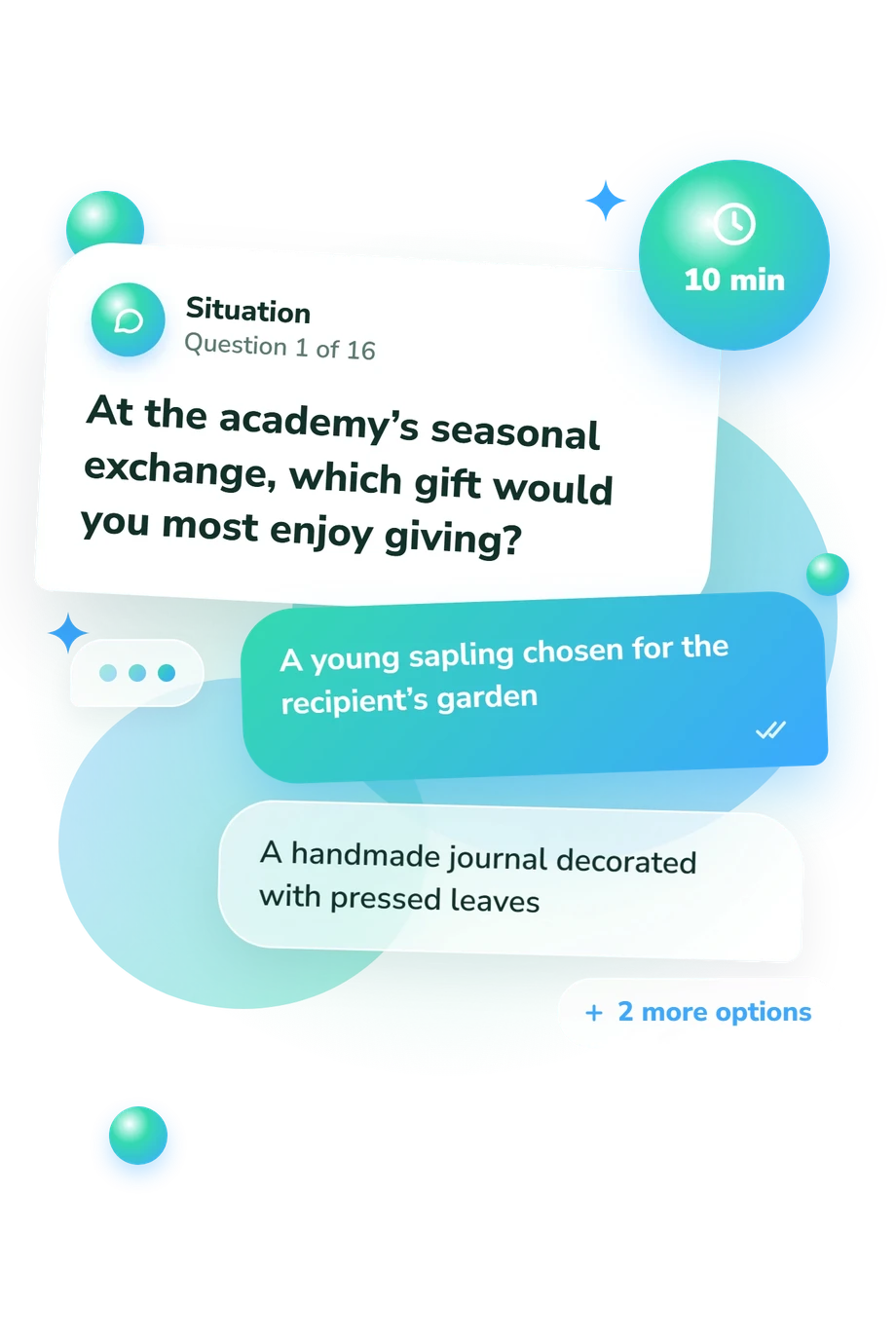
- A young sapling chosen for the recipient’s garden
- A handmade journal decorated with pressed leaves
- A basket of treats baked that morning
- A bright sky lantern for the evening launch
- A loose braid woven with fern and ivy
- A soft twist held with fresh wildflowers
- A practical tie finished with smooth wooden beads
- A sleek style scattered with crystal stars
- Along a cliff path where the sea meets the horizon
- Into the library to read old voyage legends
- To a sunny meadow for an unhurried nap
- Through the market to see what is new
Unicorn Quiz - Description and methodology of the test
Curious readers who enjoy fantasy, visual symbolism, and playful self-reflection can use this assessment to identify the color atmosphere that feels most natural to them. The unicorn quiz turns preferences about places, gifts, decoration, celebrations, and social choices into a readable style profile. A what type of unicorn am i quiz result can offer a creative prompt rather than a fixed identity.
What This Assessment Explores
Four color affinities organize choices about nature, water, moonlight, warmth, exploration, routine, creativity, celebration, and social care. The result suits readers seeking a playful style profile or character-building prompt. In this what unicorn are you quiz, the leading score represents the strongest color affinity, while scores within one point form a blended result.
The displayed dimensions are:
- Forest Green (0-12) reflects earthy, nature-led preferences: Light Woodland Trace (0-4), Growing Green (5-8), and Deep Forest Green (9-12).
- Moonlit Silver (0-12) reflects quiet celestial and reflective preferences: Faint Silver Spark (0-4), Silver Glimmer (5-8), and Moonlit Silver (9-12).
- Ocean Blue (0-12) reflects fluid adventure and open-horizon preferences: Distant Blue Horizon (0-4), Tidal Blue (5-8), and Deep Ocean Blue (9-12).
- Rose Gold (0-12) reflects warm connection and expressive preferences: Subtle Rosy Note (0-4), Rosy Glow (5-8), and Radiant Rose Gold (9-12).
Methodology and Evidence Base
Each item presents an academy scenario with four response choices. The options ask which response feels most natural, covering settings, appearance, routines, problem-solving, celebration, and interpersonal gestures. The displayed scores compare the response pattern associated with each color profile; the highest total identifies the strongest affinity, while near-equal totals can produce a blended reading.
Its structure is conceptually consistent with Ecological Valence Theory (Palmer & Schloss, 2010), which explains color preference through positive and negative associations with objects and environments. Taylor and Franklin (2012) examine how color-object associations relate to preference, while Elliot and Maier (2014) review ways color can influence psychological functioning across contexts. These sources support the rationale for exploring color preference, not the reliability or validity of this questionnaire.
This is an online self-report tool rather than a direct administration of a published color-preference instrument. Its category bands are descriptive, not standardized population norms, and responses may shift with mood, experience, cultural associations, self-awareness, and response bias. Framed as a what type of unicorn are you quiz, the result is best used for reflection, styling ideas, or imaginative play.
- Palmer, Stephen E., and Karen B. Schloss. "An ecological valence theory of human color preference." Proceedings of the National Academy of Sciences 107, no. 19 (2010): 8877-8882. 10.1073/pnas.0906172107
- Taylor, Chloe, and Anna Franklin. "The relationship between color-object associations and color preference: further investigation of ecological valence theory." Psychonomic Bulletin & Review 19, no. 2 (2012): 190-197. 10.3758/s13423-012-0222-1
- Elliot, Andrew J., and Markus A. Maier. "Color psychology: effects of perceiving color on psychological functioning in humans." Annual Review of Psychology 65 (2014): 95-120. 10.1146/annurev-psych-010213-115035
Updated: