
Types of Sentence Quiz
How the Scales are Structured
Who Usually Takes This Test?
See How You Compare
Below is a preview of how scores are typically distributed across each scale.
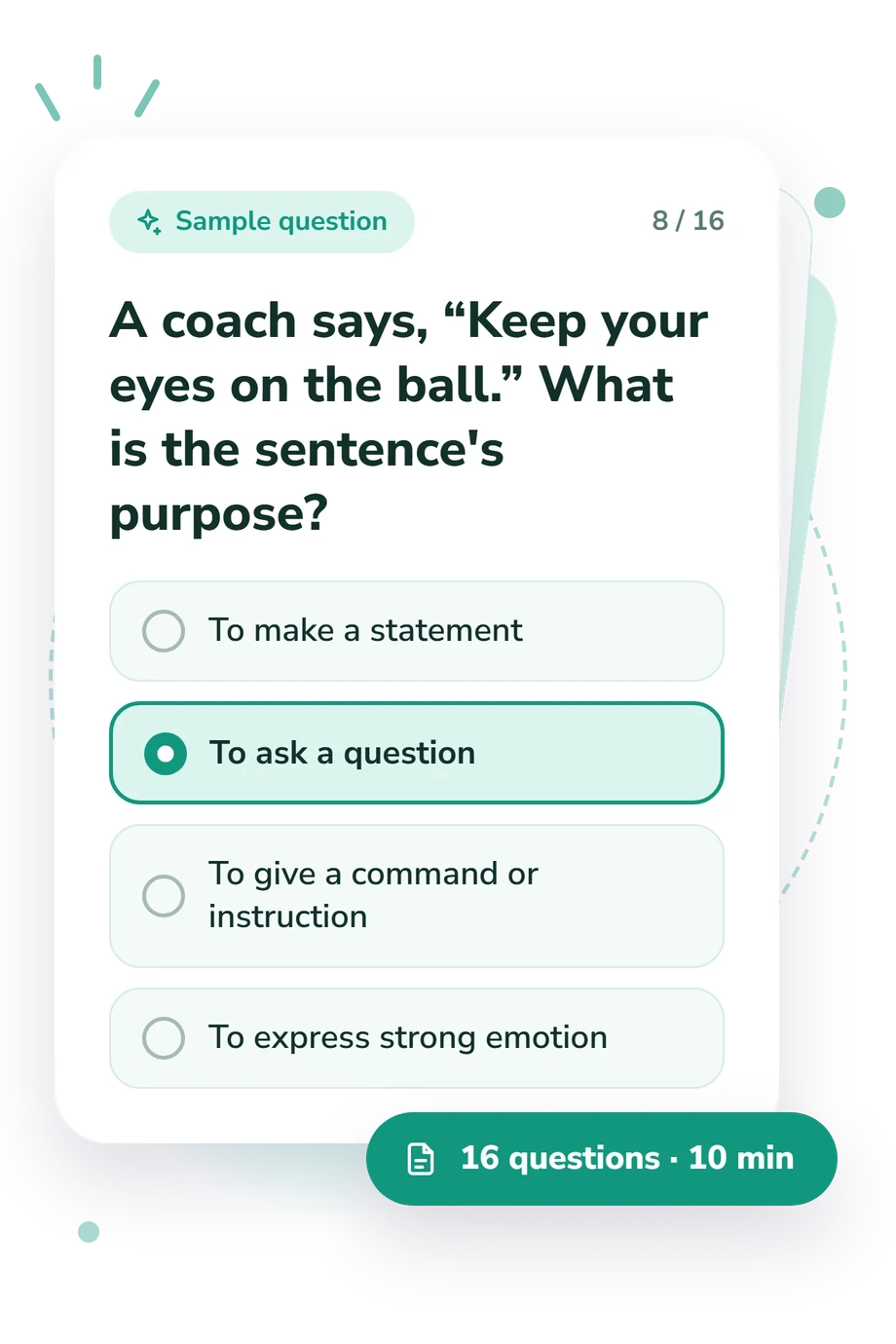
Example Questions From the Test
- What a spectacular display that was!
- Do the fireworks begin after sunset?
- Watch the fireworks from the lawn.
- The fireworks begin after sunset.
- When the bell rang, the students left.
- The bell rang, and the students left.
- The bell rang, the students left.
- Because the bell rang, the students left.
- She delivered
- Although Priya felt nervous
- The speech clearly
- She delivered the speech clearly
Types of Sentence Quiz - Description and methodology of the test
Students, teachers, and adult learners who want to check their accuracy when classifying sentence purposes and structures can use the Types of Sentence Quiz to identify concepts that deserve focused review. Anyone reviewing English grammar, preparing for writing tasks, or seeking a focused way to target practice may use this sentence types quiz. Its result describes performance on the tested classifications.
What This Assessment Explores
This assessment examines sentence purpose and clause structure. Purpose items distinguish declarative statements, interrogative questions, imperative instructions, and exclamatory expressions. Structure items test simple, compound, complex, and compound-complex patterns, including independent and dependent clauses.
Examples use familiar contexts. As a sentence quiz, it checks whether learners apply labels to complete examples rather than recite definitions. That approach keeps the focus on recognizing how wording functions in context. The 4 types of sentences quiz format lets learners use the purpose items to review distinctions; the structure items add clause analysis.
One knowledge scale organizes the result:
- Types of Sentence Knowledge (0-16) reports command of the tested classifications.
- Foundations to build (0-6) indicates concepts that need review.
- Developing command (7-12) reflects many correct distinctions with room to improve.
- Strong command (13-16) indicates consistent recognition and application.
Methodology and Scientific Basis
Each prompt presents a sentence or short grammar situation with four answer choices. Items cover purpose, clause relationships, coordination, subordination, and structural classification, so the format tests rule application rather than vocabulary, fluency, or extended writing.
Scoring produces one knowledge result, and the questionnaire’s descriptive interpretations connect performance with topics for review. Stronger performance indicates more accurate recognition and application of the tested classifications, while a lower band points to concepts that may need further study.
Because the questionnaire covers different sentence forms, its kinds of sentences quiz format helps learners revisit classification rules and choose topics for practice.
Its framework is conceptually consistent with the grammatical classifications described in Quirk and colleagues’ work and in Huddleston and Pullum’s work, particularly their treatment of sentence functions, coordination, subordination, and clause types. The online questionnaire is a separate knowledge check.
Results depend on attention, prior instruction, and interpretation of the options. The bands describe performance on sentence classification in this questionnaire and do not establish general writing proficiency.
- Quirk, Randolph, Sidney Greenbaum, Geoffrey Leech, and Jan Svartvik. A Comprehensive Grammar of the English Language. London: Longman, 1985.
- Huddleston, Rodney, and Geoffrey K. Pullum. The Cambridge Grammar of the English Language. Cambridge: Cambridge University Press, 2002. 10.1017/9781316423530
Updated: