
Thigh Muscles Quiz
How the Scales are Structured
Who Usually Takes This Test?
See How You Compare
Below is a preview of how scores are typically distributed across each scale.
Example Questions From the Test
- Adductor longus and gracilis
- Biceps femoris and semitendinosus
- The four quadriceps muscles
- Gastrocnemius and soleus
- Rectus femoris
- Adductor magnus
- Sartorius
- Gracilis
- Hip flexion, hip abduction, lateral rotation, and knee flexion
- Hip flexion, hip adduction, and knee extension
- Hip extension, hip abduction, and knee flexion
- Hip extension, hip adduction, and knee extension
Thigh Muscles Quiz - Description and methodology of the test
Students, trainees, and anatomy learners who want a focused way to judge their readiness can use the Thigh Muscles Quiz before practical work or exams. It helps you decide whether your current understanding is solid enough to move forward or whether targeted revision would be worthwhile. As a thigh anatomy quiz, it turns uncertainty into clear study priorities.
What This Assessment Explores
The questions connect anterior and medial thigh anatomy with movement and basic clinical application. They ask you to identify muscles, match them with actions and nerve supplies, and use boundaries or landmarks in short scenarios.
Your result is reported as Thigh Muscles Knowledge, with a 0-16 range: Foundations to review (0-6), Developing knowledge (7-12), or Strong knowledge (13-16). This band reflects how securely you can retrieve and apply the tested relationships, not every aspect of lower-limb anatomy.
The result draws on these themes:
- Muscle location shows whether you distinguish major anterior and medial thigh structures.
- Joint actions show whether you connect muscles with hip and knee movements.
- Nerve supply shows whether you relate femoral or obturator involvement to weakened actions.
- Applied landmarks show how you use the femoral triangle, pes anserinus, and adductor hiatus.
As a quiz about the muscles of the thigh, it guides revision toward relationships needing practice.
Methodology and Scientific Basis
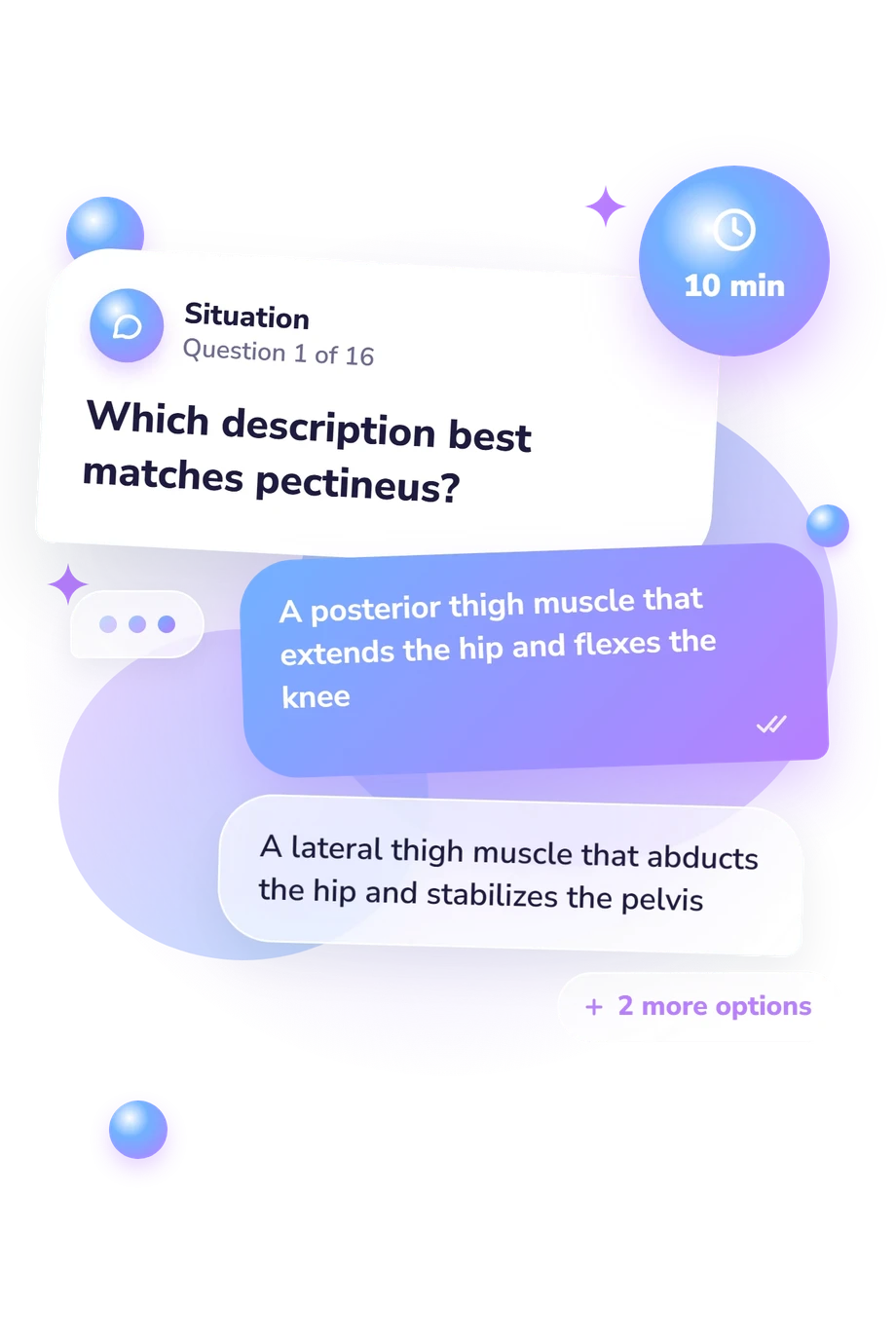
Each item uses four-option multiple choice and asks for the single best response. Direct identification is mixed with prompts about kicking, knee squeezing, nerve injury, reflex testing, and regional landmarks, checking recall alongside transfer to movement and basic clinical situations.
The displayed total summarizes performance across the tested knowledge items, while the catalogue presents the result through its stated bands.
The content is conceptually consistent with Cuschieri and Narnaware (2023) on lower-limb anatomy knowledge and with the clinically oriented teaching represented by Moore, Dalley, and Agur. It is not an adaptation of either source. The four-option responses feed one combined knowledge result, and the displayed bands describe performance on this questionnaire rather than established population norms.
As a thigh anatomy test, it is a concise study aid whose result is sensitive to previous revision, attention, uncertainty between similar options, and familiarity with anatomical terminology.
- Sarah Cuschieri and Yuwaraj Narnaware. Evaluating the knowledge acquisition of lower limb anatomy among medical students during the post-acute COVID-19 era. Clinical Anatomy. 2023;36(1):128-136. 10.1002/ca.23944.
- Keith L. Moore, Arthur F. Dalley II, and Anne M. R. Agur. Clinically Oriented Anatomy. 8th ed. Wolters Kluwer; 2019. ISBN 9781496347220.
- Mandeep Gill Sagoo, Marc A.T.M. Vorstenbosch, Peter J. Bazira, Harold Ellis, Maria Kambouri, and Charlie Owen. Online Assessment of Applied Anatomy Knowledge: The Effect of Images on Medical Students' Performance. Anatomical Sciences Education. 2021;14(3):342-351. 10.1002/ase.1965.
Updated: