
The Necklace Quiz
How the Scales are Structured
Who Usually Takes This Test?
See How You Compare
Below is a preview of how scores are typically distributed across each scale.
Example Questions From the Test
- The Loisels receive the invitation to the ball.
- Mathilde discovers that the necklace is missing.
- Madame Forestier allows Mathilde to examine her jewelry.
- Monsieur Loisel reveals how much he saved for a gun.
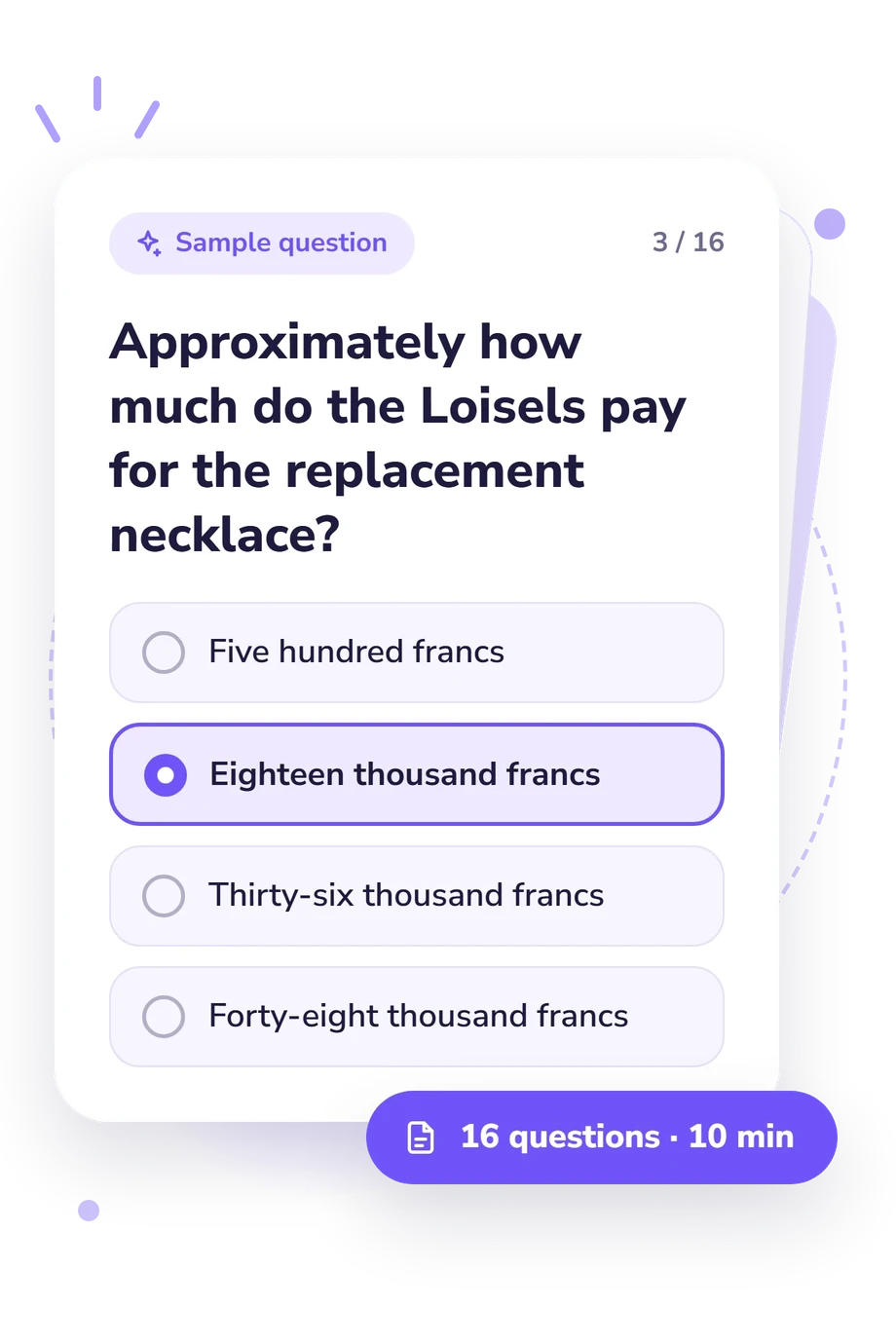
- Five hundred francs
- Eighteen thousand francs
- Thirty-six thousand francs
- Forty-eight thousand francs
- When Madame Forestier asks for it the next morning
- While Mathilde is dancing at the ball
- After they return home from the ball
- After a jeweler notices that its case is empty
The Necklace Quiz - Description and methodology of the test
Readers who want to check their understanding of Maupassant’s story can use the necklace quiz as a focused reading companion. It suits students, book-club participants, and anyone revisiting the text before discussion. A comprehension quiz on The Necklace can structure rereading before class or conversation. The result shows how securely you recognize turning points and connect plot details with character motives, irony, symbolism, and themes.
What This Assessment Explores
The questionnaire measures knowledge of the story rather than personality, reading ability, or a clinical trait. During revision, the necklace short story quiz moves from recall to interpretation, asking about money, the missing necklace, debt, revelation, motives, and social pressure. Other items test irony, symbolism, characterization, and theme.
It suits readers seeking more than a plot recap: the result shows whether recall and interpretation work together.
These dimensions shape the result:
- The Necklace Knowledge, 0-16, places performance in Foundation to build (0-6), Developing analysis (7-12), or Strong command (13-16).
- Plot recognition shows how accurately you identify events and their sequence.
- Literary interpretation shows how well you connect details with irony and symbolism.
- Character and theme analysis shows how you explain motives, status, sacrifice, and consequences.
Methodology and Evidence Base
Each item presents a question with four answer choices. Some options test precise details, while others distinguish a complete interpretation from a tempting but incomplete one. Because answers from the quiz on The Necklace depend on textual evidence, you must retrieve details and recognize how events, contrasts, and revelations function; the result is a total knowledge score rather than separate subscale scores.
Maupassant (1884) is the primary textual reference for the plot, characters, social setting, lost necklace, debt, and final reversal. Rahman, Shah, and Khatoon (2022) provide a structuralist lens for contrasts such as appearance and reality, aspiration and hardship, and surface and hidden value. The questionnaire is conceptually consistent with these sources, not a reproduction of their study or a validated adaptation.
Scoring produces one knowledge result; population norms, reliability coefficients, and diagnostic cutoffs are not stated. Performance can shift with memory, guessing, recent reading, or familiarity with classroom interpretations. Use missed questions to guide rereading, discussion, and closer attention to the story’s evidence rather than treating the score as a complete account of literary ability.
- Maupassant, Guy de. The Necklace. Le Gaulois, 17 February 1884.
- Rahman, Abdur, Naeema Shah, and Asia Khatoon. "A Structuralist Study of Guy de Maupassant's The Necklace." Global Language Review, vol. 7, no. 1, 2022, pp. 293-309. 10.31703/glr.2022(VII-I).24
Updated: