
Systems of Equations Quiz
How the Scales are Structured
Who Usually Takes This Test?
See How You Compare
Below is a preview of how scores are typically distributed across each scale.
Example Questions From the Test
- Length 10 units and width 3 units
- Length 8 units and width 5 units
- Length 7 units and width 6 units
- Length 13 units and width 10 units
- $3
- $2
- $4
- $5
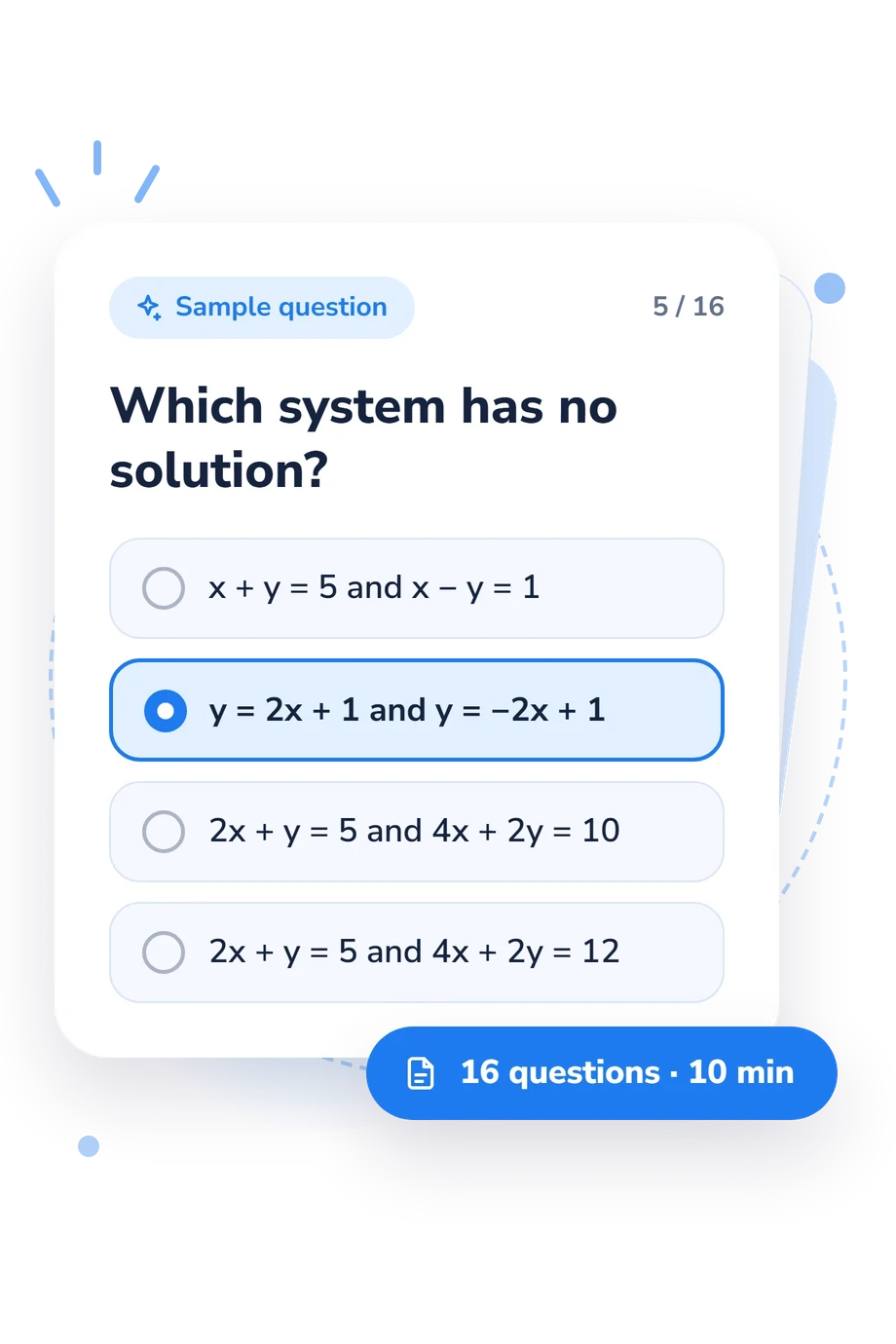
- x + y = 5 and x − y = 1
- y = 2x + 1 and y = −2x + 1
- 2x + y = 5 and 4x + 2y = 10
- 2x + y = 5 and 4x + 2y = 12
Systems of Equations Quiz - Description and methodology of the test
Learners reviewing algebra can use the systems of equations quiz to examine how equations, procedures, and graphical meaning fit together. It suits anyone practising substitution, elimination, graphs, and applied problems, especially those checking whether their reasoning remains consistent across representations. By combining writing and solving systems of equations, the quiz connects symbolic work with practical mathematical situations.
What This Assessment Measures
This assessment samples the skills needed to work with two linear equations. Questions ask learners to translate verbal facts into equations, use substitution or elimination, identify an ordered pair that satisfies both equations, and interpret graph relationships. These are question themes, not result dimensions; the outcome is one knowledge result.
Together, these themes make the assessment a quiz on solving systems of linear equations:
- Modeling shows how well the learner converts quantities and conditions from a situation into a pair of equations.
- Solution methods show whether substitution or elimination is applied accurately.
- Interpretation explains what shared ordered pairs and intersecting, parallel, or coincident lines mean.
- Systems of Equations Knowledge: 0-16 reports overall command of algebraic methods, interpretation, and applied systems problems. Its bands are Foundations to build (0-6), Developing knowledge (7-12), and Strong knowledge (13-16).
Methodology and Scientific Basis
Each item uses a selected-response format with four options. Tasks include solving, choosing equations for word problems, checking algebra, and interpreting graphs. The questionnaire reports the outcome as a displayed score; it does not specify how individual responses contribute to that score.
Karen Zwanch’s study of systems-of-equations word problems examines modeling and solving in a closely related educational context. This questionnaire is conceptually consistent with that work, not an adaptation of its instrument. Elementary Algebra 2e supports substitution, elimination, and graph interpretation, while the Common Core standards frame the expected content. Professional testing standards emphasize that score interpretation depends on evidence for reliability, validity, and intended use.
No standardization or validation has been established for this questionnaire, so the result indicates performance on these items rather than comparison with a reference population. Reading load, concentration, and response choices can affect performance. Reviewing answers to this quiz on systems of equations alongside the underlying reasoning can add context.
- Zwanch, Karen. Examining middle grades students’ solutions to word problems that can be modeled by systems of equations using the number sequences lens. The Journal of Mathematical Behavior, vol. 66, 2022, article 100960. 10.1016/j.jmathb.2022.100960
- Marecek, Lynn, MaryAnne Anthony-Smith, and Andrea Honeycutt Mathis. Elementary Algebra 2e. OpenStax, 2020.
- National Governors Association Center for Best Practices and Council of Chief State School Officers. Common Core State Standards for Mathematics. Washington, DC, 2010.
- American Educational Research Association, American Psychological Association, and National Council on Measurement in Education. Standards for Educational and Psychological Testing. AERA, 2014.
Updated: