
Stampy Cat Quiz
How the Scales are Structured
Who Usually Takes This Test?
See How You Compare
Below is a preview of how scores are typically distributed across each scale.
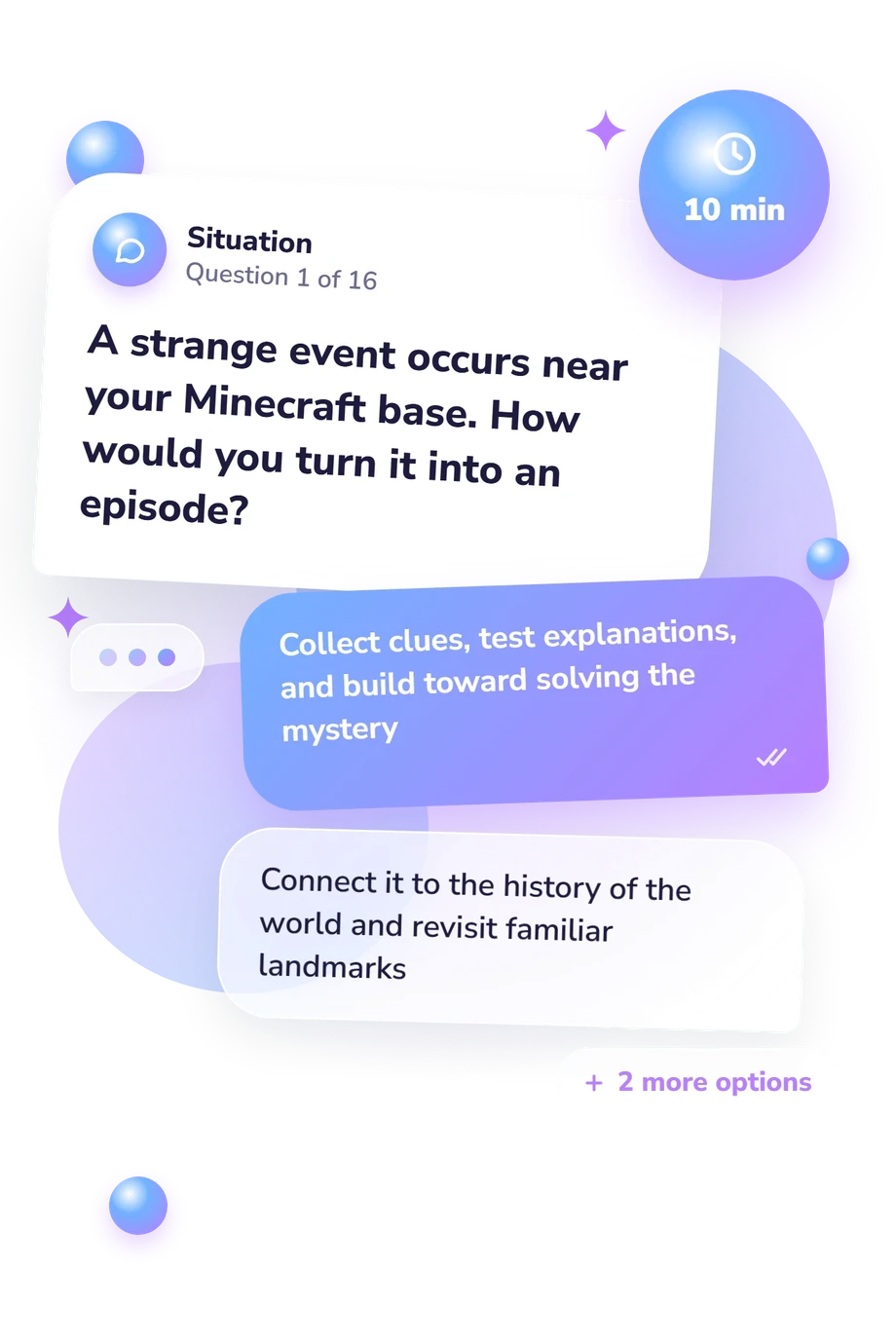
Example Questions From the Test
- Learn how its game mechanics work before deciding its role
- Build a practical enclosure that makes caring for it convenient
- Invite friends to help create a large shared habitat
- Give it a name, a cozy home, and a place in the world’s story
- Keep the banter moving and turn mistakes into running jokes
- Host the group through a structured tour of familiar locations
- Work out the mechanics and explain how to beat the objective
- Shape the setting into a calm, imaginative experience
- Test one variable at a time to discover exactly what it can do
- Design the surrounding room so the device fits the world visually
- Invent a quick backstory explaining who might have built it
- Use it as the centerpiece of an immediate challenge with friends
Stampy Cat Quiz - Description and methodology of the test
People who enjoy Minecraft storytelling, cooperative play, and creator-led world-building can use the Stampy Cat Quiz to see which style best reflects their own preferences. It is especially suited to fans wanting a stampylonghead quiz experience that compares several kinds of gameplay rather than assigning a single identity. The result offers a playful profile for thinking about what makes a series engaging to you.
What This Assessment Explores
Rather than measuring technical skill, it examines how someone prefers to enter a Minecraft world: through discovery, challenge, comic teamwork, warm continuity, or fantasy-oriented creativity. The scenarios cover mysteries, animals, repairs, shared builds, difficult sessions, and long-running stories. As a Stampy fan quiz, it gives fans a comparative profile of play preferences, not an identity label. The four displayed dimensions are:
- AmyLee33 Affinity (0-12) reflects creative, caring, nature-centred play: Light connection 0-4, Mixed connection 5-8, Strong affinity 9-12.
- DanTDM Affinity (0-12) reflects curiosity, experiments, and clearly framed challenges: Light connection 0-4, Mixed connection 5-8, Strong affinity 9-12.
- iBallisticSquid Affinity (0-12) reflects adaptable, team-focused multiplayer energy: Light connection 0-4, Mixed connection 5-8, Strong affinity 9-12.
- Stampylonghead Affinity (0-12) reflects welcoming stories, shared builds, and a cheerful Lovely World style: Light connection 0-4, Mixed connection 5-8, Strong affinity 9-12.
Methodology and Scientific Basis
Each item presents a Minecraft situation with four contrasting responses. The options distinguish mechanics-focused problem solving, structured challenges, multiplayer comedy, welcoming continuity, and imaginative atmosphere. Answers are pooled into four affinity totals: the strongest total is the strongest match, while totals within one point form a blended profile. The bands describe connection within this questionnaire, not population norms.
Viewed as a Minecraft creator quiz, the format is conceptually consistent with research on creator engagement, but it is not an adaptation of those studies. Kreissl et al. (2021) connect engagement with Let's Players to parasocial relationships; Kerttula (2019) examines storytelling and performance in online Let's Plays; Sjöblom and Hamari (2017) examine why people watch gameplay. Together, these sources clarify the relevance of creator style, narrative, social energy, and challenge preference without validating this scoring system.
The result is unofficial: it does not establish that a respondent is any creator or share a creator’s identity. Self-report, current mood, familiarity with the creators, and response bias can shift the profile, so treat it as a prompt for reflection rather than a diagnosis.
- Kreissl, Julian, Daniel Possler, and Christoph Klimmt. "Engagement With the Gurus of Gaming Culture: Parasocial Relationships to Let's Players." Games and Culture, vol. 16, no. 8, 2021, pp. 1021-1043. 10.1177/15554120211005241
- Kerttula, Tero. "What an Eccentric Performance": Storytelling in Online Let's Plays. Games and Culture, vol. 14, no. 3, 2019, pp. 236-255. 10.1177/1555412016678724
- Sjöblom, Max, and Juho Hamari. "Why do people watch others play video games? An empirical study on the motivations of Twitch users." Computers in Human Behavior, vol. 75, 2017, pp. 985-996. 10.1016/j.chb.2016.10.019
Updated: