
SQL Quiz
How the Scales are Structured
Who Usually Takes This Test?
See How You Compare
Below is a preview of how scores are typically distributed across each scale.
Example Questions From the Test
- JOIN
- UNION
- UNION ALL
- INTERSECT
- CROSS JOIN
- INNER JOIN
- FULL OUTER JOIN
- LEFT JOIN
- FROM customers SELECT name, email;
- SELECT * FROM customers;
- SELECT name AND email FROM customers;
- SELECT name, email FROM customers;
SQL Quiz - Description and methodology of the test
People who want a practical check of database fundamentals can use this sql quiz to examine how confidently they reason about common SQL tasks. It suits learners, students, developers, analysts, and interview candidates who want a focused snapshot before reviewing a topic. As an sql online quiz, it emphasizes applied judgment over memorized definitions and points toward useful practice.
What This Assessment Measures
Questions in this sql queries quiz ask whether the respondent can connect SQL syntax with the result a database should produce. Topics include selecting columns, filtering rows, combining results, joins, grouping, NULL, aggregates, window functions, keys, transactions, and parameterized queries.
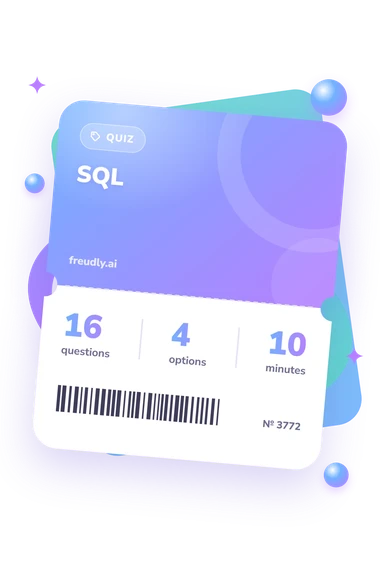
Together, these tasks show how the respondent handles common relational-database operations and which topics may deserve focused review. The single displayed scale is SQL Knowledge (0-16), with three catalogue bands:
- Foundation to build (0-6) indicates that core query and data-integrity concepts need review.
- Developing knowledge (7-12) shows many core concepts with gaps in less familiar applications.
- Strong knowledge (13-16) reflects solid command of common SQL concepts and practical query reasoning.
Methodology and Evidence Base
Each item presents a practical situation with four answer choices. The respondent selects the operator, clause, predicate, expression, or command that meets the stated requirement. This multiple-choice design samples recognition of correct SQL behavior; it does not show whether the respondent can independently write a complete solution.
The displayed result is a total on the displayed scale. The catalogue gives ranges and labels, but no separate certification pass mark or weighting rule for individual options. The bands are learning feedback rather than a formal qualification.
Boisvert et al. (2018) provides the closest supporting evidence because it examines student SQL and relational-database knowledge through task performance and automated grading. This questionnaire is conceptually consistent with that emphasis, but it is not presented as an adaptation of that study. ISO/IEC 9075-2:2023 supplies the formal SQL reference, while Elmasri and Navathe support joins, keys, grouping, transactions, and NULL. OWASP supports the parameterized-query guidance for reducing injection risk.
The main limitations are guessing, recent practice, familiarity with a particular SQL dialect, and the difference between recognizing a correct statement and writing a query independently. The result can function as an SQL skills assessment for checking progress after practice, with missed topics pointing toward useful exercises.
- Boisvert, Charles, Konstantinos Domdouzis, and Joshua License. "A Comparative Analysis of Student SQL and Relational Database Knowledge Using Automated Grading Tools." 2018 International Symposium on Computers in Education (SIIE), 2018, pp. 1-5. 10.1109/SIIE.2018.8586684.
- International Organization for Standardization and International Electrotechnical Commission. ISO/IEC 9075-2:2023: Information technology - Database languages SQL - Part 2: Foundation (SQL/Foundation). Geneva: ISO, 2023. Technical Corrigendum 1:2026.
- Elmasri, Ramez, and Shamkant B. Navathe. Fundamentals of Database Systems. 7th ed. Pearson, 2016.
- OWASP Foundation. SQL Injection Prevention Cheat Sheet. OWASP Cheat Sheet Series, n.d.
Updated: