
Spring Quiz
How the Scales are Structured
Who Usually Takes This Test?
See How You Compare
Below is a preview of how scores are typically distributed across each scale.
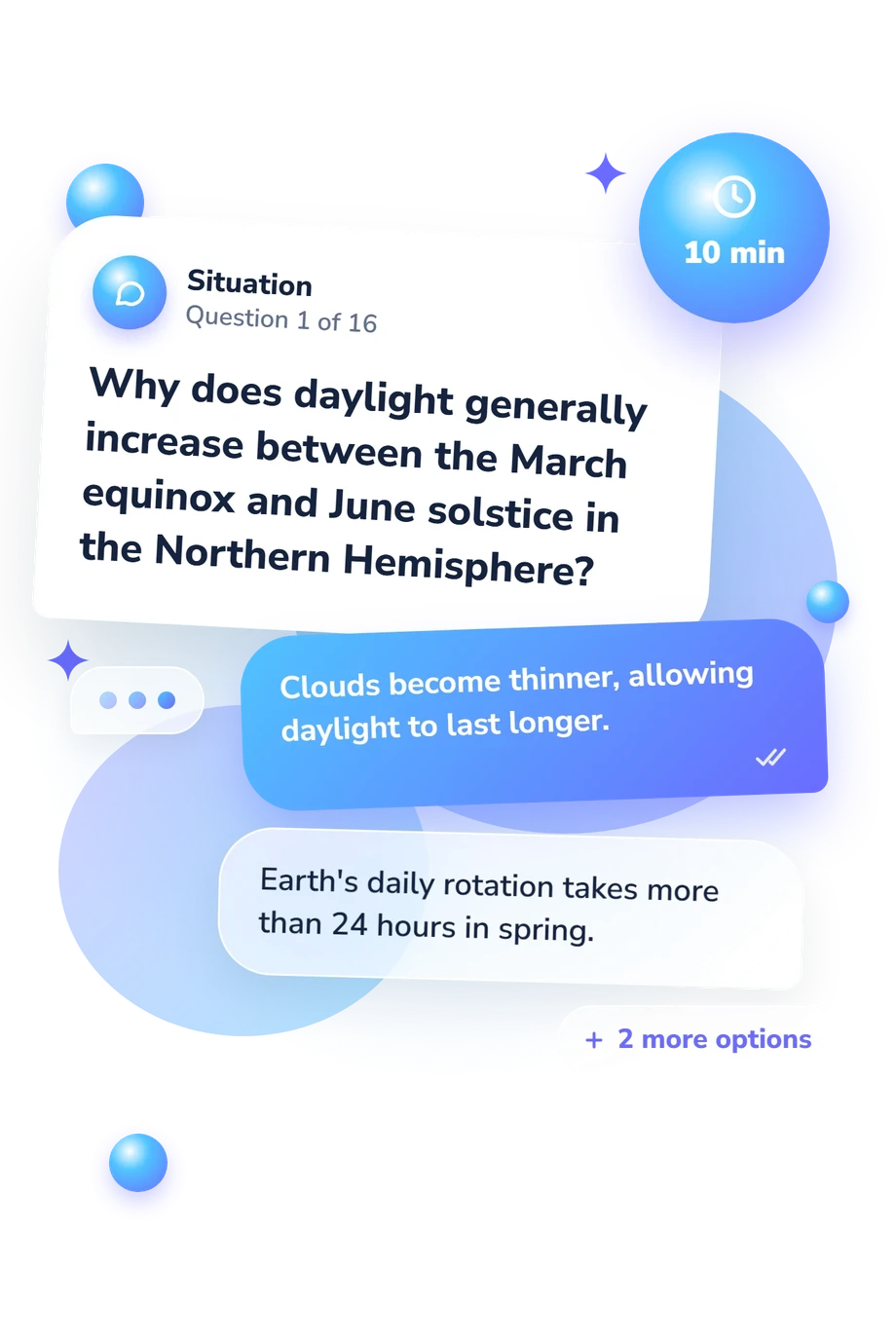
Example Questions From the Test
- Earth's axis temporarily stops being tilted.
- Earth is at its closest point to the Sun.
- The Sun's direct rays are over one of the polar circles.
- The Sun's direct rays are over the equator.
- Both the Sun and raindrops should be behind you.
- The Sun should be ahead of you, with raindrops behind you.
- The Sun should be behind you, with raindrops ahead of you.
- Both the Sun and raindrops should be directly overhead.
- Lie flat in an open area away from buildings.
- Shelter beneath the tallest nearby tree until the rain arrives.
- Go into a substantial building or enclosed hard-topped vehicle.
- Continue gardening until lightning is visible directly overhead.
Spring Quiz - Description and methodology of the test
For curious learners, the spring quiz offers a focused way to connect familiar seasonal changes with the science behind them. It suits readers who want to check how Earth’s tilt, weather, ecosystems, and gardening decisions fit together. Questions from this spring assessment move from core concepts to everyday applications, allowing the result to show which areas feel secure and which deserve further attention.
What This Assessment Explores
Spring is treated as an interconnected scientific topic rather than a calendar label. Items examine changing daylight and solar position, equinoxes and spring tides, weather hazards, pollen, snowmelt, and frost. Other questions address phenology, migration, temporary wetlands, flowering, pollinators, and stored plant energy. As a spring season quiz, it suits anyone seeking a general science check with practical seasonal relevance.
The result uses one catalogue scale: Spring Knowledge (0-16), which summarizes correct answers across astronomy, weather, ecology, and practical seasonal knowledge. Its three displayed bands are:
- Early Sprout (0-6) indicates recognition of some spring ideas while several underlying processes may remain confused.
- Growing Knowledge (7-12) shows a useful grasp of spring science that applies in many situations, with a few concepts to strengthen.
- Full Bloom (13-16) reflects strong, wide-ranging understanding and accurate application of seasonal principles.
Methodology and Scientific Basis
Each item uses a multiple-choice format with one best answer and plausible alternatives. The free questions about spring ask the respondent to choose the strongest explanation rather than rate a feeling or personal experience. This structure makes the score a count of correct responses, not a subjective profile.
Its evidence base is conceptually consistent with the Seasons and Climate Achievement Test (Yurtyapan et al., 2023), which addresses school-level seasons and climate knowledge, and with Birgin and Özcan’s instrument on season formation. Schwartz and Hanes (2010) offer a relevant framework for comparing the onset of spring through phenological measures, while Hufnagel (2002) illustrates diagnostic multiple-choice design in astronomy education. This questionnaire is not an adaptation of those published instruments; it is an online knowledge check with related subject matter.
The spring assessment and its answers indicate performance on the sampled topics, not mastery of all spring science. Guessing, prior instruction, wording, and familiarity with local seasonal conditions can affect results, so the bands are best read as a snapshot rather than a norm-referenced standard score or clinical classification.
- Emine Yurtyapan and Ayşe Gül Çirkinoğlu Şekercioğlu. "Development of an Achievement Test for the \"Seasons and Climate\" Unit of the Eighth Grade Science Course in Secondary School." International Journal of Contemporary Educational Research, 10(4), 893-916 (2023). 10.52380/ijcer.2023.10.4.501
- Aytekin Birgin and Hasan Özcan. "Development of an Instrument for Measuring 8th Grade Students' Knowledge about Formation of Seasons." Trakya University Journal of Social Science, 24(1), 305-326 (2022). 10.26468/trakyasobed.817792
- Mark D. Schwartz and Jonathan M. Hanes. "Intercomparing Multiple Measures of the Onset of Spring in Eastern North America." International Journal of Climatology, 30(11), 1614-1626 (2010). 10.1002/joc.2008
- Beth Hufnagel. "Development of the Astronomy Diagnostic Test." Astronomy Education Review, 1(1), 47-51 (2002). 10.3847/AER2001004
Updated: