
Spanish Speaking Countries Flags Quiz
How the Scales are Structured
Who Usually Takes This Test?
See How You Compare
Below is a preview of how scores are typically distributed across each scale.
Example Questions From the Test
- Uruguay
- Argentina
- Honduras
- El Salvador
- Mexico
- Peru
- Chile
- Paraguay
- Dominican Republic
- Paraguay
- Cuba
- Costa Rica
Spanish Speaking Countries Flags Quiz - Description and methodology of the test
Whether you are checking how you distinguish closely related national designs or exploring familiar symbols, this assessment offers a focused visual challenge. The Spanish Speaking Countries Flags Quiz is intended for travelers, students, and anyone interested in national flags; its result indicates performance on the described flags. By asking you to connect flag details with country identification, the Spanish flags quiz turns visual observation into a country-labeling task.
What This Assessment Explores
These questions measure practical flag recognition by linking colors, geometry, emblems, and symbols to the correct Spanish-speaking country. They suit learners, travelers, students, and anyone curious about similar national designs.
The result shows how many described flags you identify correctly and represents your performance on this flag-knowledge set. The Spanish-speaking flags quiz asks respondents to compare similar regional flag patterns, especially when colors and layouts overlap.
The question groups are:
- Spanish-Speaking Countries Flags Knowledge (0-16) records correct answers as Flag Explorer (0-6), Developing Navigator (7-12), or Flag Specialist (13-16).
- Color and layout recognition shows whether band order, tribands, quarters, and crosses guide your choice.
- Emblems and symbols indicate whether you notice shields, stars, suns, birds, seals, and similar identifiers.
- Close-flag comparison shows how well you separate designs that share colors or basic layouts.
Methodology and Evidence Base
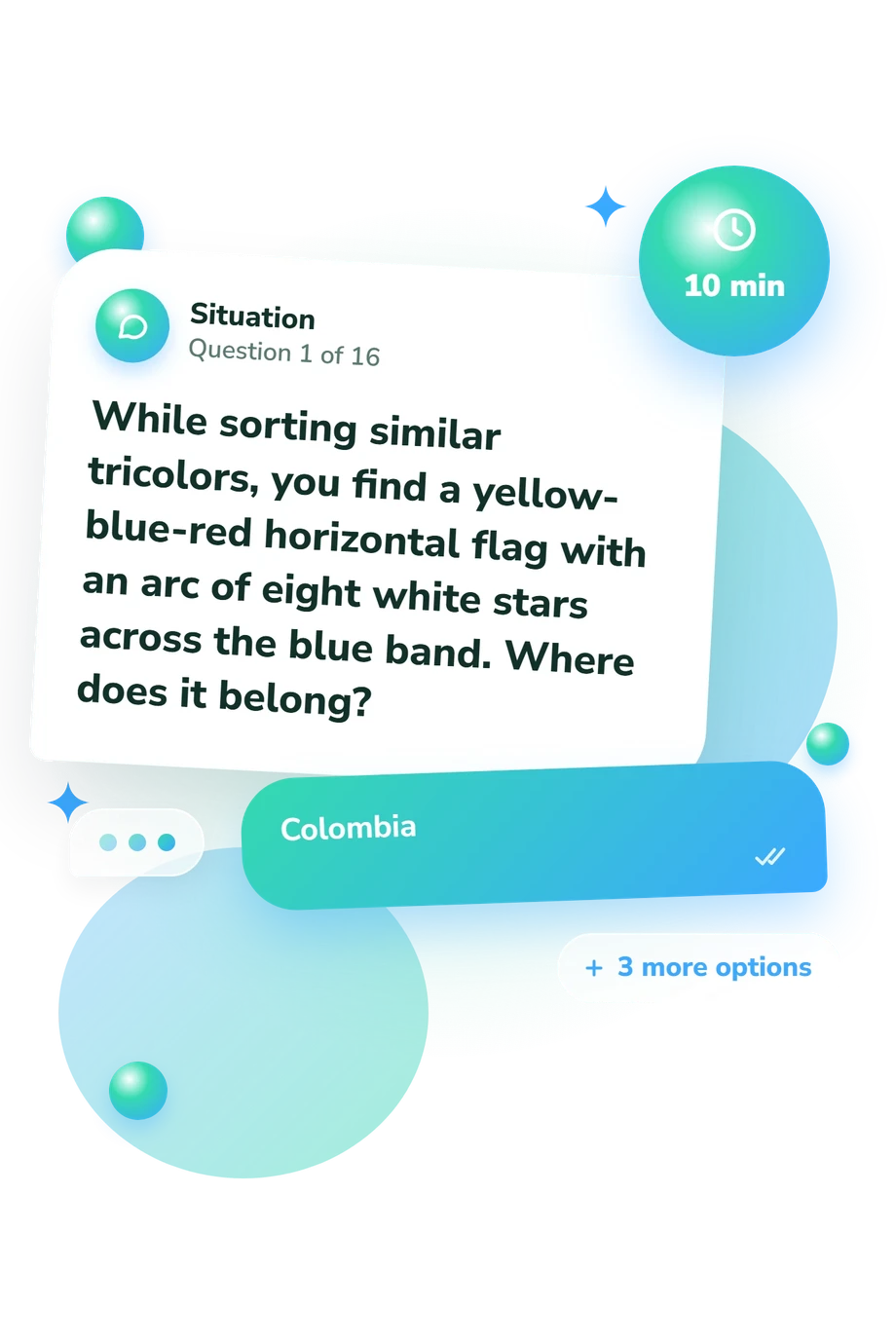
Each item presents a concise flag description or comparison with four country choices. The respondent selects one answer, and the total reflects correct identifications. Testing flags of Spanish-speaking countries in this quiz through four answer choices combines recall, visual analysis, and careful reading.
The method is four-option, criterion-scored knowledge testing: each response is judged against the named country's correct flag. Vexillological sources supply terminology and context for flag content, not validation of this online questionnaire. Morales-Ramirez (2018) discusses design features, symbolism, and context relevant to the flags covered here, but this questionnaire is not an adaptation of that study. Barraclough and Crampton (1981), Smith (1975), and Znamierowski (1999) support content terminology and historical or international context; none establishes its scoring or standardization.
As an online knowledge exercise, it provides correct-answer bands without stated norming or reliability data. Attention, memory, familiarity with particular countries, and translating words into a mental image can affect performance. A lower score indicates fewer correct identifications rather than specific learning topics or a psychological condition.
- Morales-Ramirez, Carlos A. (2018). The Puerto Rican Flag - A Study in Vexillology. Research in Social Sciences and Technology, 3(3), 42-67. 10.46303/ressat.03.03.4.
- Barraclough, E. M. C., and Crampton, William G. (1981). Flags of the World. London: Frederick Warne. ISBN 0723227977.
- Smith, Whitney. (1975). Flags Through the Ages and Across the World. New York: McGraw-Hill.
- Znamierowski, Alfred. (1999). The World Encyclopedia of Flags: The Definitive Guide to International Flags, Banners, Standards and Ensigns. London: Lorenz. ISBN 0754801675.
Updated: