
Spanish Level Quiz
How the Scales are Structured
Who Usually Takes This Test?
See How You Compare
Below is a preview of how scores are typically distributed across each scale.
Example Questions From the Test
- Es a la biblioteca.
- Está la biblioteca.
- Está en la biblioteca.
- Es en la biblioteca.
- vive
- vivís
- vivimos
- viven
- por eso
- sin embargo
- además
- es decir
Spanish Level Quiz - Description and methodology of the test
People who want a clear snapshot of their practical Spanish can use this assessment to check vocabulary, grammar, and reading in context. The Spanish Level Quiz is suited to learners who want to identify strengths before choosing what to practise next. It works especially well as a how much Spanish do you know quiz when you need a quick orientation rather than a formal language certificate.
What This Assessment Explores
Rather than testing one isolated rule, the questionnaire samples abilities used in everyday Spanish. A how well do you know Spanish quiz is most useful when its result is read as a profile of these areas:
- Vocabulary recognition shows whether familiar words are understood in context.
- Grammatical control reflects agreement, tense, mood, pronouns, prepositions, and sentence structure.
- Reading comprehension measures whether you find explicit information and infer meaning from short passages.
- Functional language use shows how accurately you handle polite requests and everyday transactions.
The items combine basic forms with hypothetical statements, time relationships, connectors, and repeated actions. They indicate how confidently you handle written Spanish in familiar situations, while the result remains a guide for practice rather than a measure of spontaneous speaking.
Methodology and Evidence Base
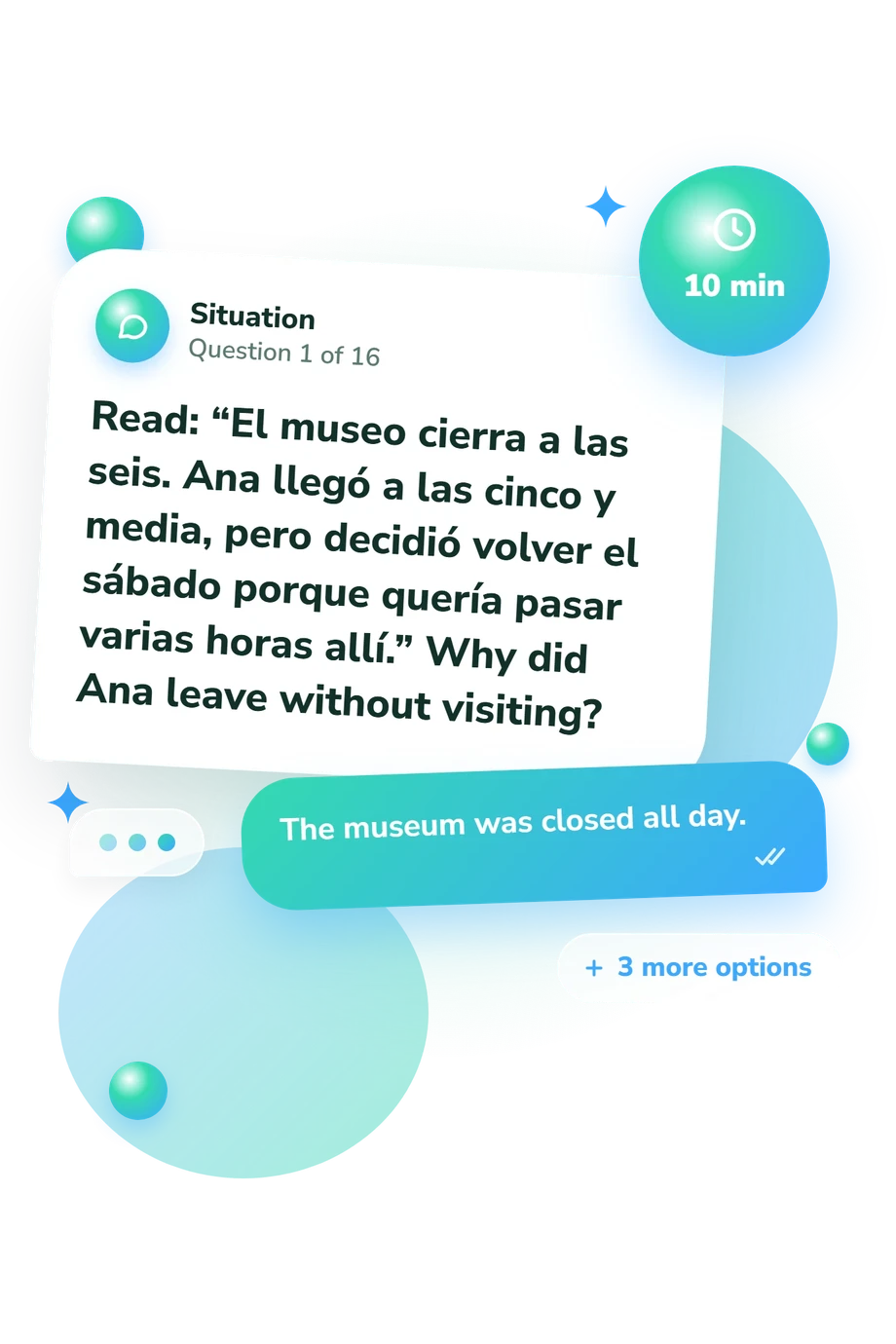
Each item uses a question or short scenario with four answer options. Some require sentence completion or a natural reply; others test pronouns, tense, politeness, connectors, or passage meaning. The alternatives make the task a choice among plausible forms, not simple word recognition.
The methodology is conceptually consistent with DIALANG (Huhta et al., 2002), a diagnostic approach linking language tasks with proficiency descriptions. It also aligns with CEFR-oriented development discussed by Alderson and Huhta (2005), Spanish reference levels from the Instituto Cervantes, and the Council of Europe's later proficiency descriptors. This is not a standardized DIALANG test, certified CEFR examination, or adaptation of those instruments.
Results are presented as one Spanish Knowledge score from 0-16. The bands are Foundation building 0-6, Developing proficiency 7-12, and Strong knowledge 13-16. They distinguish reinforcement needs, developing control of everyday structures, and reliable performance on foundational and advanced items; they do not certify a CEFR level or assess speaking, listening, and writing. This format works as a how much Spanish do I know quiz and can help set study priorities, but the informal snapshot may vary with attention, prior study, unfamiliar vocabulary, and current context.
- Huhta, Ari, Sari Luoma, Mats Oscarson, Kari Sajavaara, Sauli Takala, and Alex Teasdale. 2002. "DIALANG: A Diagnostic Language Assessment System for Adult Learners." In J. Charles Alderson (ed.), Common European Framework of Reference for Languages: Learning, Teaching, Assessment: Case Studies, pp. 130-144. Strasbourg: Council of Europe Publishing.
- Alderson, J. Charles, and Ari Huhta. 2005. "The Development of a Suite of Computer-Based Diagnostic Tests Based on the Common European Framework." Language Testing 22(3): 301-320. DOI 10.1191/0265532205lt310oa.
- Instituto Cervantes. 2006. Curricular Plan of the Instituto Cervantes: Reference Levels for Spanish. Madrid: Biblioteca Nueva.
- Council of Europe. 2020. Common European Framework of Reference for Languages: Learning, Teaching, Assessment-Companion Volume. Strasbourg: Council of Europe Publishing.
Updated: