
Southern Slang Quiz
How the Scales are Structured
Who Usually Takes This Test?
See How You Compare
Below is a preview of how scores are typically distributed across each scale.
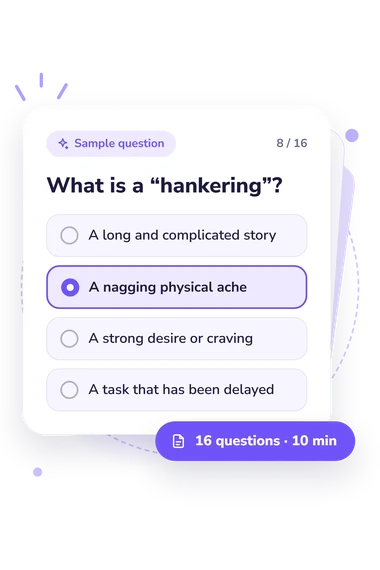
Example Questions From the Test
- A promise that help will definitely be provided
- A tentative sense that helping may be possible
- A claim that helping is physically impossible
- A complaint about being asked to help
- They are chewing the fat
- They are minding their manners
- They are putting on the dog
- They are pitching a hissy fit
- Only members of the speaker’s family
- One person being spoken about
- Two or more people being spoken to
- Any group that includes the speaker
Southern Slang Quiz - Description and methodology of the test
Regional-language enthusiasts, travelers, educators, and anyone curious about American English can use this assessment to check familiarity with Southern wording in context. The southern slang quiz focuses on understanding rather than accent performance or proof of cultural identity. It gives a single overall indication of how accurately selected expressions are recognized. Because it is a quiz about Southern sayings, it can guide further reading, listening, and self-directed language exploration.
What This Assessment Explores
These questions test recognition of meaning, usage, and implied attitude rather than accent or identity. Context matters: “bless your heart” can express affection or soften criticism, while “that dog won’t hunt” signals doubt.
The question themes are:
- Context-sensitive expressions show how tone changes a phrase.
- Regional grammar shows whether forms such as y’all and might could are understood.
- Figurative idioms show meanings linked to anger, fullness, resolve, or age.
- Everyday vocabulary shows whether words for direction, desire, and action are recognized.
All items feed Southern Slang Knowledge (0-16), which reflects recognition accuracy. Its bands are New to the Lingo (0-6), Slang Savvy (7-12), and Southern Slang Standout (13-16). These labels describe familiarity with selected expressions, not authenticity or cultural belonging. As a quiz about Southern expressions, it can support curiosity about regional English.
Methodology and Evidence Base
Each item in this southern slang test presents a short sentence or situation with four answer choices. Selecting the best meaning tests vocabulary recognition alongside context, figurative language, and grammar. The questionnaire presents one accuracy-based total rather than separate subscale scores. The four-choice format checks comprehension in use rather than isolated definitions.
Content is conceptually consistent with Hendrickson (1993), the closest reference for idiomatic meanings. Bernstein (2003) helps frame forms such as y’all, might could, and fixin’ to, while Montgomery and Heinmiller (2021) and Cassidy and Hall’s regional dictionary document wider variation in Southern usage.
These works support interpretation of the expressions, not authorship or validation of this online quiz. The result bands are quiz-specific familiarity labels: they describe performance on these selected expressions rather than standardized population standing. Results can reflect prior exposure to Southern speech, media, family usage, and local variation, while meanings may shift with speaker, place, tone, and situation. A missed item may reflect unfamiliarity with that usage at the time, rather than stable language ability.
- Hendrickson, Robert. "Whistlin' Dixie: A Dictionary of Southern Expressions." Facts on File, 1993.
- Bernstein, Cynthia Goldin. "Grammatical Features of Southern Speech: Yall, Might Could, and Fixin to." In English in the Southern United States, edited by Stephen J. Nagle and Sara L. Sanders, 106-118. Cambridge University Press, 2003. 10.1017/CBO9780511486715.007
- Montgomery, Michael B., and Jennifer K. N. Heinmiller, editors. Dictionary of Southern Appalachian English. University of North Carolina Press, 2021.
- Cassidy, Frederic G., and Joan Houston Hall, editors. Dictionary of American Regional English. 5 vols. Belknap Press of Harvard University Press, 1985-2012.