
Soil Quiz
How the Scales are Structured
Who Usually Takes This Test?
See How You Compare
Below is a preview of how scores are typically distributed across each scale.
Example Questions From the Test
- Persistent depletion of all organic matter
- Periods of saturation and restricted oxygen availability
- Recent contamination by synthetic fertilizer
- Extremely rapid drainage through coarse sand
- They make the nutrients permanently insoluble
- They turn the nutrients into organic matter
- Their large pores prevent nutrients from contacting water
- Their charged surfaces provide cation-exchange sites
- The resistance of soil to changes in pH
- The way soil particles form aggregates or clumps
- The amount of decomposed organic material in soil
- The relative proportions of sand, silt, and clay
Soil Quiz - Description and methodology of the test
When a planting, watering, or amendment decision raises questions, the soil quiz helps connect visible conditions with relevant soil principles. This quiz about soil presents practical situations involving slow drainage, crusting, pale leaves, or runoff, so you can consider likely causes and sensible responses before acting. Its educational result shows how accurately you apply core concepts.
What This Assessment Explores
This assessment asks whether a reader can interpret soil properties and choose practical management responses. The assessment is a soil science quiz for people building foundational knowledge, linking concepts with planting, watering, fertilizing, and surface protection. The questions test applying ideas to observations rather than simply recalling terms.
It covers four areas:
- Texture and structure show how particle size and aggregation affect roots and soil behavior.
- Water and drainage indicate how infiltration, runoff, saturation, and storage affect plants.
- Nutrients and pH show how test results and leaf symptoms guide amendments.
- Organic matter and biology connect residues, earthworms, and aggregation with management.
Together, these themes produce an educational result about soil science. Strong performance reflects the ability to connect observations with actions, while a lower result identifies topics to revisit. The result describes demonstrated knowledge and practical interpretation, not a soil condition.
Methodology and Scientific Basis
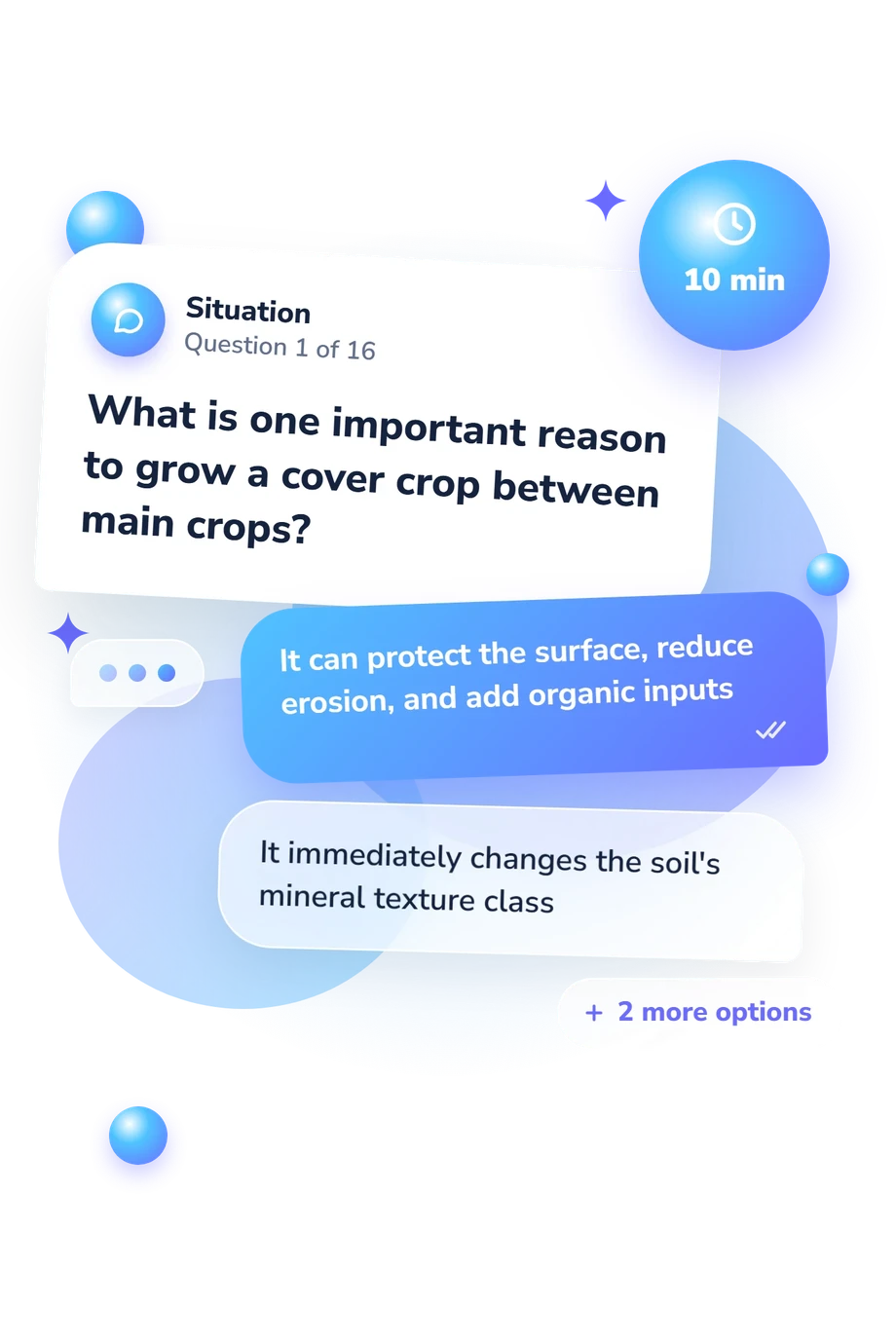
The questionnaire presents soil science questions with four answer choices; the respondent selects the best option for each item. Scenarios involve cover crops, runoff, compaction, salts, pH, nutrient symptoms, texture, structure, and jar-test settling. This format tests recognition and interpretation rather than attitudes.
The questionnaire is conceptually consistent with soil-science teaching and interpretation in work by Krzic and Brown, Weil and Brady, and Soil Science Division Staff. These sources frame its content; they are not source instruments for this questionnaire. It is an educational questionnaire whose bands function as learning categories rather than standardized norms.
Scoring awards one point for each correct answer, producing the Soil Knowledge scale from 0 to 16. The displayed bands are Groundwork (0-6), Developing Knowledge (7-12), and Strong Soil Knowledge (13-16). They describe demonstrated knowledge of the tested material and practical interpretation.
Results offer a focused learning snapshot, while the four-option format leaves room for guessing, attention, prior instruction, and differing interpretations of the scenarios. The result reflects knowledge and test-taking conditions, making review of missed concepts useful for planning study.
- Krzic, Maja, and Sandra Brown. Question Banks for Effective Online Assessments in Introductory Science Courses. Natural Sciences Education, 51, e20091, 2022. 10.1002/nse2.20091
- Weil, Ray R., and Nyle C. Brady. The Nature and Properties of Soils. 15th ed. Pearson, 2017.
- Soil Science Division Staff. Soil Survey Manual. 4th ed. Edited by C. Ditzler, K. Scheffe, and H. C. Monger. USDA Handbook 18. Government Printing Office, 2017.
Updated: