
Social Psychology Quiz
How the Scales are Structured
Who Usually Takes This Test?
See How You Compare
Below is a preview of how scores are typically distributed across each scale.
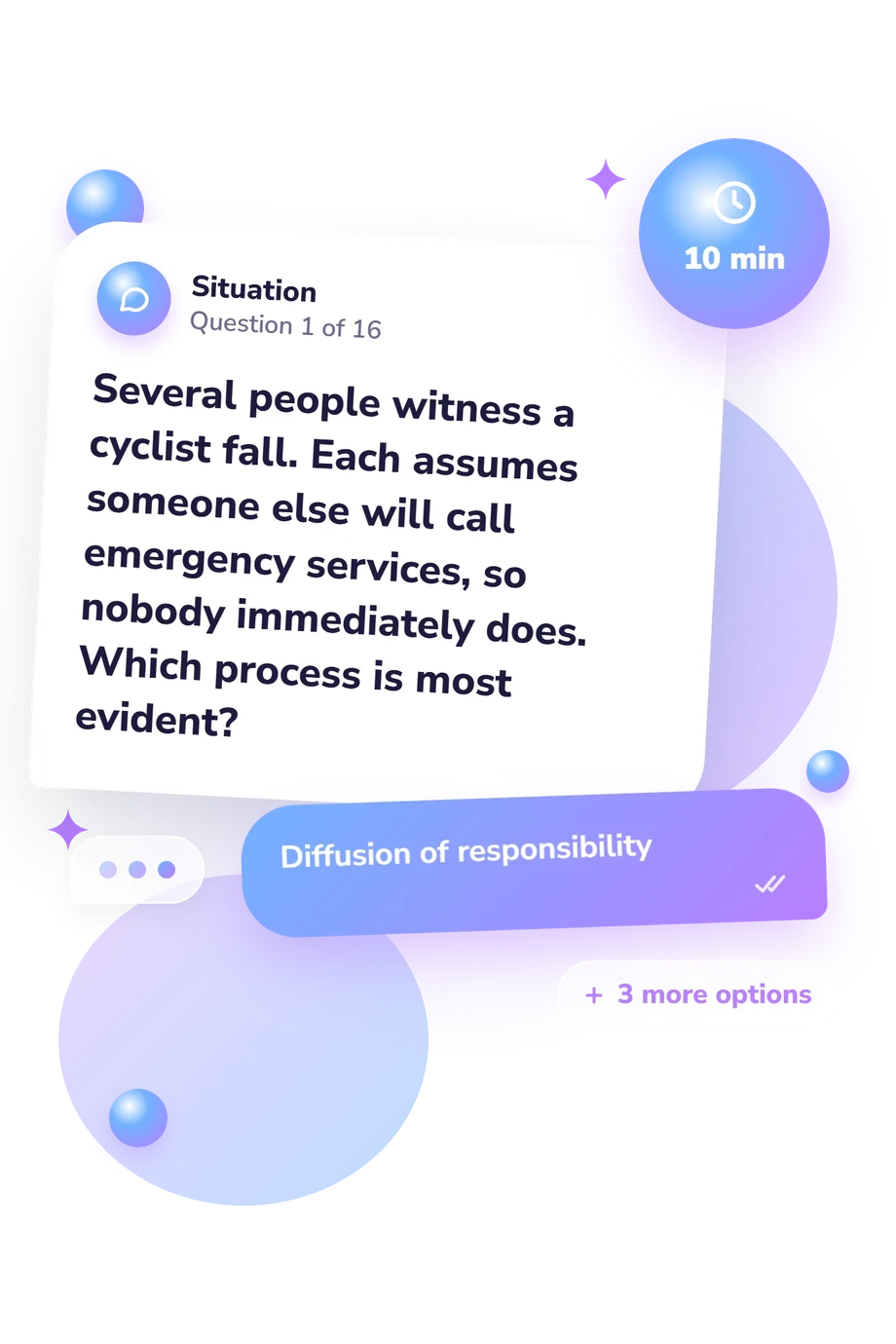
Example Questions From the Test
- Psychological reactance
- Confirmation bias
- Pluralistic ignorance
- Cognitive dissonance
- Diffusion of responsibility
- Social loafing
- Group polarization
- Out-group homogeneity
- Groupthink
- Social compensation
- Group polarization
- Pluralistic ignorance
Social Psychology Quiz - Description and methodology of the test
Readers who want to review foundational social behavior can use this assessment to check whether they recognize core concepts in context. The social psychology quiz focuses on applying terms to brief situations rather than reporting personal experiences. It is useful for students, curious learners, and anyone revising introductory material. Working through social psychology questions can identify concepts worth revisiting and guide focused study.
What This Assessment Explores
Readers who want to distinguish related social processes can use this assessment while revising introductory material or checking core terminology. The items examine how people interpret, respond to, and influence one another when attitudes conflict, groups exert pressure, responsibility is shared, or identities shape judgment.
The thematic groups below show what the result represents:
- Cognitive processes show how dissonance, attribution, and biases shape interpretation.
- Group behavior shows how audiences, anonymity, discussion, and shared responsibility affect action.
- Persuasion and compliance show how messages, repetition, and staged requests change responses.
- Social identity and intergroup relations show how belonging, cooperation, and rivalry shape evaluations.
As a social psychology knowledge test, it reflects recognition of selected foundational concepts across these topics. Social Psychology Knowledge runs from 0-16, with one point for each correct answer. The bands are Foundation to build (0-6), Developing knowledge (7-12), and Strong knowledge (13-16).
Methodology and Scientific Basis
Each item presents a short social situation, four answer choices, and one best concept to identify. The format tests recognition and application: accuracy depends on noticing the defining mechanism and separating it from related distractors. This social psychology assessment samples conceptual knowledge, not personal tendencies or lived experience.
Scoring assigns one point for each correct response, and the total is interpreted through the displayed educational bands. It summarizes performance on this selected set rather than every aspect of social-psychological knowledge. Guessing, wording interpretation, memory, and prior coursework can affect the outcome.
The conceptual reference point is Aronson, Wilson, and Sommers (2021), whose coverage includes influence, attribution, groups, persuasion, and intergroup behavior. Related themes correspond with Festinger’s cognitive-dissonance theory, Darley and Latané’s account of diffusion of responsibility, and Tajfel and Turner’s social-identity approach. The questionnaire is conceptually consistent with these works, not an adaptation of one published instrument.
This questionnaire has no stated population norms, reliability estimates, or clinical cutoffs, so use the result to target further study rather than claim professional expertise or diagnose a condition.
- Aronson, E., Wilson, T. D., & Sommers, S. R. (2021). Social Psychology (10th ed.). Pearson.
- Festinger, L. (1957). A Theory of Cognitive Dissonance. Stanford University Press.
- Darley, J. M., & Latané, B. (1968). Bystander intervention in emergencies: Diffusion of responsibility. Journal of Personality and Social Psychology, 8(4, Pt. 1), 377-383. 10.1037/h0025589
- Tajfel, H., & Turner, J. C. (1979). An integrative theory of intergroup conflict. In W. G. Austin & S. Worchel (Eds.), The Social Psychology of Intergroup Relations (pp. 33-47). Brooks/Cole.
Updated: