
Self-Focused Attention Scale (SFAS) Test
How the Scales are Structured
Who Usually Takes This Test?
See How You Compare
Below is a preview of how scores are typically distributed across each scale.
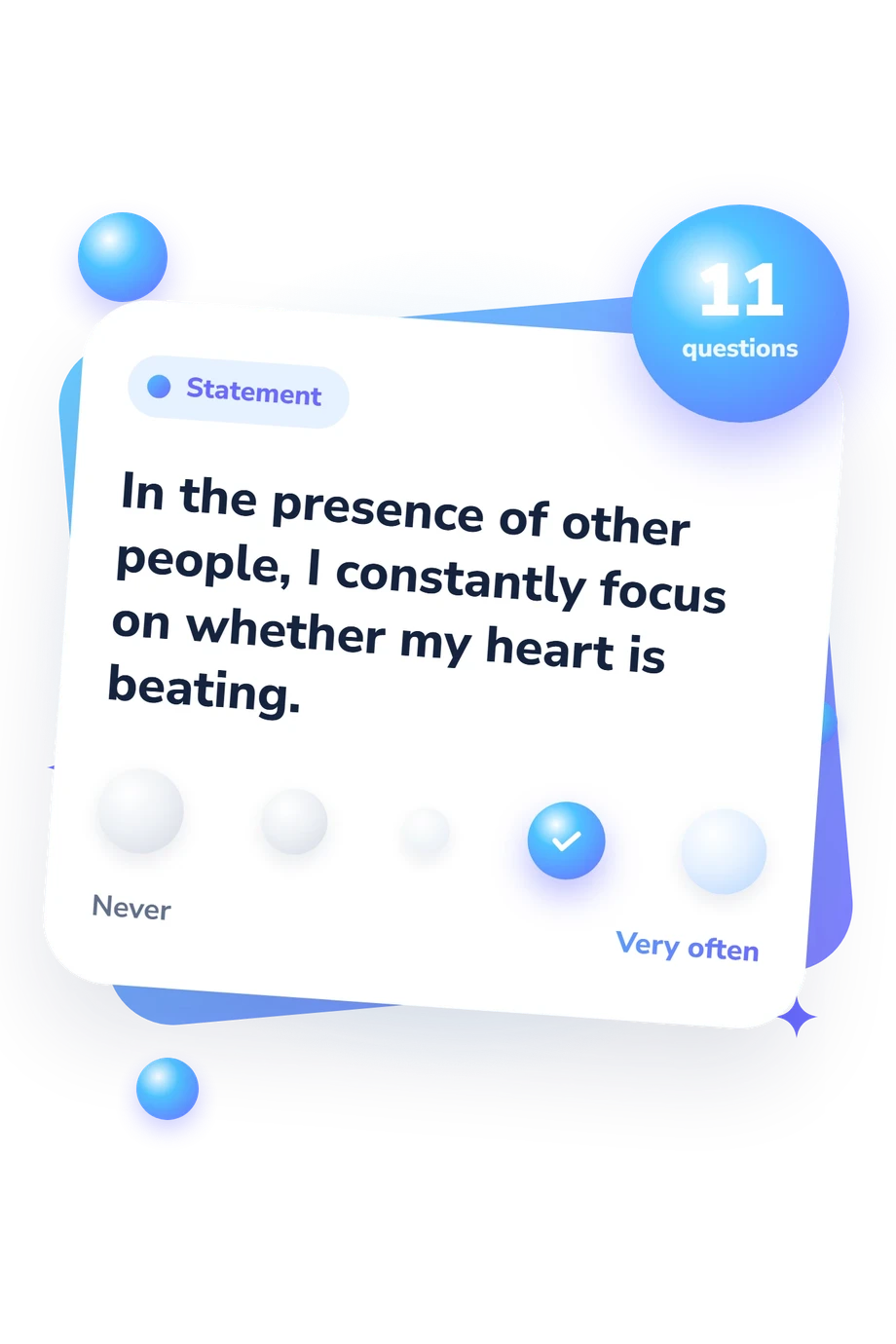
Example Questions From the Test
- Never
- Rarely
- Sometimes
- Often
- Very often
- Never
- Rarely
- Sometimes
- Often
- Very often
- Never
- Rarely
- Sometimes
- Often
- Very often
Self-Focused Attention Scale (SFAS) Test - Description and methodology of the test
For readers deciding whether to examine bodily and social self-monitoring, the Self-Focused Attention Scale (SFAS) Test offers a brief self-report profile of attention in social situations. It can serve as a self-awareness assessment for readers considering that pattern. Such reflection can focus on bodily signals. Bodily awareness is one context for observing attention; social performance provides another. The result summarizes the pattern represented by selected responses.
What This Assessment Explores
Rather than measuring one emotion, the questionnaire examines where attention goes during inner experience and social functioning. Its situations include bodily arousal, tension, conversation, social skills, appropriate behavior, and understanding others. Together, they represent inward monitoring of physical signals and social performance.
The result describes a tendency rather than a label. Higher inward attention may reflect self-reflection or monitoring of tension; lower inward attention suggests greater orientation toward external events. This self-focused attention scale can help readers notice patterns for personal reflection.
The item themes are:
- Self-Focused Attention: 0-44 - this dimension reflects attention to thoughts, feelings, body signals, and internal experiences; Low self-focus 0-10, Moderate self-focus 11-28, and High self-focus 29-44 are the displayed bands.
- Bodily and tension monitoring captures awareness of heartbeat, breathing, blushing, sweating, trembling, and visible tension.
- Social-performance monitoring reflects attention to fluency, participation, social skills, appropriate behavior, and understanding.
Methodology and Evidence Base
Each statement offers five options, from Never to Very often. The respondent chooses one for each statement, including perceived social abilities and bodily or visible tension. The online form provides the displayed score bands without a documented point-conversion rule or standardization data; the answer choices therefore cannot establish how points are assigned.
Conceptually, the questionnaire is consistent with Bögels, Alberts, and de Jong’s 1996 instrument, which examined attention to arousal and self-related experience. It is not presented as an adaptation of that instrument. Scheier and Carver’s 1977 work links self-focused attention with emotional experience, while Noda and colleagues’ 2021 study examined factor structure and validity in a Japanese version. These studies provide conceptual or version-specific evidence, not validation, norms, or standardization for this online questionnaire.
This self-focused attention questionnaire has no clinical cutoff or population norms. The result is a snapshot shaped by current context, self-awareness, and response style: a high score may reflect a stable tendency, temporary tension, or heightened bodily monitoring. It can guide reflection, but persistent distress or impairment calls for broader assessment.
- Bögels, Susan M., Maurice Alberts, and Peter J. de Jong. "Self-consciousness, self-focused attention, blushing propensity and fear of blushing." Personality and Individual Differences, 21(4), 573-581 (1996). DOI 10.1016/0191-8869(96)00100-6
- Scheier, Michael F., and Charles S. Carver. "Self-focused attention and the experience of emotion: attraction, repulsion, elation, and depression." Journal of Personality and Social Psychology, 35(9), 625-636 (1977). DOI 10.1037//0022-3514.35.9.625
- Noda, Shota, Sho Okawa, Kentaro Shirotsuki, Satoko Sasagawa, and Susan M. Bögels. "The Japanese self-focused attention scale: Factor structure, internal consistency, convergent, and discriminant validity." Journal of Clinical Psychology, 77(9), 2011-2026 (2021). DOI 10.1002/jclp.23133
Updated: