
Sense of Coherence Scale (SOC) Test
How the Scales are Structured
Who Usually Takes This Test?
See How You Compare
Below is a preview of how scores are typically distributed across each scale.
Example Questions From the Test
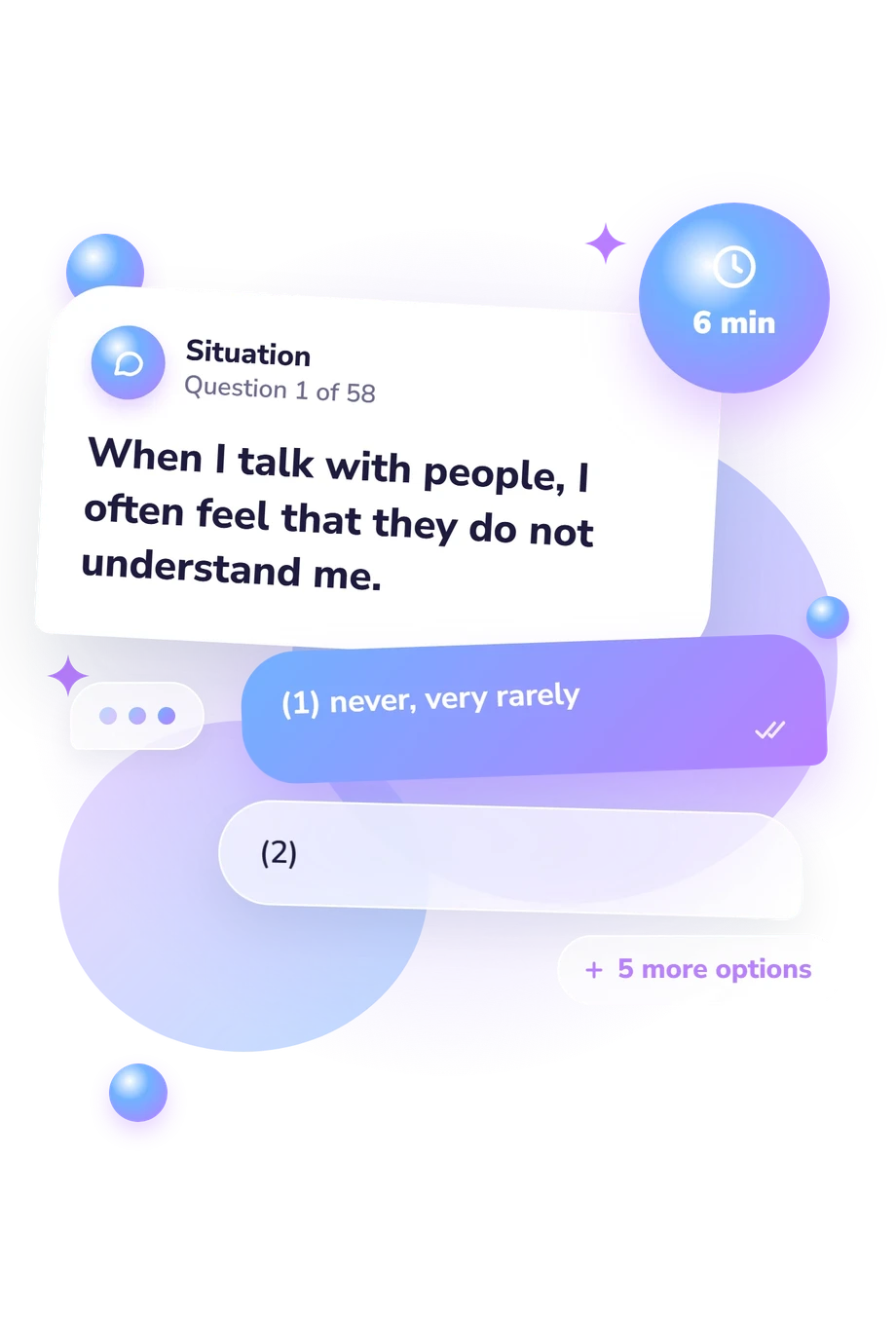
- (1) never, very rarely
- (2)
- (3)
- (4)
- (5)
- (6)
- (7) very often, always
- (1) never, very rarely
- (2)
- (3)
- (4)
- (5)
- (6)
- (7) very often, always
- (1) am surprised how poorly I know them
- (2)
- (3)
- (4)
- (5)
- (6)
- (7) am sure I know them very well
Sense of Coherence Scale (SOC) Test - Description and methodology of the test
People who want to understand how they orient themselves under uncertainty may find the Sense of Coherence Scale (SOC) Test useful for focused self-reflection. It examines whether daily events seem understandable, resources feel available, and effort appears worthwhile. It describes a coping orientation rather than assigning a diagnosis or fixed judgment about personality.
What This Assessment Explores
This assessment looks at how life is experienced as structured, predictable, and meaningful, especially when circumstances change or demands become difficult. The result helps respondents consider whether situations make sense, resources feel available, and challenges seem worth sustained effort.
Three related dimensions organize the result:
- Comprehensibility reflects whether events and inner experiences appear ordered enough to understand.
- Manageability indicates whether a person feels able to draw on personal, social, or practical resources when demands arise.
- Meaningfulness captures whether ordinary responsibilities and major challenges seem valuable enough to engage with.
The overall Sense of Coherence scale is scored from 27-189. Its displayed bands are Low coherence 27-113; Moderate coherence 114-155; and High coherence 156-189. A higher band generally indicates a stronger perceived orientation toward understanding, coping, and engagement, while the score remains a snapshot of self-reported experience.
Methodology and Scientific Basis
The items use a seven-point response continuum, with endpoints describing frequency, confidence, emotional reaction, or contrasting views of life. Respondents select the position that best matches personal experience. The online questionnaire’s weighting and reverse-scoring procedure is not documented.
This SOC questionnaire is conceptually consistent with Sense of Coherence Scale (Antonovsky, 1993), the 29-item instrument developed within Aaron Antonovsky’s salutogenic model, but it should not be treated as a validated adaptation of that publication. The framework treats coherence as an orientation involving comprehensibility, manageability, and meaningfulness rather than a single mood or coping skill. The items sample relationships, change, uncertainty, purpose, setbacks, and problem solving.
Eriksson and Lindström’s systematic review reported generally supportive validity evidence across varied settings while showing that results can differ by population, language, and application. The published evidence supports the construct but does not establish population norms or clinical thresholds for this online version.
Interpret the result as current self-perceived orientation, not a permanent trait. Mood, recent stress, self-awareness, and candor can shape responses, so interpret the score in light of the circumstances in which you answered.
- Antonovsky, Aaron. The structure and properties of the sense of coherence scale. Social Science & Medicine, 36(6), 725-733, 1993. 10.1016/0277-9536(93)90033-Z
- Antonovsky, Aaron. Unraveling the mystery of health: How people manage stress and stay well. San Francisco: Jossey-Bass, 1987.
- Eriksson, Monica, and Bengt Lindström. Validity of Antonovsky's sense of coherence scale: A systematic review. Journal of Epidemiology and Community Health, 59(6), 460-466, 2005. 10.1136/jech.2003.018085
Updated: