
Adolescent Existential Scale Test
How the Scales are Structured
Who Usually Takes This Test?
See How You Compare
Below is a preview of how scores are typically distributed across each scale.
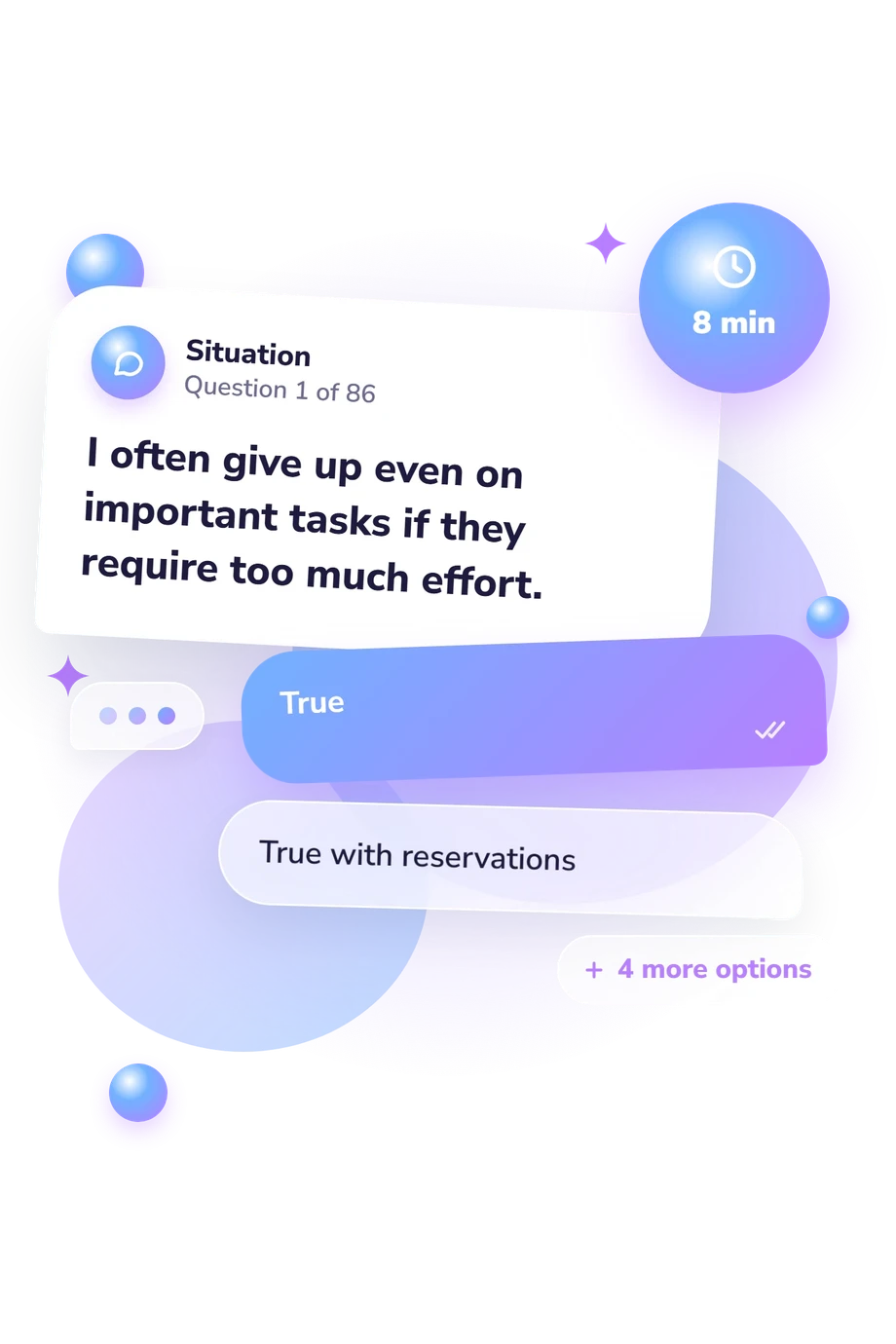
Example Questions From the Test
- True
- True with reservations
- Mostly true
- Mostly untrue
- Untrue with reservations
- Untrue
- True
- True, with limitations
- Mostly true
- Mostly not true
- Not true, with limitations
- Not true
- True
- True with reservations
- Mostly true
- Mostly untrue
- Untrue with reservations
- Untrue
Adolescent Existential Scale Test - Description and methodology of the test
For readers considering how they make choices, respond to obligations, or find direction, the Adolescent Existential Scale Test offers a structured self-report profile rather than a single label. Readers considering an existential assessment for adolescents can use the result to examine how they respond to demands, uncertainty, and possibilities. It can help identify patterns worth examining in personal decisions and relationships with the surrounding world.
What This Assessment Explores
The profile links choices, obligations, uncertainty, relationships, and meaning. The Adolescent Existential Scale presents seven dimensions for adolescent respondents:
- Personality (22-132) measures openness and maturity: Closed / less mature 22-74; Developing openness 75-100; Open / mature 101-132.
- Existential Orientation (21-126) measures determination and responsibility: Low 21-64; Moderate 65-94; High 95-126.
- Responsibility (V) (11-66) measures commitment and involvement: Low responsibility 11-35; Moderate responsibility 36-53; High responsibility 54-66.
- Freedom (F) (10-60) measures decisions and action: Low freedom 10-30; Moderate freedom 31-47; High freedom 48-60.
- Self-Transcendence (ST) (14-84) measures emotional responsiveness and values: Restricted 14-48; Developing 49-66; Meaning-oriented 67-84.
- Self-Distancing (SD) (8-48) measures reflective distance: Low self-distancing 8-22; Moderate self-distancing 23-34; High self-distancing 35-48.
- Existential Fulfillment (43-258) reflects openness, engagement, and duty: Lower fulfillment 43-144; Moderate fulfillment 145-196; Higher fulfillment 197-258.
Methodology and Evidence Base
Each statement uses six ordered choices, from True through qualified or mostly true/false options to Untrue. This graded format captures partial agreement rather than a yes-or-no reaction; the items address meaning, motivation, decisions, freedom, emotional responsiveness, self-reflection, and responsibility.
Responses are aggregated into profile scores and a result. Because the online form does not publish item-level weights, answer labels do not show each choice's contribution, so read the profile as a pattern rather than a calculation to reverse-engineer.
The methodology is conceptually consistent with Existence Scale for Adolescents (Pergamenshchik & Puzyrevich, 2011) and the Existence Scale developed by Längle, Orgler, and Kundi. Its existential framework considers perceiving, valuing, deciding, and acting. This questionnaire is consistent with those sources, not an adaptation of their published versions. This online version states no standardized norms; scores support description, not population comparisons.
This existential self-reflection questionnaire's overall profile, rather than one scale alone, may show how openness, indecision, responsibility, and orientation toward opportunities combine. Mood, context, honesty, and self-awareness affect self-report; displayed bands are descriptive, not clinical cutoffs, and the profile is not a diagnosis.
- Pergamenshchik, L. A., & Puzyrevich, N. L. (2011). The Existence Scale by A. Längle and C. Orgler for Adolescents: The Process and Results of Adaptation. Psychological Diagnostics, 1, 95-119.
- Längle, A., Orgler, C., & Kundi, M. (2003). The Existence Scale: A New Approach to Assess the Ability to Find Personal Meaning in Life and to Reach Existential Fulfilment. European Psychotherapy, 4(1), 135-151.
- Längle, A., Orgler, C., & Kundi, M. (2000). Existence Scale: Manual. Göttingen: Hogrefe-Beltz.
- Alfuqaha, O. A., Al-Hammouri, M. M., Rababah, J. A., Alfoqha, B. A., Alfuqaha, O. N., Haha, M. F. F., Musa, S. S., & Matter, A. A. (2022). Psychometric Properties of the Arabic Version of the Existence Scale. PLOS ONE, 17(4), e0267321. 10.1371/journal.pone.0267321
Updated: