
Rotter Interpersonal Trust Scale (ITS) Test
How the Scales are Structured
Who Usually Takes This Test?
See How You Compare
Below is a preview of how scores are typically distributed across each scale.
Example Questions From the Test
- Strongly agree
- Agree
- Not sure
- Disagree
- Strongly disagree
- Strongly agree
- Agree
- Unsure
- Disagree
- Strongly disagree
- Strongly agree
- Agree
- Not sure
- Disagree
- Strongly disagree
Rotter Interpersonal Trust Scale (ITS) Test - Description and methodology of the test
For readers examining how readily they rely on other people and social institutions, the Rotter Interpersonal Trust Scale (ITS) Test offers a structured self-report of interpersonal expectations. This interpersonal trust test can help you notice whether your judgments tend toward suspicion, confidence, or a more measured position when you consider promises, honesty, authority, media, and everyday cooperation.
What This Assessment Explores
The assessment examines social trust as an expectation that people, groups, and institutions will act honestly, reliably, and fairly. Questions address caution around strangers, promises, cheating, public officials, news, courts, international organizations, and society’s future.
Unlike a measure limited to close relationships, this social trust scale covers both everyday encounters and the wider social environment. The result describes a broad pattern in expectations, not a verdict about one person or relationship.
The questions represent these main themes:
- Trust in other people shows how readily you expect others to keep commitments and act fairly.
- Trust in institutions shows your confidence in courts, officials, media, education, and international bodies.
- Suspicion and social outlook show whether you anticipate deception and exploitation or see society as dependable.
The displayed result is Social Trust Level (25-125), reported as Low trust (25-50), Balanced trust (51-100), or High trust (101-125).
Methodology and Scientific Basis
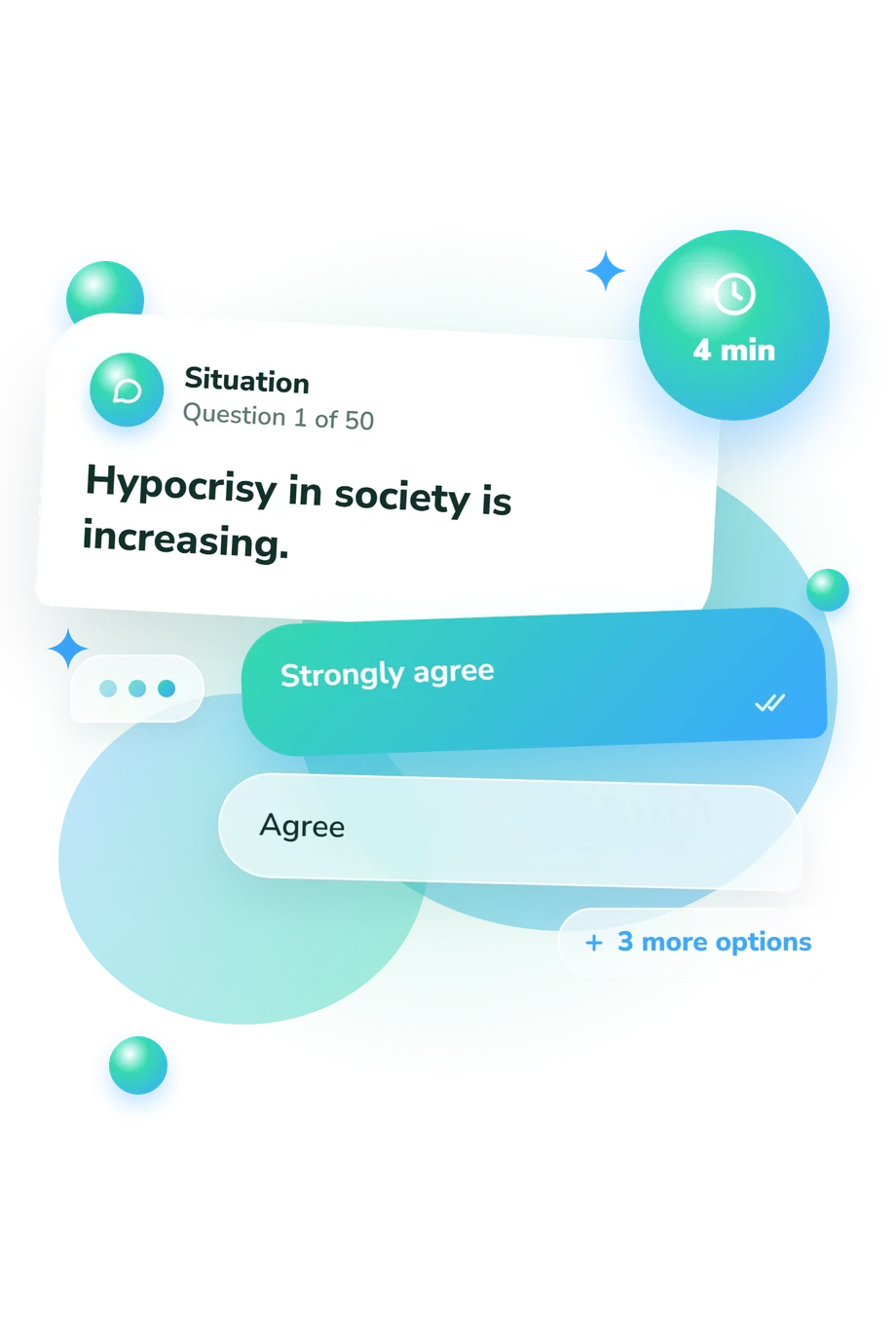
Each item uses a five-point agreement format, from Strongly agree to Strongly disagree, with an unsure middle option. Because the statements are self-report prompts, results depend on candid answers and awareness of your current perspective.
As an online administration of Rotter’s Interpersonal Trust Scale (Rotter, 1967), this questionnaire presents the published instrument in digital form. Wright and Tedeschi (1975), and Hunt, Kohn, and Mallozzi (1983), examined the published instrument’s factor structure. No version-specific norms or psychometric results are established for this online questionnaire.
The questionnaire presents one Social Trust Level result classified through the displayed bands; its item weighting or calculation is not documented. Lower results indicate greater wariness; higher results indicate greater confidence in other people and society. The low end indicates marked distrust, while the high end indicates excessive or irrational trust that may be unsafe.
Mood, recent experiences, cultural assumptions, and self-awareness can shape responses, so use the result as a focused reflection on current expectations. It cannot by itself establish a diagnosis or explain a particular trust pattern.
- Rotter, J. B. (1967). A new scale for the measurement of interpersonal trust. Journal of Personality, 35(4), 651-665. 10.1111/j.1467-6494.1967.tb01454.x
- Wright, T. L., & Tedeschi, R. G. (1975). Factor analysis of the Interpersonal Trust Scale. Journal of Consulting and Clinical Psychology, 43(4), 470-477. 10.1037/h0076844
- Hunt, R. W., Kohn, P. M., & Mallozzi, C. B. (1983). Factor analysis of the Interpersonal Trust Scale with a noncollege population. Journal of Personality Assessment, 47(5), 507-508. 10.1207/s15327752jpa4705_10
Updated: